

We've Got A File On You features interviews in which artists share the stories behind the extracurricular activities that dot their careers: acting gigs, guest appearances, random internet ephemera, etc.
By this point in Crowded House's career, you can expect a new album from the band to feature gorgeous music and heartfelt lyrics. The group's latest, Gravity Stairs, is certainly no exception: It's a collection of ornate, breezy pop with nods to summery '60s tunes ("Oh Hi"), moody sonic pastiches (the soulful "Magic Piano"), and baroque indie (The National-esque "Teenage Summer"). Out today, Gravity Stairs also exudes sweet nostalgia: Closing tune "Night Song" feels like a low-lit jazz number, while "Some Greater Plan (For Claire)" calls to mind the lovely heartache of a long-ago late night out.
Despite such consistency, frontman Neil Finn isn't averse to mixing things up. "I changed a few titles every now and again, just to keep the record company on their toes," he says lightly. For example, as Gravity Stairs was in the midst of production, he switched up a name. "My grandson reminded me that the peak of the song that was going out [as a single] was actually 'Teenage Summer' and not 'Life's Imitation' as it had previously been called," Finn says. "He said, "I love that song, 'Teenage Summer,' papa," and the light went off and I went, 'Oh, the children have spoken.'"
The requestor wasn't Finn's grandson Buddy — who was a charming presence on Finn's pandemic-era streaming sessions, dubbed Fangradio, and later appeared with the group at Glastonbury — but another grandson, Mania. "He wasn't really out and about as a spokesperson or commentator at that point [of Fangradio]," Finn notes. "He was too little. But now he's definitely making up for lost ground." When it's noted Finn starts the family members early, he quips with his usual light humor, "We've got mach two — well, probably mach three — version of Crowded House to groom now."
An ever-evolving lineup is par for the course for Crowded House, the ornate-pop band formed in the mid-1980s after the breakup of Split Enz. Today, the group is a family affair, with Finn's sons Liam and Elroy in the lineup alongside keyboardist Mitchell Froom — who produced the group's first three albums — and co-founding guitarist Nick Seymour. Of course, it's just one of many Finn-heavy bands Neil's been in — with others being the beloved new wave trailblazers Split Enz, with older brother Tim, and the Pajama Club with wife Sharon. But the dynamic within Crowded House in 2024 is typically loving and irreverent.
"On the last tour of America, Liam was delivering some pretty good shows out front of the Crowded House shows," Finn says, referencing his song's penchant for witty banter. "He's evolving all the time too. But it's completely mad. I don't know where he gets it from. But he certainly is stepping up to the plate now. And there's a lot of trust in the band. We've been throwing asides and Elroy's generally pretty quiet at the back — but he's now getting a few killer one-liners and putting me in my place on a few occasions, which is good. It's healthy."
As it so happens, Liam Finn calls on FaceTime at one point during our talk, which took place as Neil called in from Auckland, New Zealand, from his "little room that I disappear into every day to write and do interviews." The hour-long conversation covered Crowded House's new album and touring history, as well as Neil's other bands — Split Enz and Fleetwood Mac — and his time in the orbit of Flight Of The Conchords and Bluey.
Crowded House's Gravity Stairs (2024)
This is the second record with the lineup that Crowded House has coalesced around in the last couple of years. You've also been able to go out and tour as well with it. How did that affect the music this time around?
NEIL FINN: It's really a lovely thing that this time when we put a record out, we can actually go on tour and support. Last time we put a record out [2021's Dreamers Are Waiting], it was in the midst of lockdowns and pandemics and we kept delaying. We can coordinate a lot more this time.
We became a really good band on the course of that touring, as bands do. The more gigs you do, the more trust you develop. We started to jam. There's just more flamboyance, more extravagance. And watching people develop is exciting. So I think we're gonna burst out of the blocks with this album. We know it'll be a great album to play live. We're really excited about it.
How long ago did you start working on Gravity Stairs?
FINN: A year and a half ago — and maybe it was even more like two years. We were touring Australia and we decided we would have two weeks in Byron Bay at a rehearsal studio, which was actually a studio, and we thought, "We'll record it. You never know, we might get some new songs out of it." As it turns out, the recording was quite fruitful. We connected with a local engineer called Steven Schram, who ended up producing and engineering the whole record with us. The first song we got was "Magic Piano," and we got three or four others that have become key songs on the record. It's the old-fashioned, band-on-the-floor [approach], working things out and playing as a whole live band.
We disappeared for a while and sent files to each other, and then we got together again in LA and did the same thing for another week in Los Angeles and then, eventually, back in New Zealand we had another session to pick up the last few. In between, we were working on them individually and trying our ideas out and sending files to each other and having them dismissed or disappear off the session by the time you got it back. That's like being a band in slow motion.
That's the best of both worlds. You have the really intense in-person sessions where you get that energy. And then you can take it back and do the studio stuff and see what overdubs you can do and things like that.
FINN: That's right. In a recording studio, when you're all together, the downside of that is that you might have an idea, but you can't quite verbalize it or elaborate on it, so it gets dismissed, and you don't get a chance to see it. Whereas on your own, you can actually make it real and try it out. It still sometimes gets dismissed. [Laughs.] But at least you get a chance to work out what it is that vague thing that you're thinking, it becomes concrete. It's quite a nice way to work.
I think next time we record, we will spend six weeks continuous, because there is something to be said for the speed and the dynamic of the band being able to be there for every development. That speeds things up.
I love that this current lineup has Mitchell Froom, who of course, was there early on in Crowded House, and then you have Liam and Elroy. It's a nice bridging of generations. What they individually bring to the sound is a really interesting mix.
FINN: It's been enormously successful in terms of the development of the band. We've come a long way. And [that's] what was exciting about the idea when it when it dropped was all of these people are deeply connected to the soul and the origin of the band, but they all bring new angles.
We hadn't worked with Mitchell for a long time. But there's something reassuring about his hand and the way he plays keys, which is quite Crowded House. But he's also moved on too. And certainly Liam and Elroy both developed into really good songwriters and great arrangers, and they've been able to amass their own experience as musicians. They bring a lot. It leads us on into fresh angles.
My favorite song is "Some Greater Plan (For Claire)," which has such a lovely backstory; you used your father's war diary. How did you end up wanting to use that?
FINN: Dad's sadly no longer with us. He would have been 102, but he made it to 98, which was pretty damn good. But he had these very exhaustive war diaries that he kept for the whole time he was in the Second World War. My brother Tim had them and reminded me of a great story of him going to the Baglioni Ballroom in Florence. It was the officer's quarters. They had a dance going with a jazz band playing and he snuck in, because he wasn't an officer, with his friends.
They'd been out on the lash that night, as the Irish say. And he looked across the room and there was this glamorous girl who has turned out to be a diplomat's daughter. He says in his diary, "She was out of my league, but I asked her to dance and she said, 'Yes.'" And then they started a lovely two-week, three-week romance while he was in Florence.
It became part of the family mythology, because dad only knew about six phrases of Italian, but he'd bring them out every time we went to a restaurant or something. [Finn affects a slight Italian accent to imitate his dad speaking] "Arrivaderci!" or "Grazi!" "Prego!" And my mother would roll her eyes and go, "I suppose that's what [she] used to say." It became a joke in the family. That was the origin of the first verse of the song. And then it became a little bit more universal in its intent as it goes on. But it's a lovely story. That's what you want when you get caught up in the romance of a moment.
Do you have other favorite songs on the record?
FINN: Oh, it's always a hard question, because you love them equally, these kids that you fashion out of clay and wires and keys. One really nice aspect of the album is that there's some really lovely collaboration. There's a song called "Thirsty" which I wrote with Elroy. He had this beautiful bed of chords and an arrangement that he brought forward, which was just an instrumental thing, and I found a really sweet melody to go with it.
[Laughs.] The first line I got was, "How come some people never get thirsty?" And it always seemed a little bit like, "Can I really get behind that thought?" Even though it's completely true and we know people that never drink water. But I had to find some deeper significance. And Elroy helped me out with that, by saying that the young kids these days say if you're thirsty, you're wanting to hook up with people. It's a new expression. I was so relieved to hear that, because I had another angle all of a sudden. And "How come some people never get thirsty?" is about reluctance to get involved with people. That's the lyric that emerged from it.
With all of my lyrics, they're a little ambiguous in places. I like to leave doors open for people to have their own imagining. But that's the setting of it, is a reluctance to jump in and get involved—probably because of the fear of past experience and things going badly wrong. It was a lovely development from Elroy and I talking about what the intent of the song should be. And a most welcome thing to be working with my son like that.
That's another nice generational kind of bridge too. And the younger people know all the slang.
FINN: There's some really strange expressions out there. The internet is full of really unfortunate terminology. The language hasn't been boosted by the terms "podcast" or "hashtag." [Laughs.] They're not really evocative things that we all talk about every day. You know, "selfies." There's no romance in the new terminology that I'm aware of. Perhaps we'll enter a new zone and people will be a bit more inventive.
Split Enz (1977-1984; Various Years After)
https://youtube.com/watch?v=SQ_yj3lYC-U /wp:paragraph -->
https://youtube.com/watch?v=wiqBlKnb91A /wp:paragraph -->
https://youtube.com/watch?v=SQ_yj3lYC-U /wp:paragraph -->
In hindsight, the Pajama Club album feels like it's sort of foreshadows some of the stuff Crowded House has been doing, the vibe at least, in recent years.
FINN: That really came out of the blue, pretty accidental. Our kids had already left home for a while, but we were sort of in that thing where you don't know what to do when your kids have left home. Sharon is a really good dancer, and she picked up a bass every now and again and just played these really good grooves — not changing notes or anything, just one or two notes, just really good grooves. I had a sense that she could do it. And I wasn't a drummer at all, but I could do a couple of beats. I thought, "Oh, we're perfectly matched."
We went into our room one night after dinner — maybe with a wine or two on board — in our pajamas, more or less, and started jamming. Not songs, just feels, and I recorded them all. I thought, "Oh, these feels are actually pretty good." We'd been listened to ESG quite a lot. Even though they're really good musicians, [their grooves] are so simple. You listen to them and you go "Ah, sounds like we could do that." So they were our inspiration. And I found a few grooves that were really appealing to listen to, just as bass and drums, and I started writing songs on them that became the Pajama Club.
How does your musical relationship with Sharon differ than from the musical relationship you have with other family members you work with?
FINN: It was completely different really because it wasn't anything that was evolved in terms of…We didn't discuss how to make the songs more sophisticated, particularly. We just jammed on a really basic level and found things that that became the basis [of songs]. It was a really different way of working, built from the ground up, from bass and drums. Normally you're bringing bass and drums into a song that's already written.
I tried as much as I could not to create pressure situations because she wasn't that confident in terms of being able to be a muso-muso [and initially] was very nervous about being on stage doing it. It felt really scary for her initially. She got used to it. But it was a whole different mindset. There was challenges in terms of how our relationship had to evolve to deal with it, but they ended up really well.
"The Song Of The Lonely Mountain," From Peter Jackson's The Hobbit: The Unexpected Journey (2012)
How did you get into the mindset to write that song for such an epic movie?
FINN: I got a call when I was in London. I decided that it was probably good to go to Wellington and get myself in the frame for what they wanted. I didn't know if I needed to — but I just thought it was a good idea, I wanted to give it my best. They gave me Peter's office, actually, because he wasn't using it at the time. I set up a little setup in there with a ProTools rig and spent a few days writing. They'd come in and have a listen at the end of work.
[I adapted a theme] that was written by some people in Wellington that were working on the music. I developed [it] into a into a fully-fledged song, I had a few different thoughts to get there and ended up finishing it. I was just about to make a record with Dave Fridmann, so that was the first thing we did; he mixed that for me.
I think it worked pretty well in the movie. I thought they should have turned it up louder. In fact, when we saw the premiere of the movie, I went straight to the production people and said, "Can we have it louder?" It just didn't seem like it burst out of the out of the speakers loud enough.
I'm sure it was good vibes being in Peter Jackson's office, though.
FINN: Yeah, it was a lovely office. And they were very generous. They were great. We went out for some memorable dinners. And we got to hang out with some of the fantastic people that they have around. That was a lovely experience.
The Finn Brothers
I love a lot of the Finn Brothers Records you've made with Tim. Have you guys considered making it another one?
FINN: I'm sure we probably will get around to it. We have discussed possibilities of doing something. We'd better not leave it too long. But, yeah, I reckon that'll probably there'll be something.
We write quite well together. It's not always easy to write with anybody. But Tim and I have developed quite a good little partnership for a while in writing. And we have different skills that we bring in. They're quite…what's the word, harmonious?
He's good with titles and themes. I'm often not even thinking about titles, themes, or lyrics when I'm starting to write a song. I let my subconscious throw things out and then I try and figure out what they mean. Tim will come with a concept, which is quite good. And quite good starting points. I didn't choose [my way]; it just chose me. I don't find it easy to have a theme to follow on my own. I just rely on things falling out of my mouth. And then I listen back and go, "Oh, that's interesting, that line. That suggests this," and then I'll start to formulate the theme from something that's come in completely unconsciously.
It's almost like Eno's Oblique Strategies where you have a phrase and that brings something out of you. It's a little bit more instinctual rather than being very planned in advance. That's really interesting.
FINN: I've learned to trust it. At times, you can sort of go, "I don't know what this means, this makes no sense." But there's something about it: Because the lines that come out are always joined to a melody and chords, so they just somehow belong together straightaway. I'll take that over literal sense and try and make something of it. It's quite an unwieldy process; I work convoluted at times. But I've just learned to trust it. It's led me to some good places. I'm a bit envious of people who write screeds of lyrics and then just try and find a tune that goes with it. It feels like it might be an easier way to do it.
Being In Fleetwood Mac (2018-2019)
Now that you've had some distance from playing with Fleetwood Mac, how did that change and influence you as a musician?
FINN: It came at a time that was most unexpected. And gave me the experience of standing on stage with a with a classic band and seeing how the already quirky individuals make this incredible sound together that you couldn't make any other way. Everybody has their individual contribution to that. It reminded me of the fact I had a band, and that it's possible to redefine it and maintain some kind of beautiful, soulful rendition of the thing. I think we went and did the old girl proud with Fleetwood Mac.
I wasn't the frontman; I didn't have as much to do as I normally would. It felt at times like I didn't know what to do, because I was just standing around. It was a very unfamiliar feeling. But to see why other songs are put together, and to really inhabit somebody else's work — it brought out something good for me for the next round and made me appreciate my own band and think that there was something valuable about the idea of a band, and the individuals creating the beautiful sum of parts and all that stuff.
It was a good reminder — as well as just being an extraordinary experience to suddenly be in this…. It doesn't feel real now I think about it. Like, "I was in Fleetwood Mac?" It doesn't feel like it actually happened.
What it was like touring with them? Fleetwood Mac, that's another echelon. It's almost mythical almost.
FINN: Our manager Carl [Stubner], who's now my manager, said he always thought of them as mythological characters, like Knights of the Roundtable or something. Like, Christine's Maid Marian. I'm probably mixing up the mythology right now.
But you just get to know people as people in the end. I got used to it. There was always pinch yourself moments here and there. There were a few songs in set I always really reveled in. "Gold Dust Woman" was one. A couple of Christine's — "Little Lies" was always endlessly enjoyable to perform. But you become part of the fabric of the tour.
All the community around the tour was really great. They had a lot of women on the tour — I mean, they were unusual in the day in having two lead singers that were women and writers, such great writers. They laid down a template for the ideal scenario, really. And backstage on the tour, there were lots and lots of women around. It had a beautiful culture and community around it.
Which you don't know. Some bands have a really weird, distant vibe on tour and the band don't mix with the crew and they don't eat together. And it was very much different on the Fleetwood Mac tour. Everyone was hanging out together. And that was a lovely feeling, because that's always been the way it's been with Crowded House, albeit it on a smaller scale. We've always had really good community on our tours. Not as many women. But we're getting better at that.
How did it feel like being able to play "I Got You" and then also "Don't Dream It's Over" with them?
FINN: Oh, that was a lovely, generous thought they had, that it'd be nice to play a couple of my songs. I mean, I think Stevie was a big fan of "I Got You" from early MTV days. We did that on some of the tour. But I think in the end there was so much pressure on the setlist that we ended up just doing "Don't Dream It's Over." But every night, there was a highlight.
It was Mick's idea to do it stripped back. Because the band had played it a couple of times and did an okay job. It wasn't a natural song for Fleetwood Mac to play. It always felt like they were a little unsure about it. And then Mick said, "Why don't you just do it with Stevie?" We came down and tried it at rehearsal, and it seemed like a really good, nice idea. It was a good moment in the show. And people seemed to like it.
"Don't Dream It's Over" has always been such a big song for you. But it feels like in the last couple of years, it seems like it's almost gotten bigger. And I think it's because of covers like this. I know Miley Cyrus covered it as well. The amount of people keeping the song alive and putting their own spin on it. is really helping the song grow, and the legacy grow.
FINN: It's been brought out in a lot of occasions. There's something about the open-ended lyric of it that has an overwhelming positivity but also referencing troubles and struggles and battles. That means it's appropriate for a lot of different causes.
Just recently, U2 did it at the [Sphere] in Vegas as a kind of a nod to the troubles in the world and in particular to Alexei Navalny's widow, Yulia. I feel quite honored when the song gets used in those ways because it feels like it's resonated in a way I couldn't have imagined and would have dreamed of at the time.
For some people, it's possibly the only song they know of mine. And there's always a little bit of feeling like, "I've got other songs too." [Laughs.] But you can't argue with it. And I still like playing it. I'm happy that I'm still proud of the song. It's not a novelty song representing me out there. It's a song I'm proud of.
That is weird when people think that you're a one-hit wonder or something. It's a very odd scenario. And you're like, "No, no, I've got a lot more. Keep listening!"
FINN: It is amazing how often you get somebody that tells you one of the more obscure songs of yours got them through a tough time or was one of their family's favorite songs and then they're gone now. Just about every song has its day at some point. And they're mysteries — they go out and have a life of their own and you never know where they're going to turn up. And it's a beautiful thing.
What album or song of yours do you wish got more attention?
There's lots of songs that I'm pretty proud of that I could possibly mention. From each album, there'd be two that I would say I'm very fond of that didn't get much attention. I don't know—the last album had "Show Me The Way" that we really enjoyed playing live and I think is a really strong song. The one before that, Intriguer, I'd say "Elephants," the last song. I'm really proud of that song. We play that sometimes live. And then there's things like "Private Universe," from [Crowded House's] Together Alone. We still play that a lot.
"Find Your Way Back Home" With Christine McVie And Stevie Nicks (2020)
What was it like working with them?
FINN: It was a lovely moment because Stevie was able to come into the studio in Auckland when I was trying to finish that song off. I'd sent it to her quite a while earlier. And people don't get a chance to listen to things; it hadn't really moved on. And then all of a sudden she said, "I was getting ready to come to the gig and I had your song on. It's so beautiful." And she just really had a moment where she jumped into it and really related to it.
So I got her in the studio here in Auckland in my studio and we had a really lovely session with a few people hanging out. She got a really cool vocal really quickly and her presence was greatly appreciated.
Christine was much, much later. She'd helped me actually organize the song a little bit on tour. I'd played it for her and she made a few suggestions. She was a pretty good songwriter, so I took notice. [Laughs.] And then we were doing the tribute to Peter Green in London, and she was backstage and I just got her to sing over the end. I'd brought my little ProTools rig into the backstage area and she sang on it and it was just a beautiful way to finish. It was the last thing that went on the track.
I was really happy to have her on there as well, given she really contributed to it by helping me out with the structure. That song became quite significant for the Auckland City Mission who are building a new accommodation for the homeless people in Auckland here. And it did a lot of good for the promotion of that cause and it's always nice to have another reason for songs to be there.
Making An Appearance On Bluey (2023)
You were recently on Bluey, which is massively popular online at this point and has a huge following. How did you end up appearing on the show voicing a doctor?
FINN: I get a lovely Christmas message from the producer every year. He writes his message on a piece of paper and he sends a little photo of him holding up the written message for you. There's something quite Bluey about that. But I was a fan of the show, because our grandkids were watching it. And it had a beautiful style and delivery and not that crazy cartoon world that a lot of kids get absolutely transfixed by, these weird superheroes that jump around all the time. It had a lovely pace to it, but softly delivered messages and a lot of really good humor.
I was a big fan anyway when they asked me, and I jumped at it and did my little session. I think there's about four lines, but I really wanted them to work. I'm actually too scared to watch them.
Awww.
FINN: I've never seen it, because I didn't want to spoil the illusion. My brother [Tim] once went on…you may also know The Wiggles over there?
Oh, yeah!
FINN: Another Australian phenomenon. Years and years ago, my brother got asked to appear on The Wiggles. And he probably wouldn't have thought to, but he had a kid [Harper Finn] and he thought, "Ahh, Harper's going to love this!" So he went and sang "Six Months In A Leaky Boat," I think he was dressed as a pirate. [Laughs.]
And the big moment came and he comes on the TV and says, "There's dad on The Wiggles!" And then Harper kind of looked at weirdly at Tim and then went and turned the TV off.
[Laughs.]
FINN: I think it ruined The Wiggles. I don't think he wanted to watch it from the point.
Kids have no filter.
FINN: But it's a great show, The Wiggles. And obviously [Bluey] is getting even bigger. It's dragged a whole generation of parents in as well.
It's really gently delivered. It's gentle humor and some beautiful sentiment, really funny and good characters. I like Bandit because he's such a great dad. He's always inventing ways that he can have the easy job in the game. And I so relate to that — if you can end up being the guy that's being jumped on and you get to lie on the floor. [Laughs.] Somehow it's very relatable.
Touring With Crowded House
Over the years, Crowded House have done so many seminal and iconic shows. What are some that really stand out to you as either being extremely moving? For example, the one at the Sydney Opera House in Australia that drew more than 100,000 people in 1996 stands out to me.
FINN: I have a lot of fond memories of particular shows. A lot of them are the really small things we did — [like] playing in people's lounge rooms in a snowstorm somewhere in the wilds of Canada for somebody who had won a competition on MuchMusic.
We were doing a lot of busking at the time. We became a band doing that. It was a way of us being able to go and promote our first record before anything was happening with it, [and] not costing the record company extravagant amounts of money to get the whole band. The room would just be ignited by this. We learned how to sing together and the banter was absolutely wild and free. We could do anything in that context. So we took that attitude on stage quite a bit.
Doing the Albert Hall…and it was actually in the context of the very sad experience of losing our drummer Paul [Hester]. But the gigs that Tim [Finn] and I did with Nick [Seymour] there at the Albert Hall after that were some of the most emotional shows I've ever done. And it's an amazing room. But yeah, obviously, the Opera House show was extremely incredibly memorable. They'll never be as many people outside the Opera House as there was then. It's a miracle no one died. Nobody had thought about health and safety in those days. Now when they put shows on there, they limit it to five or six thousand [people]. [Laughs.] A lot's changed in the meantime.
[Other] memorable shows…King Tut's in Glasgow, a little tiny club, people going completely nuts. Newcastle Town Hall with Paul Hester throwing a beer up to somebody in the balcony, which didn't quite make it, and it ended up dropping and smashing on the monitor desk and bought the whole show to a shuddering halt. For about 15 minutes while they fixed it, we just chatted away to the audience and sang acoustically. The audiences loved it, you know.
And then, memorably, when we got the PA back, there was a huge cheer. And Paul went and threw another beer to the same guy—and he caught it this time. [Laughs.] It was ridiculous. But it was a beautiful moment.
There's also the MTV show you did after Crowded House's debut album hit America where you're on the beach somewhere. It was such an incongruous situation because you're wearing the suits you wore the first record — and speaking of safety hazards, it's all these people binge drinking on a beach while listening to you guys.
FINN: Spring break?
Yep!
FINN: Down in Florida. The Beastie Boys were doing the same [thing]…. We were hanging out at these weird parties. There was a guy [who] was a suntan lotion millionaire; he was sponsoring everything. We went to a weird party at his house with all these TV screens, and MTV kind of people, and Beastie Boys were there. So we ended up hanging out with them. And Nick showed Adam Yauch how to play "(You Gotta) Fight For Your Right (To Party!)" on acoustic guitar, because he hadn't figured it out.
That was a really funny moment, because Nick thought it sounded like "Smoke On The Water" or something, there was some reference point that he made for it. And he mentioned it to him and said, "Yeah, it goes like that." [Adam said] "Oh, how did you do that?" It was a lovely exchange.
Wrapping up, is there anything else you want to add?
FINN: I'm feeling more compelled and more fascinated by making music than I ever have. And I would credit a lot of that to having an amazing band around me now. It feels like it's full of potential and wonder, the idea of making songs. I feel truly blessed in that regard. I hope people can be part of that — our community of people and those that are on the fringes might just get inspired and comforted by the presence of Crowded House in your neighborhood.
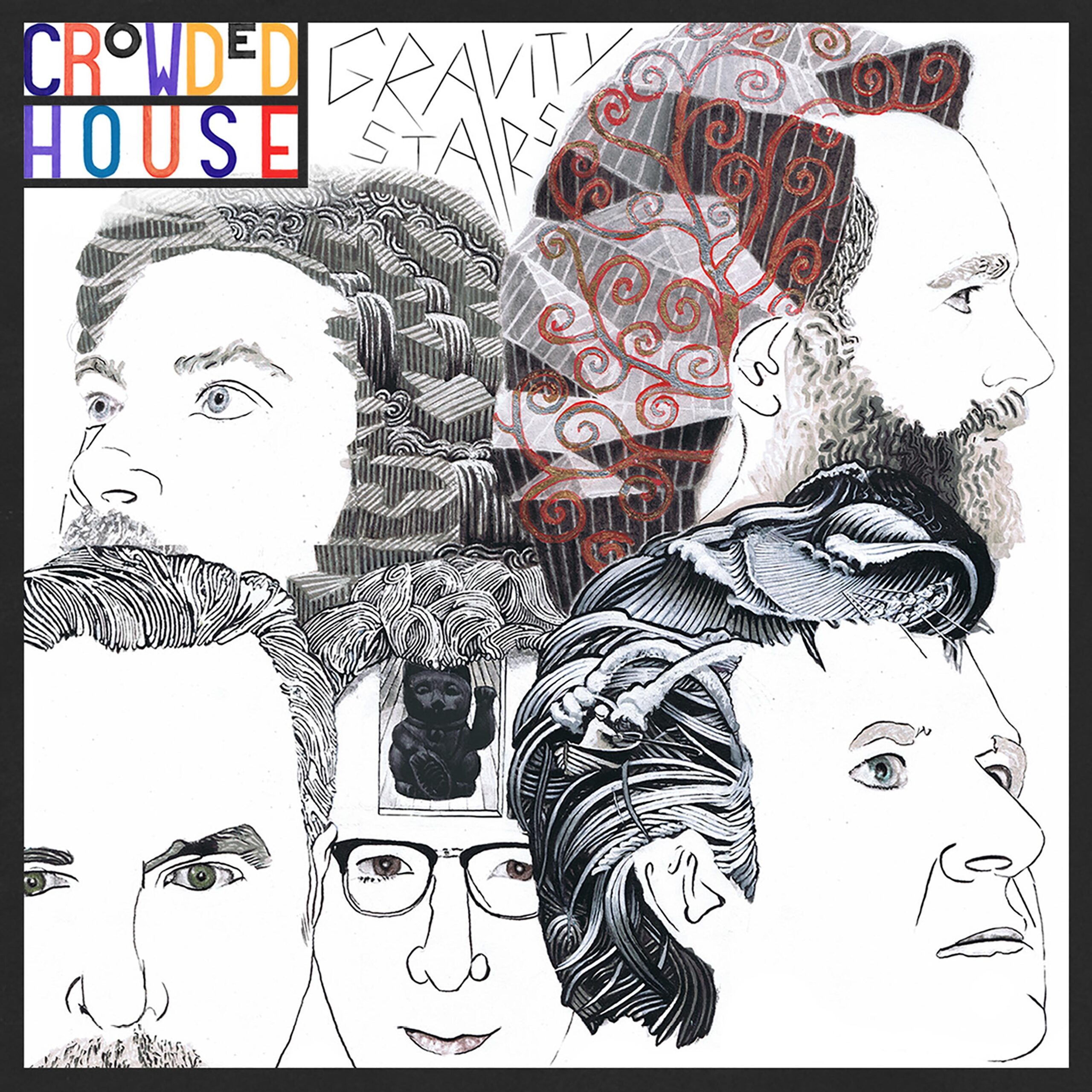
Gravity Stairs is out now via Lester/BMG.