
Metal had to set its "Days Without a Nazi Festival" counter back to zero after the ignominious Metal Threat Fest brought sketchball acts like Graveland, Inquisition, Grand Belial's Key, and Arghoslent to the Chicago suburbs earlier this month. It was an amusing circus to behold from afar, at least.
Close to half the bands on the bill dropped off at the last minute, either because they (ironically) couldn't get artist visas under the Trump Administration's border crackdown, or because they wised up enough to decide against playing with straight-up fascists. Fans threw Sieg-heil salutes at the stage while GBK played, which is not great, but their shitbag Nazi frontman got so winded from performing that he had to sit down on the drum riser, which was funny. Master race, indeed. As good as the schadenfreude was, Metal Threat was also a stark reminder that, while right-wing extremism may not live at the heart of the metal scene, it still makes a home at its fringes. The Dutch black metal band Terzij de Horde want to burn that home to the ground.
"Really, in these times, it's so edgy to be a Nazi? No, fuck off," declares bassist Johan van Hattum. "I mean, it's sad to begin with. Every single interview with the second wave of black metal is essentially these guys saying, 'Yeah, we were young, we were stupid, we just wanted to make people angry.' And now you have these 40-year-old edgelords sitting behind their computers going, 'This is true black metal.' Fuck off! This is not true black metal."
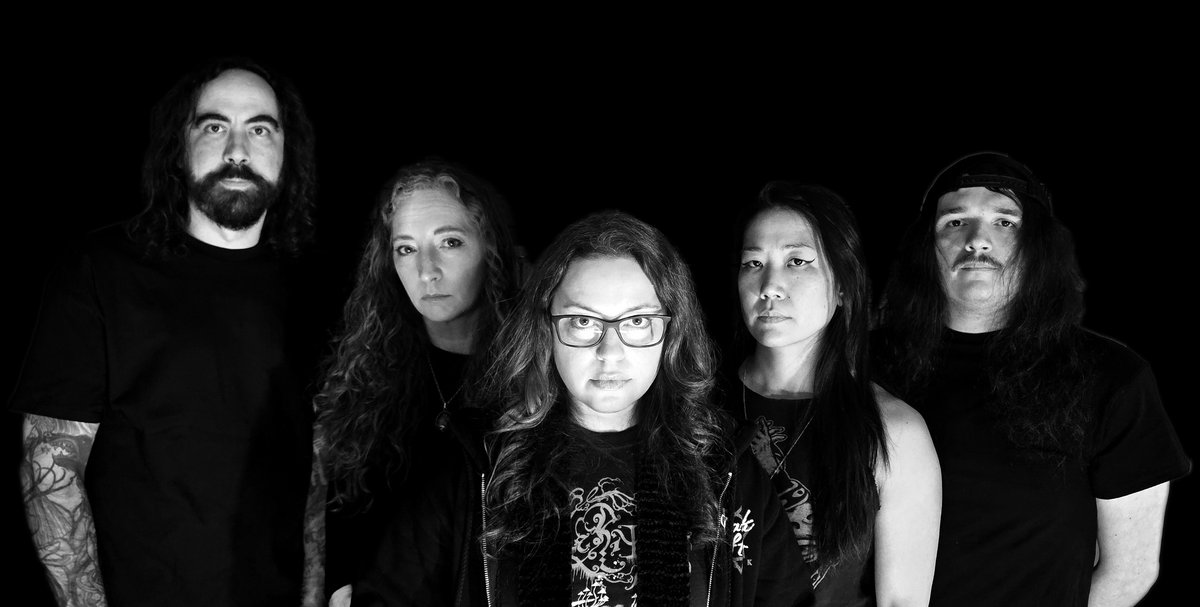
In fairness, Terzij de Horde probably aren't too many people's idea of true black metal, either. Formed in 2010 from the ashes of the screamo/post-rock band Liar Liar Cross On Fire, Terzij de Horde ("set apart from the horde") play black metal with a distinctive post-hardcore flair. They quote poets, philosophers, and academics, and their albums wrestle with big, existential ideas. How can human beings transcend individualism? What happens when clashing ideologies produce incompatible realities? What does it mean to be connected to other people? Van Hattum and vocalist Joost Vervoort, who write the band's lyrics, are both university scholars and heavily involved activists. (When we speak, Vervoort has just come from a protest in the Hague against Israel's illegal capturing of the humanitarian Sumud Flotilla.) They're not stereotypical black metal guys, which alone makes their presence in the black metal scene provocative — and important. They have every bit as much of a right to this music as the edgelords, and they weaponize that tension.
"The aestheticization of violence in black metal, while hiding behind the skirts of the authoritarian state, is ridiculous," Vervoort says. "I love the song 'With Strength I Burn' by Emperor, but there's the sort of aesthetics of strength, and then just being a fucking bootlicker, right? That's ridiculous. Black metal is about desecration, right? It's about pushing back at things, so it can also be pushed back at itself."
Our Breath Is Not Ours Alone is the third Terzij de Horde full-length, and it's their most complete, satisfying body of work to date. Its title was inspired by the German sociologist Hartmut Rosa, whose work deals with combating alienation under the frenetic pace of social acceleration. The band offers a visceral application of his ideas, with sweaty, urgent songs that demand to be screamed along to in a humid room with a few hundred strangers. When the room empties out, perhaps you'll realize that your fate, especially as the environment strains under the weight of capitalism, is deeply interconnected with the fate of everyone else who was there. Maybe – hopefully – that will positively influence your behavior going forward.
"With this album, we wanted to focus more on personal responsibility and courage, from a perspective of understanding that you are deeply connected to others in the world," Vervoort explains. "In a way, it's like an anti-black metal album in terms of its thematic focus, because if you think about black metal being this lionizing of the individual alone in the woods and so on, what we're talking about is the exact opposite. We're in the middle of society. We're deeply connected to other people. That's what it means to be alive. And realizing that and standing up for that is crucial, and that's what the album's really about."
A critical part of Terzij de Horde's process is pairing their lyrical ideas with music that seems to best carry the message. For Our Breath Is Not Ours Alone, that meant a turn toward directness. The band's previous album, In One Of These I Am Your Enemy, was built around a pair of thorny, multivalent epics that clocked in at nearly 12 and 14 minutes. On Our Breath, nothing cracks the 10-minute mark.
"That definitely was conscious," Vervoort says. "We just felt like we wanted to challenge ourselves to do that. The long songs are a more natural way for us to work, but we wanted to increase the punkiness and hardcore element of it, to be a bit more direct like that."
"It was the directness of the message that we want to send," van Hattum concurs. "But also the idea that sometimes we stick to an idea for too long, or that you feel like we could have taken off one or two repeats. And what we've tried to do with this record is, let's make some of the amazing riffs slightly too short, perhaps, and see whether or not that works. This led to intense discussions. 'We have to do this eight times!' 'No, four!' 'Eight!' 'Four!' 'What about six?' 'Okay, let's try that.' That really compressed the songwriting as well, which I was really impressed with, because this was quickly done. You play it a couple of times, and suddenly the songs that are meandering become very condensed, very high octane."
"And that's definitely something we wanted," Vervoort adds. "We wanted more of that compressed urgency, and I think that's there."
The band really only lets its foot off the gas on the album's final track, "Discarding All Adornments." That song is bisected by a spacious, atmospheric section, where the drums fall away, the guitars ring out cleanly, and Cinder Well's Amelia Baker delivers a spoken word part that sends chills up my spine every time I hear it:
We have adorned ourselves In shivers of awe, In the highest energies, In divine resonance. All the currents of the universe, All the horrors of power. Having thus fed the roots, We await our rebirth To the light of the morning star.
"It's a song about the descent of the goddess Inanna into the underworld, and this metaphor of the ruling elites and the regime having to lay down their adornments, their powers, and be reborn, works so well," Vervoort says. "And it's an amazing piece — her vibe, with those lyrics, in contrast to the rest of the music."
Van Hattum became a fan of Baker's spare, slyly modernist take on traditional folk music back in 2010, before she was even recording under the Cinder Well name, and he always kept her in the back of his mind as a potential future collaborator. When her 2020 album No Summer came out, the rest of Terzij de Horde became obsessed, too. (By coincidence, the No Summer highlight "From Behind The Curtain" has almost certainly been my most played track this year. Cheat code for instant tears!) When the idea of having a guest musician on "Discarding All Adornments" first came up, Baker immediately sprang to van Hattum's mind.
"We were like, we can send her a mail, see what happens," he says. "I was like, 'Hey, huge fan! We play black metal, but would you consider that?' And I think within two or three days, it was like, 'Dude, awesome. Yeah, let's do this!'"
Baker's inclusion on Our Breath Is Not Ours Alone emphasizes the collectivity at the core of the album. Baker isn't a metal artist, but she's played Roadburn Festival and toured with Pallbearer, and her ability to move between worlds resonates with what Terzij de Horde are trying to do. There's a prolific, supportive black metal scene in the Netherlands right now, but Terzij de Horde work hard to reach beyond it, whether that's by collaborating with folk singers, touring with punk bands, or playing indie rock festivals. Lately, politicians from the leadership of leftist political parties have started coming out to Terzij de Horde gigs. In its own way, black metal can be a big tent. Terzij de Horde hope the urgency of their music can help throw wide the flaps.
"It's important, because we're living in a nightmare time, right? If we were living in the early '90s or something like that, it might have been a very different record," Vervoort says. "But this is an absolutely insane time that requires a directness, that requires a very clear response, that requires clear political positions. There's no time for bullshit."
TEN NAILS THROUGH THE NECK
Cathedral – "Society's Pact With Satan"
Location: Coventry, UK
Subgenre: doom metal
Cathedral went out on top when they released their 10th and final album, The Last Spire, back in 2013. That's a semi-credible pick for the best album the UK doom godfathers ever made, and to their credit, they've stayed dead since announcing it would be their last one. But wait! Somehow, a 30-minute song from the Last Spire sessions wound up on the cutting room floor all those years ago, and now it's seeing the light of day.
Internal Bleeding – "Deliberate Desecration"
Location: Long Island, New York
Subgenre: brutal death metal/slam
I don't really have the time to get into just how influential Internal Bleeding have been on death metal's lurch toward hardcore over the past decade, especially within younger scenes. That should probably be its own column someday. In short, though: Any death metal band that uses the term "slam" to describe its brutal, groove-oriented sound is, either consciously or unconsciously, paying homage to Internal Bleeding. On an episode of Chris Garza's podcast from last year, guitarist Chris Pervelis said the band's late drummer Billy Tolley coined "slam" to describe their sound: "no filler, no wasted space, just groove, constantly."
That term, and the philosophy behind it, guided Internal Bleeding on both classic albums (Voracious Contempt) and deeply problematic embarrassments (Onward To Mecca), but it never changed, and young death metal bands all over the world are catching up. Internal Bleeding's seventh album, Settle All Scores, is their first to truly come out into this new reality. It's brutal slamming death metal of the first order, with Pervelis delivering those bottom-heavy grooves, nodding to classic New York hip-hop and hardcore while throwing plenty of red meat into the pit for the death metal knuckleheads to chew on. My favorite song, "Deliberate Desecration," starts with a surprising swirl of acoustic guitar and synth — merely a feint before the assault of chugging riffs and guttural vocals. Lots of bands are ripping this sound off right now. None are doing it quite like the OGs. [From Settle All Scores, out now on Maggot Stomp.]
Agriculture – "Serenity"
Location: Los Angeles, California
Subgenre: experimental black metal
In the wake of Liturgy's Aesthethica, the 2011 album that launched a thousand thinkpieces, the metal literati braced for a wave of copycat bands that never really came. Liturgy moved too quickly past the "transcendental black metal" manifesto set forth by that album to start a true movement, so a lot of the intriguing ideas that Aesthethica explored were left to languish.
Agriculture's The Spiritual Sound doesn't answer Aesthethica’s questions so much as ask new ones in parallel. The LA band says they play "ecstatic black metal," and they're interested in some of the same ideas about how brightness and transcendentalism can subvert black metal's sense of ritual. The Spiritual Sound feels a little overintellectual at times, to be sure, but when the band locks into a common sense of purpose, as they do on the three-minute, tremolo-picked maelstrom of "Serenity," they can move mountains.
The riff structures of "Serenity" mirror some of the more tightly wound moments on Aesthethica, as well as the screamo-leaning atmospherics of Roads To Judah-era Deafheaven. It's a relatively conventional song, as The Spiritual Sound goes. Plenty of the album isn't metal at all, and you get the sense that the band relishes their right to switch between styles at will — even when the experiments occasionally fall flat. They've bought themselves the leeway to do whatever they want, though, and it feels like their next album might be where it all finally coheres. [From The Spiritual Sound, out now via The Flenser.]
Unto Others – "They Came From Space"
Location: Portland, Oregon
Subgenre: traditional/gothic heavy metal
I've always appreciated that Unto Others have such a robust sideline of outtakes, B-sides, bonus tracks, and stopgap EPs. The Portland goth metallers' proper albums are big events, but there's just as much fun to be had with the lighter fare that comes out in the margins. The first I Believe In Halloween EP, released in October 2021, is home to one of my favorite Unto Others songs, the "Grim Grinning Ghosts"-gone-horrorpunk lark "Out In The Graveyard." The second installment brings another heavy hitter in alien-invasion banger "They Came From Space," a song that pays homage to '50s sci-fi B-movies in gleaming, surgical heavy metal. It's tossed-off, sure, but only an exceptional band can toss off a song this good. [From I Believe In Halloween II, out now via Century Media Records.]
Evoken – "Lauds"
Location: Lyndhurst, New Jersey
Subgenre: funeral doom/death metal
New Jersey's Evoken came up with an ingenious conceit for their seventh full-length, Mendacium. Each of the concept album's eight songs corresponds to a prayer in the Divine Office, running from "Matins" to "Compline." The Benedictine monk at the center of the story is dying, and as his lucidity begins to slip, he wonders if what he's experiencing is divine vision or fevered hallucination. That's a great setup for a metal album, especially one in the subgenre where slow tempos, low drones, and organ parts already call to mind a liturgical setting.
Evoken are masters of funeral doom's subtle dynamics, and as Mendacium unfolds, it casts a hypnotic spell that never breaks. But unlike some of their peers and stylistic descendants, Evoken aren't afraid to ugly things up. The guitar tone they achieve on Mendacium is dirty as hell, and it's deeply rooted in '90s death metal. As beautiful as a track like the 10-minute "Lauds" is at times, it's crucial for the full Evoken effect that its down-tuned guitars keep plenty of grit in their gnashing teeth. [From Mendacium, out now via Profound Lore Records.]
Morke – "Wisterian Arbor"
Location: Minneapolis, Minnesota
Subgenre: melodic black metal
On last year's Forged In Steel And Love EP, Morke underwent a significant transformation. Multi-instrumentalist Eric Wing launched the project in 2016, making more-or-less straightforward atmospheric black metal with a depressive edge. That sound reached its terminus on 2021's grim We Are The River, and as Wing publicly transitioned – they are nonbinary and transfeminine – Morke transitioned along with them.
Forged In Steel And Love was their first attempt at making the medieval-period-obsessed, confrontationally melodic black metal style sometimes called "castle metal." That transformation is in full bloom on the new Morke full-length, To Carry On.
As the title suggests, To Carry On is largely about perseverance in the face of hardship and indignity, and Wing's melodies, layered into dense stacks of harmonized guitar tracks, feel defiant in their beauty. Obsequiae's Tanner Anderson, whose work on albums like Aria Of Vernal Tombs and The Palms Of Sorrowed Kings laid much of the blueprint for what Wing is doing here, contributes to several tracks, including the glistening "Wisterian Arbor." The "Edenic pavilion" described in the lyrics is brought to life through Anderson and Wing's expressive guitar lines, which entangle one another like vines. [From To Carry On, out now via True Cult Records.]
Coroner – "Trinity"
Location: Zürich, Switzerland
Subgenre: technical thrash metal
It's been 32 years since Coroner last released a new album. That's long enough to land the Swiss thrash giants on the Wikipedia article for List of longest gaps between studio albums, alongside such illustrious names as Joe Pesci, Regis Philbin, and William Shatner. (And, to be fair, Heavy Load, Coven, and Toxik.)
For Dissonance Theory to be more than the answer to a trivia question, Coroner would have to do what they did on their first five studio albums and push the envelope. They were an odd band out at thrash's commercial peak, both too technical and simply too weird for broad mainstream acceptance. But in their long absence, they amassed a host of cult followers, especially musicians who admired their liberated approach to songwriting. When a young Mikael Åkerfeldt would get writer's block with the famously boundary-pushing Opeth, he would apparently ask his bandmates, "What would Tommy Vetterli do?"
That spirit does indeed carry through into Dissonance Theory, a comeback album that isn't content to rest on the laurels of past glories. Coroner never played tech-y for the sake of it, but even so, they've never sounded more intuitive or more focused on the hook than they are here. Take "Trinity," a post-Oppenheimer bit of nuclear paranoia built out of a reworking of Vera Lynn's "We'll Meet Again." The song hinges on the rhythm section of bassist/vocalist Ron Broder and drummer Diego Rapacchietti, who hold down a sturdy groove for Vetterli to encircle with his chugging riffs and slicing melodic leads. (The Coroner album Dissonance Theory most resembles is 1993's groove/industrial experiment Grin, though it more often sounds like the missing step between that album and its predecessor, Mental Vortex.) Broder's gruff, insistent bark is still in fine form, despite the fact that he stepped away from music altogether in the decades Coroner was on hold. On "Trinity," he reworks Lynn's famous refrain into a promise that Coroner fans are glad he kept: "It won't be long/ We'll meet again." [From Dissonance Theory, out now via Century Media Records.]
Testament – "Meant To Be"
Location: San Francisco, California
Subgenre: thrash metal
One thing about me is I'm going to celebrate a power ballad. We don't get enough of them anymore, especially without MTV and rock radio to help prop them up. What was once a reliable way for heavy bands to reach a mainstream audience has become a lost art, so when I reached track four on the new Testament album and heard that fuck-ass acoustic guitar, my blood started pumping.
This band practically wrote the handbook on the metal power ballad — the ballad on Practice What You Preach is literally called "The Ballad," and The Ritual highlight "Return To Serenity" is one of thrash's all-time great crossover moments. "Meant To Be" didn't let me down. Chuck Billy's voice has gotten richer and deeper as he's gotten older, and he has the gravitas to sell melodramatic divorced-guy lines like "The air we breathe is choking you and me" and "You took the best of me/ You're just a memory."
At seven-and-a-half minutes, "Meant To Be" is the longest song on Para Bellum, and Testament lean hard into its epic qualities. A full string section backs up guitarists Eric Peterson and Alex Skolnick, who move gracefully between chunky midtempo riffs and twilit acoustic passages, with Skolnick occasionally tearing into a smoldering solo. (Skolnick spent almost a decade in Trans-Siberian Orchestra, and the metal-goes-to-the-symphony instincts he acquired in that band show up all over "Meant To Be.") If you've ever dunked on "Nothing Else Matters" to score some easy cred points, move along. This one's for the yearners. [From Para Bellum, out now via Nuclear Blast Records.]
Terzij de Horde – "Discarding All Adornments" (Feat. Cinder Well)
Location: Utrecht, Netherlands
Subgenre: black metal/hardcore punk
I already wrote about this song at length in the Terzij de Horde profile above, so I won't belabor the point. But I would like to call attention to the hazy, dissonant drone of violins that Amelia Baker contributed to the outro for this song. Those were her idea, not the band's. Per Johan van Hattum: "She was like, 'Hey, I can do some violins if you want.' We're like, 'No, no, just the vocals is enough, because the violins, I don't think it's gonna fit.' And then she sent us an idea with a bunch of violins, and everyone was like, 'Oh, yeah. OK, fine, we'll take the violins as well." [From Our Breath Is Not Ours Alone, out now via Church Road Records.]
Yellow Eyes – "Brush The Frozen Horse"
Location: Beacon, New York
Subgenre: experimental black metal
Surprise! There's a new Yellow Eyes album out today. Like every Yellow Eyes album, it's going to take months (or years) to fully untangle its mysteries, but it's already clear that we're dealing with a major work. Pitched as a kind of shadow companion to the band's 2023 ambient/noise/neofolk release Master's Murmur, Confusion Gate is both a full-fledged return to black metal and a subtle reintegration of the various strands of Yellow Eyes' most esoteric musical interests. Oblique references to musical phrases and lyrics from the previous album abound, though they're unrecognizable in their new context. "Brush The Frozen Horse" is one of three songs with contributions from saxophonist Patrick Shiroishi, whose avant-garde free jazz is a natural bedfellow for Yellow Eyes' uninhibited approach to black metal. The song's title makes me think of Béla Tarr's wintry The Turin Horse, a masterpiece of tonal bleakness that, come to think of it, would work great with a soundtrack by Yellow Eyes. [From Confusion Gate, out now via Gilead Media.]