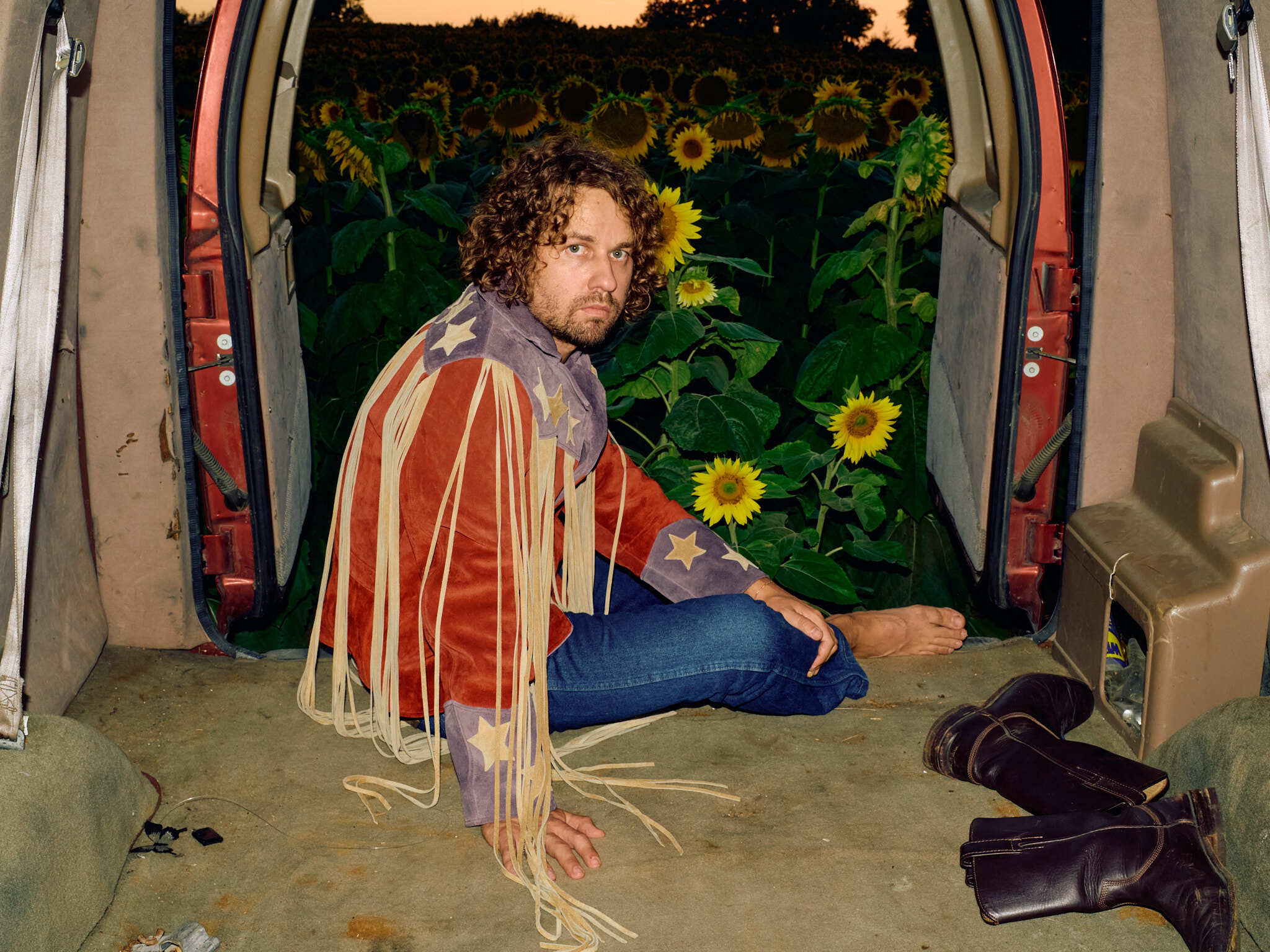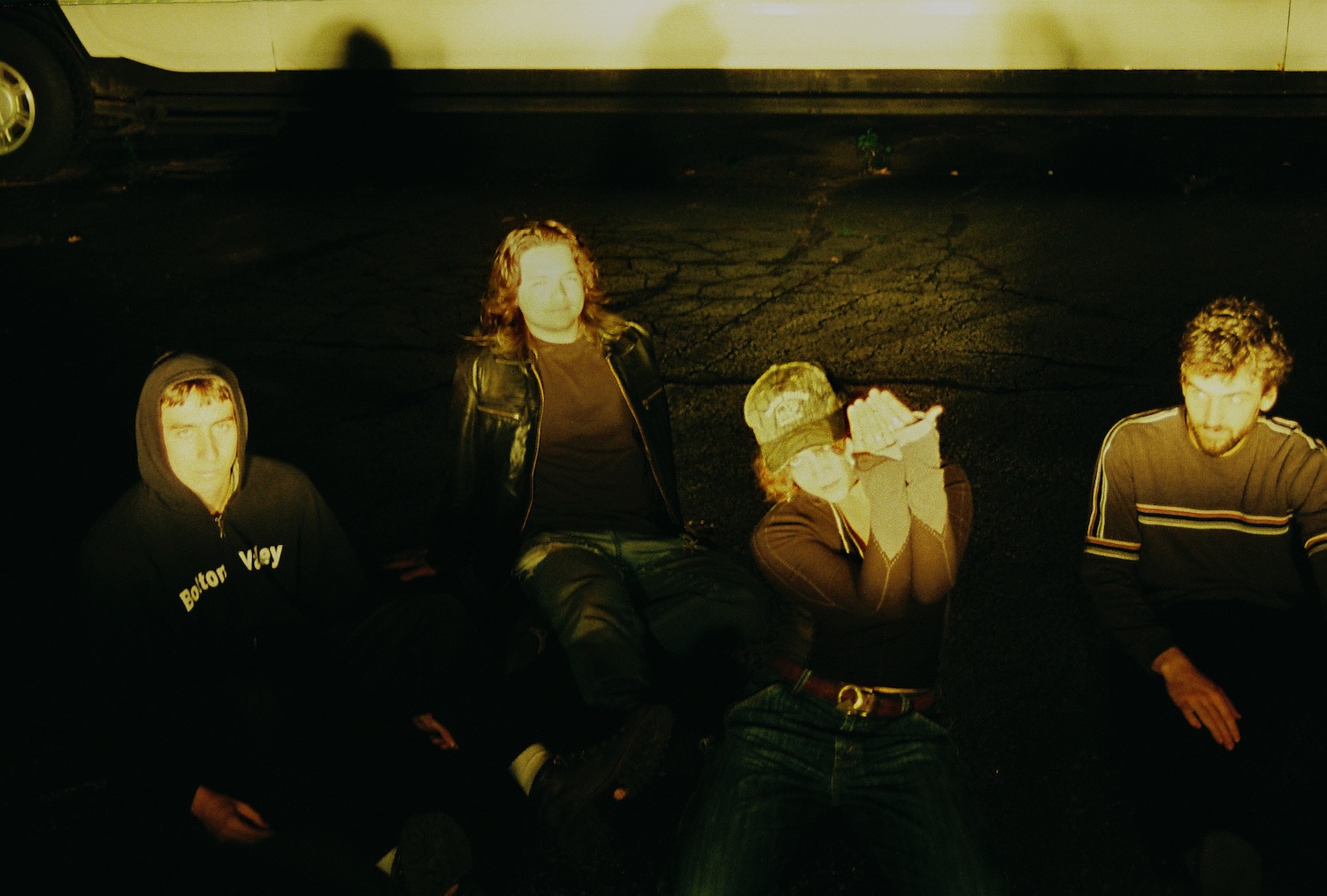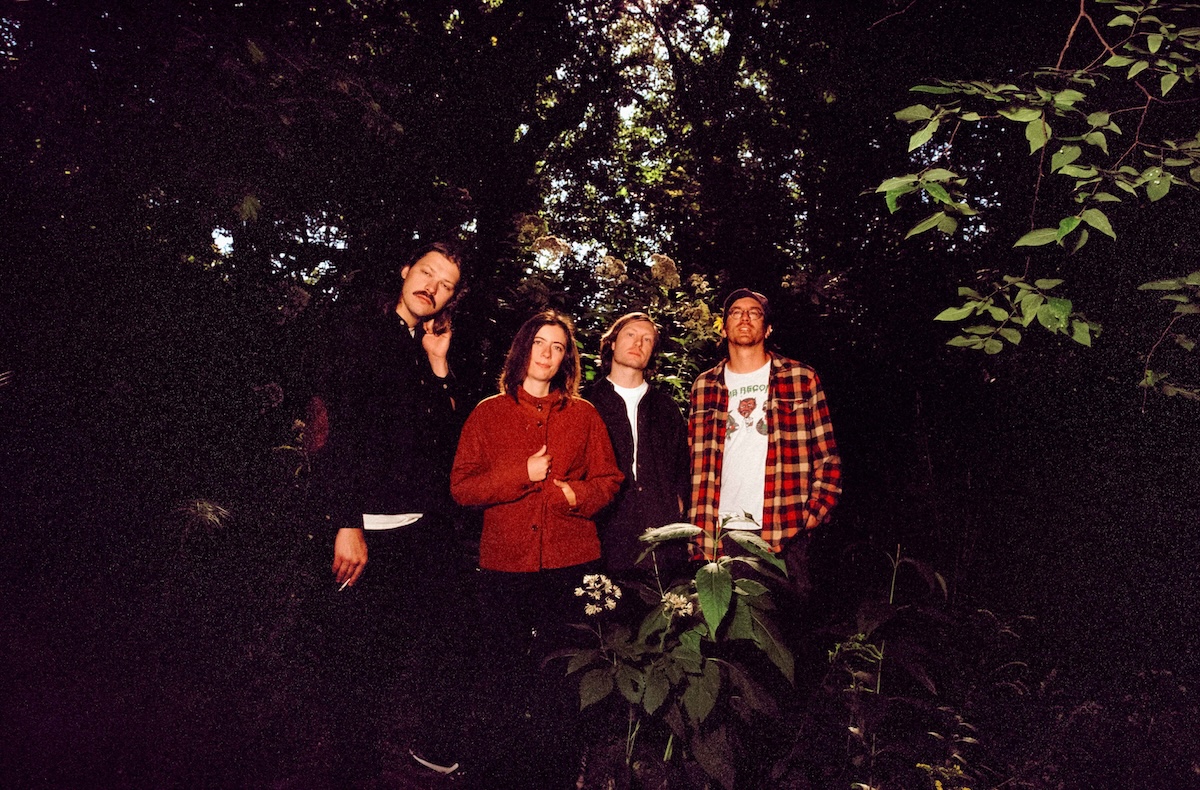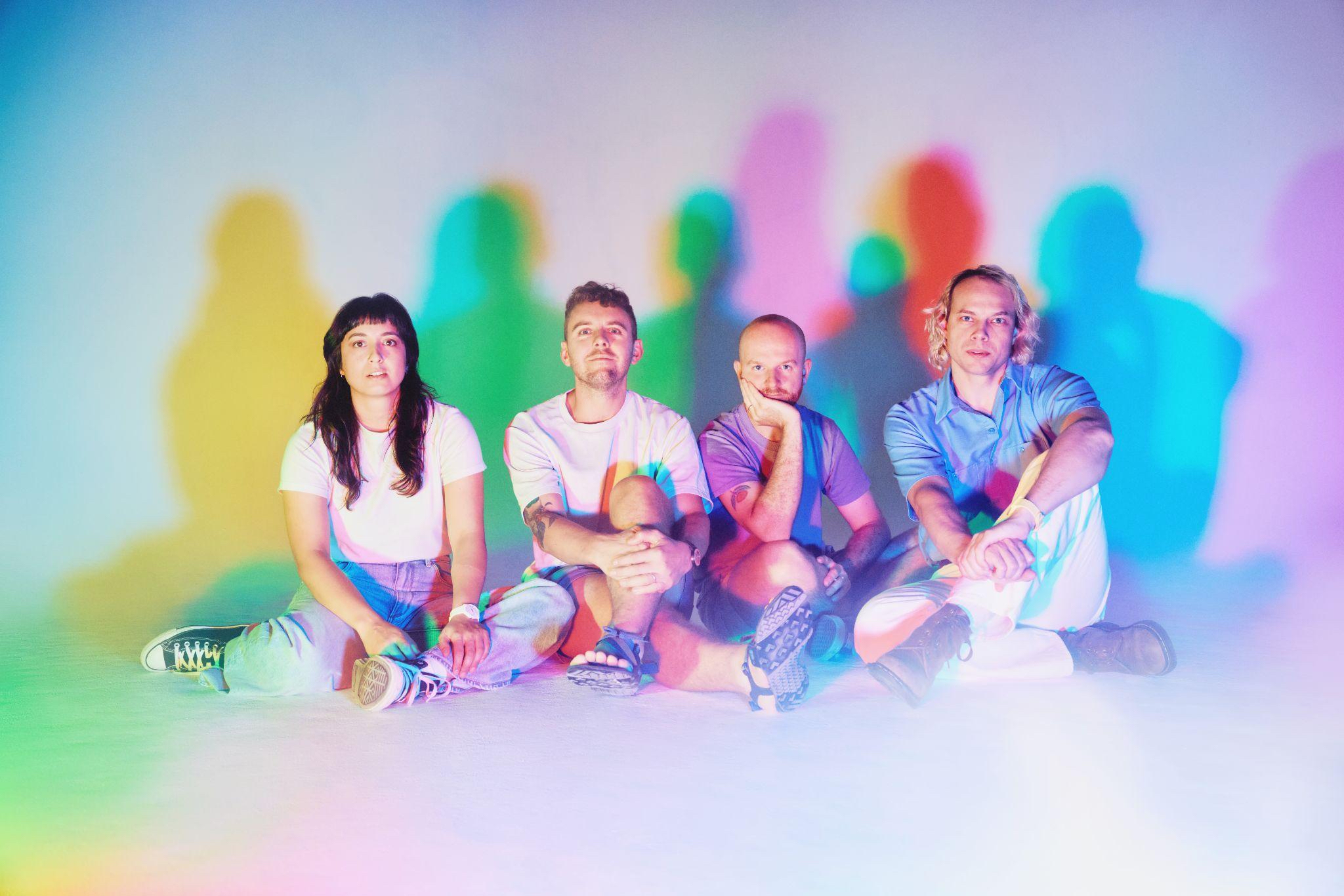

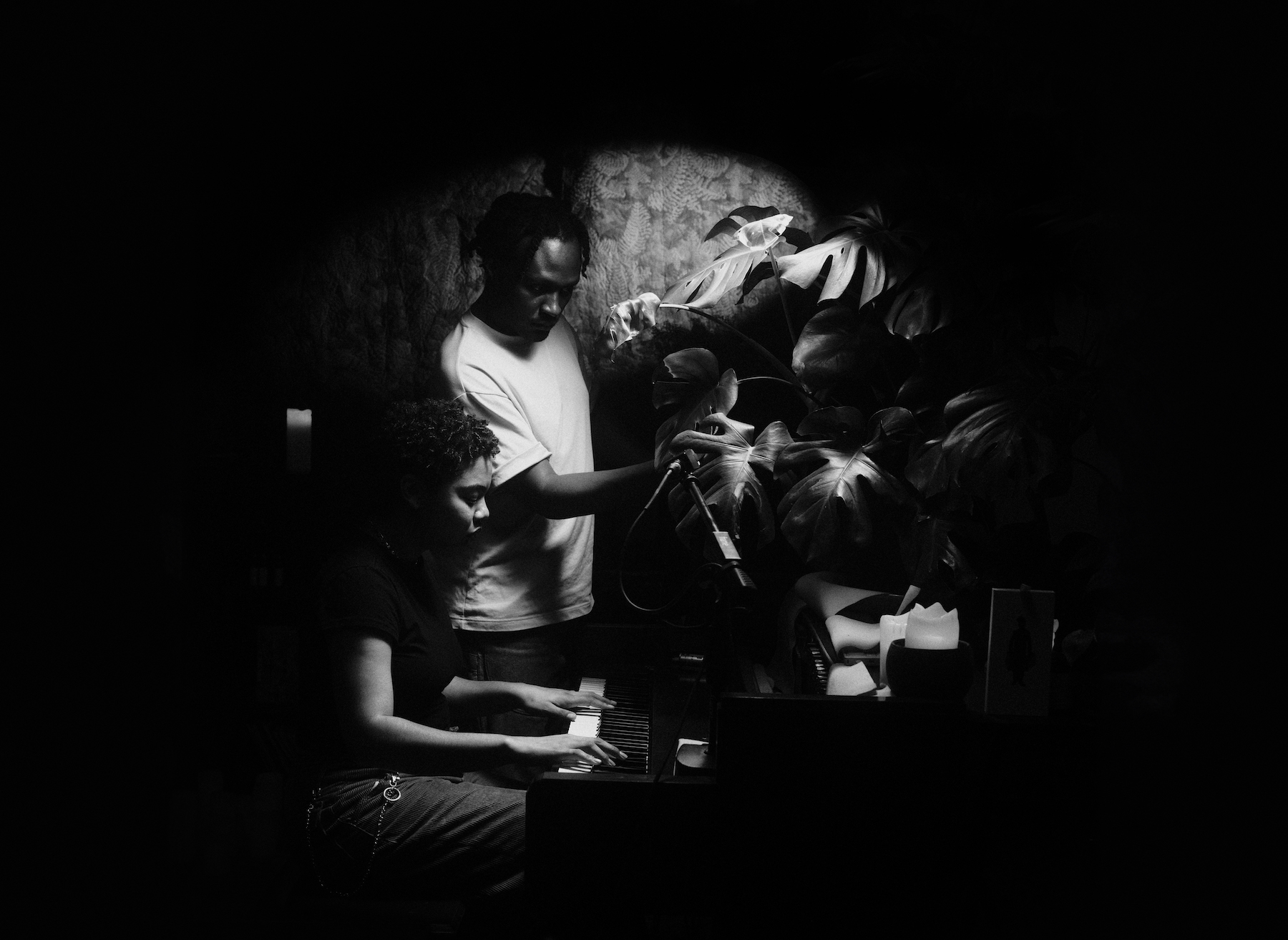
Traditional Noise will go down as one of the most staggeringly beautiful collections of music this year. The album, out today, is billed as April + VISTA's full-length debut. But because the DC duo has been releasing music for close to a decade, it also works as a culmination of everything they've been building toward. These 11 tracks will reward the patience of those who've been keeping their ears to the ground. And for newcomers, it all adds up to a startling introduction.
Originally, they were going to call it Traditional Noise For Anxious Adults. The idea was for singer/composer April George and composer/producer Matthew Thompson (aka VISTA) to find comfort by burrowing into the music of their formative years. But the noise they conjured is not all that traditional, even if there are countless reference points swirling within the album's blend of orchestral movements, electronic beats, and rock instrumentation.
A Moon Shaped Pool-era Radiohead looms large, as do Portishead, Broken Bells, alt-J, and other past music where moody atmospherics meet cinematic strings and hard-crashing beats. George's textured swoons evoke a continuum from Billie Holiday to Adele (imagine her official Bond theme had a baby with Radiohead's rejected Bond theme). During our interview last week, the duo referenced alt-rock and R&B alike, name-checking European genre-melders like Gorillaz and Stereolab and even the kamikaze post-hardcore of At The Drive-In.
Within this sonic landscape, George sings of archaeology, ancestry, and past selves. In language as vivid as the music, she looks to the past to find a way forward into her future — a journey that Traditional Noise fulfills in real time. "I ran so fast I left myself behind," she declares on late-album highlight "Grotto." Yet nothing feels rushed about this album, save for maybe a brisk runtime that often leaves me circling back for more. Instead, the advancements here feel patient and hard-won.
In our interview, April + VISTA went track-by-track through Traditional Noise, explaining the inspirations and techniques that brought this music to life. Below, press play on the album and read the Q&A.
1. "Hello"
The introduction gets its own track. There's a version of this album somewhere in some multiverse where this and “Very Bad News” are one track together. What's the reason for splitting this off into its own thing?
MATTHEW THOMPSON: Well, we have a tradition of having interludes on our projects. You Are Here, we opened up with very similar interlude that transitioned into “Fomo,” so it's just one thing that we really like to do. We like to create these little storytelling moments on projects that aren't necessarily songs but push the theme along. And “Hello” is one of them.
APRIL GEORGE: Yeah, it's like a score. One of our dreams is to score a feature length film. We've done short films here and there. And so this is our way of creating our own score in a way, and trying to set the scene and set the tone for the album, give you a little time to breathe before we smack you in the head with “Very Bad News.”
So it's very intentional because they're two different dynamics. The intro is so quiet and “Very Bad News” starts off with a huge explosion, and we like keeping those separate to kind of make it more dramatic.
THOMPSON: And we've always wanted to make an album with more than 10 songs, so this — we did it [laughs]. Goal complete. “Hello,” thank you so much. One thing about “Hello” is that it actually started out as a cue for a score that I was working on for a short film that didn't quite make it. And I'm so super happy that it didn't because we liked it so much. We're like, “I've got to figure out how to use it ourselves.”
You talk about setting a tone, setting the scene. Were there certain images or keywords or ideas that you were pushing for with the sound of this track?
GEORGE: We didn't have a theme we were pushing for, but I think we were trying to find a way to — when we were writing a lot of these songs, we started thinking about how they were going to translate live. And “Hello” is just a way to ground the listener, but also ground us. When you hear all those voices saying “hello,” those are the voices of our mothers, our sisters, my godson’s in there when he was around five. All of these different people who mean a lot to us. And when we play live, we use that as a transition track, sometimes as an opener to ground us and to bring the people that we love with us, to help us feel comfortable and calm. And so that was just something that that track turned into. We didn't initially think of it that way, but as we started to work on it and complete it, it turned into that. So it was a beautiful opener and a grounding exercise for us too.
THOMPSON: We just like to open our projects off with these softer moments before we get into the dirt.
2. "Very Bad News"
This one really does start off with a bang. There's so much bass. The drums and bass are just coming at you. Tell me about where this song came from.
THOMPSON: It came from “Hello.” We started off with that intro.
GEORGE: Remixed it.
THOMPSON: All of our songs are born out of sound experiments and these strange idea starters. So as I was picking around with the elements of “Hello,” thinking I was going to turn “Hello” into a full song. It ended up finding its way into a completely different feeling and composition with “Very Bad News.” And I think that's really why they ended up being two separate tracks. Because I needed to start going in a completely different direction with some of these “Hello” elements and ended up making an almost like Black Sabbath-y psych situation with it, right?
GEORGE: Yeah, it was the goal. The cool thing about it is — like you said sound experiment — my favorite thing that we did that kicked off “Very Bad News” is, our studio mate had this old guitar laying around in the studio. And Matt got the idea to break a string and record the string breaking, and then like magnify it 1,000 times to make it sound really big. So that's what you hear when as soon as the —
THOMPSON: [Imitates sound effect.] Yeah, it's a string pop with a bunch of pedal effects on it.
GEORGE: To make it sound like an explosion. Like a warped explosion, or like you're being dragged through space or something like that. So I thought that was really cool. It is a very explosive track.
The spoken part at the beginning, is that a sample or is that something that you guys created?
THOMPSON: Yeah, it's like a little computer voice. You know how on Apple Notes or Windows — April mentions Microsoft Sam a lot when we talk about this — but, what we also do for our live set, we have these cues in our ear to remind us where we are in the set, and we'll create that by having the little computer voice prompt. We'll type some things in and so forth. We brought that idea into this to create a sort of infomercial opener for a self-help book for anxious adults.
GEORGE: Yeah, it's just our little prompt voice that we use live to count off all of our cues.
THOMPSON: Yeah, and the whole project, one of the core themes or ideas was us returning to music that brought us comfort and us finding safety and tradition. And we are anxious adults, so it was kind of a fun joke there, “traditional noise for anxious adults." That was originally the longer name of the project, but then we just shortened it to Traditional Noise.
I wanted to highlight a particular lyric, but on this song, I feel like they're all really vivid and interesting. It sounds kind of like — I don't know if it's combative or paranoid or what's going on here, but it definitely sets a mood and creates images in my head. What were you thinking about when you were writing this?
GEORGE: The lyrics were born from my frustration from feeling like I'm in this rat race, this capitalist rat race. For this entire time I've had to work a 9-to-5 job at the same time as pursuing music, and working in a corporate environment is a very stark difference from this. And it bred a lot of frustration for me that I actually have to do this in order to live. I cannot just pursue my dreams freely.
I also take a lot of time — like when I commute to work or when I'm spending time dealing with people at work — I have a lot of time to just think about how trapped I feel, how trapped a lot of people are and may not even know that they are. Especially here in America, we just work so much and it takes us to the point where we don't take a backseat and think about where we are in the world, who we are, and all those things.
So this song was just like my middle finger to the system, where I was thinking about all of the greed. We're based in DC, so it's really difficult to get away from the news and all the headlines in the center of it. And every time we would hear something crazy that's going on with the government, or I hear stories from my family members or people in my community where they talk about [how] they can't afford basic things that you need to live, it had me thinking about writing a song that touches on those things but isn't preachy. I wanted to keep it atmospheric and let people come to their own assumptions, but that's where my intentions lie. It's a commentary on that.
3. "Do What You Know"
The lyric that jumped out at me first here was “I dug a hole to the other side, had to go lower to reach high.” Can you unpack that one a little bit?
GEORGE: Absolutely. “Do What You Know” is one of my favorite songs on the record. It is a letter to my childhood self, that things get better, that you can pursue your dreams and the things that you wanted to accomplish. When you become an adult, you either accomplish them or you get super, super close. I feel like we're on the precipice or something very good.
So it's that. And when I was young, I was very obsessed with archaeology. One of the reasons why our album cover is a real fossil that Matt photographed. I just had a very deep fascination with paleontology. I used to collect rocks, and I love to collect bugs, and all those things. So one of the things I used to do as a kid, I had an archaeology kit, and I would dig in the backyard to see how far I could go and what I would find. And I grew up in Virginia Beach, so we're below sea level. I would find all kinds of shells and all kinds of things. One time I dug so far, I found an arrowhead, and I kept it as a necklace. So yeah, I thought about the action of digging, I was thinking about paleontology and trying to tie that into the record somehow, because that photo of the fossil really kind of blossomed all these themes and ideas for me.
So it's a double-sided thing. It's me thinking about one of my favorite pastimes as a child and also thinking about how you do get to the other side, and you do get away from a lot of the trials and tribulations that I dealt with as a kid and didn't think that I could escape.
THOMPSON: I don't know if you were thinking this intentionally, but it's also kind of a callback to our last EP Pit Of My Dreams.
GEORGE: “We were in a hole,” yeah. Three meanings.
Anything you wanna share about the music on this one? The beat kind of reminded me of “Lost” by Frank Ocean except spooky.
THOMPSON: No. Well, damn, that's cool that you mentioned that. We were listening to a ton of Gorillaz as we always are.
GEORGE: And Stereolab.
THOMPSON: And Stereolab, people like that who are just crazy.
GEORGE: And whimsical.
THOMPSON: Yes, it's dark and whimsical at the same time. We wanted to create something like that. We attempted this song, like a few songs on this project, a few different ways. There were different arrangements on the beat that didn't quite work out. We recorded the drums with our drummer, Foots, in the studio, for earlier versions of the song that didn't work. But when we finally landed on this progression, this music, we wanted to keep some of those raw takes from the drums, which the drum pattern is just a loop from Foots. And at the end of the pattern you can hear Foots ask, “Is that OK?” We were like, “Oh no, we actually have to keep that.” But it was our attempt at pop, and I'm really happy about it.
4. "Two Evergreens"
I was impressed with how much drama this song gets without a heavy percussive element. I'm wondering about how layering textures plays a role in building a song like this.
THOMPSON: One of my favorite idea-starting devices is the Moog Subharmonicon. It spits out these bleeps and bloops and sequences that you can dial in. And when I don't have any ideas immediately, when I'm at my computer, I'll just play around on that. Just like a bunch of songs on this project, I started out and found a nice little chord drone for “Two Evergreens,” and I washed it out with a bunch of reverb. And April already had these lyrics for “Two Evergreens” for an earlier piano arrangement. And so it was just too good. We could not use it. So I really was trying to figure out a different piano arrangement so we could keep this song. So I just built keys around that Subharmonicon. I wanted it to be as sparse as humanly possible because I think space and silence is just as important in a song, or it can be just as important to the story, as a bunch of elements.
But we also still really love static and noise. So during that break in the middle, after this really quiet and peaceful verse, a staticky, repeating screen kind of boils up, which brings in this tension without it being overstated or without it being too explicit. I really liked that. So I think that part really adds to the drama of the song. But also we were listening to a lot of acoustic records, like Elis & Tom, bossa nova records where they create drama with just a voice and a piano, with just the voice and the guitar. It's my dream to make something like that.
GEORGE: That song is special to me because it's about my grandmother who passed away when I was entering college with Ms. Elsie Wilson. She is the reason why I'm a musician. She bought all of my instruments that I play to this day. When I would stay at her home — I pretty much grew up there — she had two evergreen trees that bookended her home. And I would climb them as a child and get sap all on my hands. I would get in trouble cause I'd be all sticky. But I just remembered that her home meant safety to me, and I felt like she was looking down on me and is my guardian and is making sure that I'm OK.
So that's what that song's about. And it's so interesting, too, how songs can evolve. My grandfather recently passed away, right in this rollout, and so he became my second evergreen. So now I have two. So that song's very, very, very, important to me.
Wow, I'm sorry to hear that about your grandfather.
GEORGE: It’s OK. I got two guardians now watching me.
5. "Standing In Place"
This is another one where you did a great job of making the lyrics as evocative as the music. When you say, “My view is crystalline,” I'm wondering what you're seeing there. Are you looking out at water or what is the crystalline view?
GEORGE: That song, it's like a goodbye to my former self. At the time, I had just entered into my 30s. A pandemic was raging, and it made us have to stop, slow down. We couldn't travel, we couldn't do much in real life, things for music. And at the time, it was very difficult to navigate having a transition in my life and my career at the same time. So I saw a reflection of myself on a horizon, and I'm getting further and further away from her and growing into who I aspire to be. And I think that this song talks about how scary that feels, but feeling comfortable in the fear, if that makes sense. I realized I have to — in order for me to grow and to get to the goals that I have for myself and for us, for our career — me personally, I have to let go of my comfort zone. I cannot be the same person I was in my twenties. My brain has now formed. I am so much more mature, and I've gone through so much life, that I have to let that go in order to create space. And so that's what “Sanding In Place” means, and that's what I'm thinking as I was writing the lyrics.
6. "Rot"
We made it to the second side of the vinyl, and we've got another interlude to kick things off. Tell me about it.
THOMPSON: It was totally intentional to have like the side B of the record open up yet another interlude. I'm so happy it's symmetrical like that, you know what I'm saying? It worked out in a super cool way. “Rot” is one of those sound experiments where I'm just layering ideas. A lot of times, a lot of the chords that come from the project come from me making something weird on the Subharmonicon and sampling it, and pulling it out of the computer, then putting it through a pedal, then bringing it back in. And then I hear a different melody, and then I'll usually flesh it out with keys or a guitar or something.
But we really just loved this one. We love the grimy, dirty vagueness of “Rot.” And we just decided to keep it — I was thinking of putting drums on it, keys, but…
GEORGE: Stripped it down.
THOMPSON: Really happy we left it here. I'm constantly calling back to Pit Of My Dreams, because there's like remnants of that angst and that anxiety that created that project that still kind of roll over here. And I think “Rot” is one of those like spiritual successors to that EP. Like “Spite The Face” is a really noisy, scary, interlude on Pit Of My Dreams, and “Rot” is like a cousin of that to me. So that also kind of connects that with our “Hello” samples from our friends and family that take us into the next song.
GEORGE: And that song, the name of it came from, we were reading this book called Stages Of Rot. It's a graphic novel by Linnea Sterte, and it was about thousands of years into the future, how organisms and humanoids — because they're not quite human, but aliens on another planet — how they live within their alien ecosystem. And it centers around this whale-type alien that died, and its carcass feeds the ecosystem and the people and organisms that need it. And I was just thinking about dilapidation and thinking about how this album came from thinking of archaeology and what we want to leave behind after we're dead. This album is our little fossil that people will find. And so “Rot” comes from that line of thinking. That’s why we named it that.
7. "Bless My Heart"
This one is amazing because I thought it was one kind of song, and then the beat dropped, and it totally changes the geometry of what's happening in the song. I was amazed at that. Was that a situation where you had a steady beat and then you decided to pull some of it out, or how did you decide how to deploy the drums there?
THOMPSON: I always wanted to make a beat like that. Listening to shit like At The Drive-In, fucking “One Armed Scissor” was my jam at that time. And I wanted to make something that was a riot. I found a really great sounding kick and snare, and I was like, “It's making itself.” That's one of the songs that was pretty fast to me, because once you get that four-to-the-floor thing going, then it's just a matter of layering stuff on top of it also.
Also, fucking Foo Fighters. You know what I'm saying? At the very end, I wanted to kind of do our own version of the [imitates “Everlong” guitar riff]. But I'm not that great, so it ended up being something totally different, which is kind of like a fail of what I was attempting. But it's kind of cool in its own way. Yeah, the production is really an homage to my favorite rock stuff and my attempt to do something similar.
GEORGE: It features our friend Tony Kill, who is a producer from this area, and he also lives within a very experimental, very noise-influenced, very rock-influenced, go-go and R&B influence all tied up into this very messy, grimy sound. So we had to call him. As soon as we started working on his record, Matt was like, “This is a Tony Kill record. We have to actually tap him.”
THOMPSON: If you dive into Tony's music, you'll hear it immediately. Once we finished it, or at least our part of it, we were like, “Oh, this sounds like something Tony would have done in 2018," because he's inspiration for us.
GEORGE: So his voice is on the hook, and he added some amazing signature sounds from his sound catalog.
8. "Love Unspent"
I'm really interested in the different vocals happening here. Because it sounds like in addition to April and the choir, there's a pitched-down vocal in there too. I don't know if that's just a double of you or what's happening there.
GEORGE: We do that a lot. Matt got this plugin, was it Little AlterBoy?
THOMPSON: Little AlterBoy. I use it like hot sauce.
GEORGE: Yeah, it’s hot sauce. Just a little dab to add a little dimension and some depth to my voice.
THOMPSON: If we thought about it, we could probably come up with some deep meaning, but there isn't actually. I just was obsessed with pitching things.
GEORGE: I like how it rounds out my voice. As I get older, my voice gets a little deeper, and that's something I've always wanted. Because I always felt like my voice was quite nasally. So when he adds that layer in, it's wonderful. We also worked with four of our friends. Four of our friends were at the choir on “Standing In Place” and also “Love Unspent,” so they're also layered on the vocal tracks there as well.
“Love Unspent” is an interesting concept. I think about a dollar bill crumpled up in your hand, but you didn’t get to use it. It’s an evocative image. Was there a specific image in mind for that?
GEORGE: Yes, this song was quite heavy. I had a couple of my friends pass away during the pandemic time, and I was left thinking about grief and our relationship with grief. And I came across this analogy called the ball in the box analogy. Think of your body like a container, and grief is like a ball rolling around inside that container. And when it's new, it's really big and it takes up so much space, and it's always knocking into you and always reminding you of the loss that you have. And as you grow, you grow around that grief. It never leaves you. You just get larger and larger, and so it hits the sides a little less, but it always stays with you. And so that's the visual that I was meditating on while writing the lyrics for that.
THOMPSON: In the closing line.
GEORGE: Yeah, in the closing line. “I hear your voice rattling inside that box.” Like every time you may pass a place where you used to hang out with this person, or you or you may pass your childhood home and think about a lost parent or a lost grandparent, and that's going to hit you. But when you're dealing with grief, it's important to remember that it will always stay with you, and your relationship with it is to let it pass and let it stir you up a little bit because that means that you have love that's unspent. You still love this person, and it's a beautiful thing.
I didn't realize how much grief was animating this album. It's interesting because obviously you can hear a lot of A Moon Shaped Pool in the sound of the album, and that's another one where Thom [Yorke] is grieving his partner. Like the different version of “True Love Waits” that's all hollowed out and cold as opposed to the old one. So it’s an interesting vector of connection there.
GEORGE: Yeah, one of my favorite songwriters is Thom Yorke. I love how he deals with a lot of — he has a lot of grief and loss in his life, and he's very angry at the system, angry at the world. And the way that he writes his lyrics, it leads you to come to your own conclusions, but he's very intentional about what he's trying to say. And that I'm happy that you pointed that out. It's one of my favorite records of all time, but also a really big driver in how I chose to write the lyrics for this album.
9. "Grotto"
THOMPSON: “Grotto.” First song that we wrote for the whole project, and it kind of catalyzed the sound. We were writing things, we didn't want to take it too serious. We were just like, “We're just gonna write some songs. Whatever comes, we'll figure out what the sound is.” But as soon as we nailed down the foundation of “Grotto,” we were like, “We're making a whole album like this.” So yeah, that was a minute ago. April bought me a guitar for Christmas. And I was trying to figure out how to play it. And that was the first idea I came to with that guitar. Which is right there! [Points behind him.]
GEORGE: “Grotto” is an interesting song because it’s just a very introspective song, thinking about, again, very similar themes as “Standing In Place,” where I felt like I was growing into someone, leaving my old self. It also deals a little bit more about self-doubt. When you're a creative in any capacity, you're always trying to shield yourself from people telling you you can't do something, right? So that's what “Grotto” is, is that frustration in feeling like I'm on this track to trying to pursue something that I've always dreamed about. I was just tired of people trying to limit me, and having a small imagination about who I could be and where I could go. So that's what the song faces.
I love the lyric “I ran so fast I left myself behind.” The instant mental picture there really sticks with me.
GEORGE: Thank you.
10. "Modify Your Tradition"
So we’ve got one more interlude here, “Modify Your Tradition.” That's an interesting title, since you’ve got Traditional Noise as the title of the album. I assume that this is a climactic moment in the story of the album then?
THOMPSON: Yeah. Also kind of like a spiritual parallel to another almost closing instrumental from Pit Of My Dreams. It's another storytelling element that we try to close the project up with. And it started from yet another sound experiment that we sat on for a very long time because we wanted to flesh it out and build it. But what we realized over time is that we just like to meditate in these sounds, and I don't think that we'll be adding any more to the story by producing it out. It just needs to be what it is.
GEORGE: Use the voice to talk about tradition, which is a passage that you wrote.
THOMPSON: Yeah, it's a reflection on tradition. As I said earlier, we kind of sought our traditions as children as a refuge. After Pit Of My Dreams, we wanted to kind of go back to a safe place, go back to something that felt familiar. And on the arrangement side, familiar meant legible pop-rock, soul songs that we listened to on car rides with our parents as kids or getting ready for school. We're children of MTV and VH1 in the early 2000s, right? So those things became tradition. It became tradition for me to turn on MTV2 after school, right? But then we also think about tradition as a sort of inhibitor, like a cage that inhibits you from growth. For us, as Black musicians, we're always being forced into an R&B box. And we are absolute — R&B is prevalent in all of our music. It's one of the foundations of our sound for sure.
GEORGE: But it's not the only sound.
THOMPSON: But it's not the only sound. And though we absolutely celebrate the tradition of R&B, we have our life experiences. We have our other influences that we have no choice but to honor as well alongside it. So in a sense, we are celebrating our tradition, but we're also modifying it with our own unique identity. So there's the Microsoft Sam voice and there's also me, April, and our photographer close friend, Foster White. We sat in front of a field recorder and just recorded some funny things that don't necessarily mean things. The stuff that we're talking about, it's just kind of us enjoying a silent moment on the album.
GEORGE: By not being silent at all.
THOMPSON: By not being silent, but we were just kind of encapsulating this quiet moment in real life. It was during the summertime. It was warm outside.
GEORGE: We were here up in our studio upstairs. Because we record at home a lot, and you'll hear us going [imitates breathing exercise]. We did some breathing. We did all kinds of weird crazy stuff.
THOMPSON: Yeah, it's like a fly on the wall moment. We're just hanging out.
11. "Morning Star"
I see in the lyrics references to several things that we've talked about already. Rot is reoccurring in there, and talking about stuff being buried. I don't know if that's connected to the archaeology thing at all, or if there’s a different context for burying something. Did you write this with the intention of it kind of summing everything up and being the ending note? Or did it just get sequenced that way for other reasons?
GEORGE: It got sequenced that way. It did feel like a closer to me when it came together, and it's the reason why it takes that position. We had some other things that we were trying to fit onto the record that came after it, and a little before. When we took them away, and when we listened to it all back, it sounded very cohesive, so we kept it.
THOMPSON: There's a version of it with a beat that's fire, but…
GEORGE: We took it off. I think taking the beat off and letting it kind of breathe serves as a palate cleanser. It helps connect it to the first song, to “Hello.” So if you were to play it back, it kind of has a cyclical feeling to it. And also, the song is about ancestry, and so I was still thinking in my archaeology phase, thinking about the things that we leave behind for generations after us. I thought about my heritage as a Black American and thinking about all of the suffering that my people went through and how we overcame them. And so I thought of morning star because it's a weapon, but also something that — Black Americans, when we went through slavery, looked at the North Star for freedom. So those are my two visual cues that I try to use to explain my ancestry and how I felt. And that's why I say “Roots of the scorned/ Oh, they're buried all the way down.” We have all this history that is quite ugly and scary and oppressive, but we came out of it and grew out of that very strong, like a strong tree.
And so that's what “Morning Star” is about. And it also made me think too, because a lot of these songs take us through our childhood. We think about our parents and our grandparents, the people who raised us. I also love thinking about my ancestry and how — you know, my sister is a psychologist, and she was teaching me about how our DNA remembers things. A lot of the trauma that you deal with through your family line gets passed down through your DNA truly. And so I was thinking about that, how not only has our trauma made its way through our lineage, but also our resilience I think was passed down through our DNA as well. So that's what that song is about.
THOMPSON: And a ton of production would have distracted from that message, I think. Anything else beyond just piano and the strings and the texture would have taken away from something so powerful.
Traditional Noise is out now via Third & Hayden.