

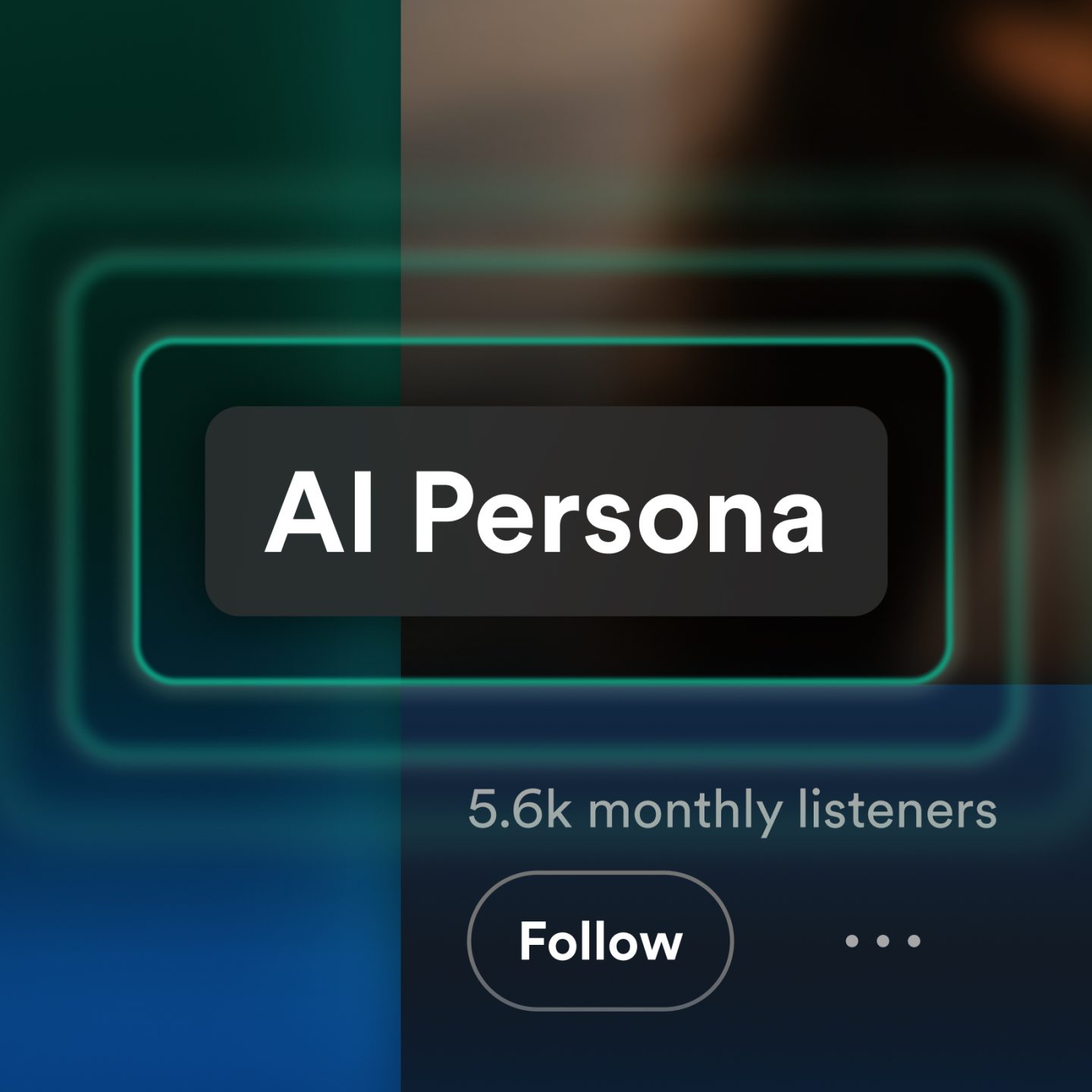
Spotify announced today that profiles for fully AI-generated artists will now be labeled as "AI Personas," and the streamer will exclude music from these profiles from their editorial and algorithmic recommendations. It's an intriguing step in a saga that is becoming central to the health of the music industry.
AI-generated music has been flooding onto DSPs at a massive scale. Back in April, the French streaming service Deezer estimated that 44% of all new songs uploaded to their database were created by AI, a harvest of about 75,000 AI-gen tracks per day. This phenomenon has raised concerns among musical artists, whose work was already at risk of getting lost in the seemingly infinite glut of music available online, and the alarms seem to ring louder every time a fully AI-created act like the Velvet Sundown goes viral.
Journalists like Liz Pelly have chronicled Spotify's practice of lining their playlists with "ghost artists," essentially muzak commissioned by the company and licensed at a lower royalty rate. Her fellow Spotify skeptic Damon Krukowski points out that some of this muzak is owned by Spotify-connected companies, such as the catalog of Johan Röhr, a fixture of Spotify's official playlists with music released across 656+ pseudonyms. With the influx of music from fully AI-generated artists, human musicians naturally feared that the streamer would foist their own proprietary slop on listeners.
This new policy theoretically will prevent that. Here's how they explain it in a press release:
Listeners have been clear in telling us that they don’t like seeing an artist profile that seems human, only to find out that the persona is AI-generated. That’s why, starting mid-September, you’ll begin to see an AI Persona badge on some artist profiles. The badge signals to listeners that an artist’s identity may be AI-generated and does not represent a real person. Alongside artist profiles that self-disclose as AI Personas, we will also start applying badges to relevant profiles.
By default, Spotify will not include AI Personas in any editorial or algorithmic recommendations. That means you won’t see any music from AI Personas in your personalized recommendations, unless you follow AI Personas, for example. While we believe all artists have creative choice in determining how they present themselves, Spotify’s programming is focused on elevating music from authentic artists building careers in music.
Spotify says they will slap the AI Persona label on profiles that self-identify as AI, but they'll also attempt to sniff out AI artists that are being passed off as authentic. The label should start appearing in mid-September. "We’ll start with artists who have met defined audience thresholds," Spotify writes, "so the labels cover the vast majority of artist profiles that users visit."
This is a good step from Spotify, but the question of how to deal with AI-generated music remains complex. For instance, this policy does not address AI-generated tracks released by real human artists, such as "Rubberz," the recent controversial viral hit from Fenix Flexin. Also, "AI" is a vague term that could apply to a wide range of recording practices and technologies, as evidenced by an array of artists like Empire Of The Sun, Two Shell, Diplo, Tyga, and ABBA's Björn Ulvaeus recently admitting they use AI.
On a related note, artists including Lorde recently pushed back against Spotify's own use of AI for their new About The Song feature, which spits out sometimes-inaccurate factoids about the music you're listening to.