
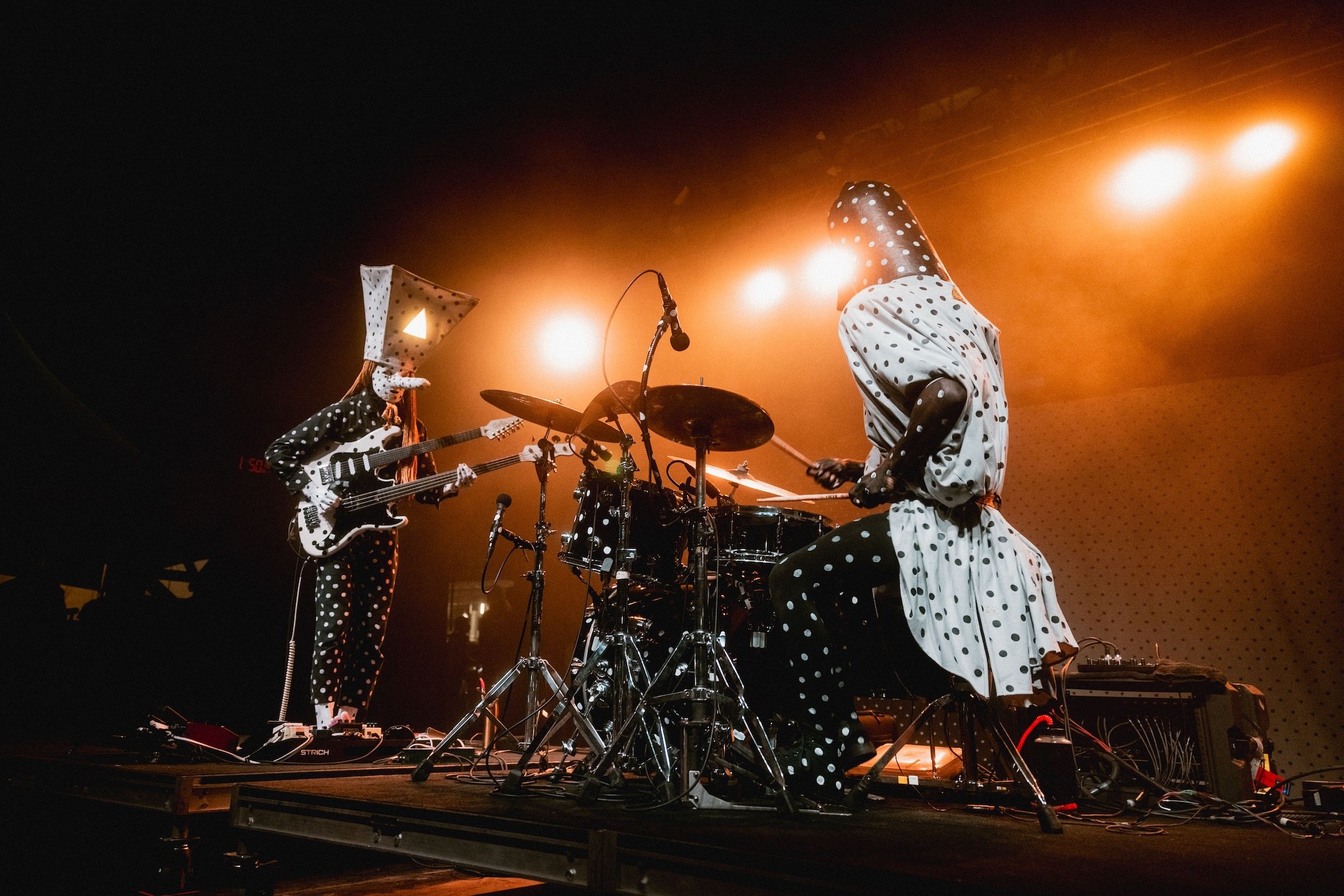
People showed up to the festival in polka dots. The polka dots took many forms. Homemade T-shirts. Facemask hoodies. A pretty decent number of kids who painted themselves white and then added the black spots. Angine de Poitrine, the gimmicky and otherworldly Quebec math-rock duo who inspired those getups, have been virally famous for, what, a few months now? Their KEXP session, currently at 19 million views and counting, went online in February. Seven months later, grinning teenagers dress up as dalmatians at a rock festival. That's a steep trajectory. It says something. I wish I could figure out what.
What is hype? I should know this by now. I have lived my entire adult life as a cog in the hype machine. I had a full-time job at Pitchfork Media Dot Com in 2009, OK? The eye of the hype storm. I should be an expert. I should ply my trade as a consultant, traveling the world to advise corporations on how to manufacture and channel the unpredictable tide of enthusiasm that continues to drive the music universe. The problem is that I don't understand hype at all. It's a mystery — an ephemeral force, directed by humans but operating independently of them. People try to generate hype via psyop, but we can never agree on whether that actually works. You don't know how fast you're moving when you're on the hype train, baby.
Pspeaking of psyops: Geese played the festival, too. People didn't show up in Geese cosplay, though I guess I wouldn't notice if they did. What would a Geese costume entail, anyway? Shaggy hair? Plain black tank tops? Grown-out eyebrows? This was my first time seeing Geese, almost exactly one year after their own moment of deafening hype crested with the release of Getting Killed. I've got friends who saw them at last year's Hopscotch Fest in Raleigh, which would've been a perfect time to witness the splitting of the hype atom. Twelve months later, the Geese hype has already been through all the predictable stages of backlash and frontlash, and they've become festival standbys. Our own Chris DeVille just wrote about catching another Geese festival set back in June, and I concur with him: Geese are not a psyop. They're fucking awesome.
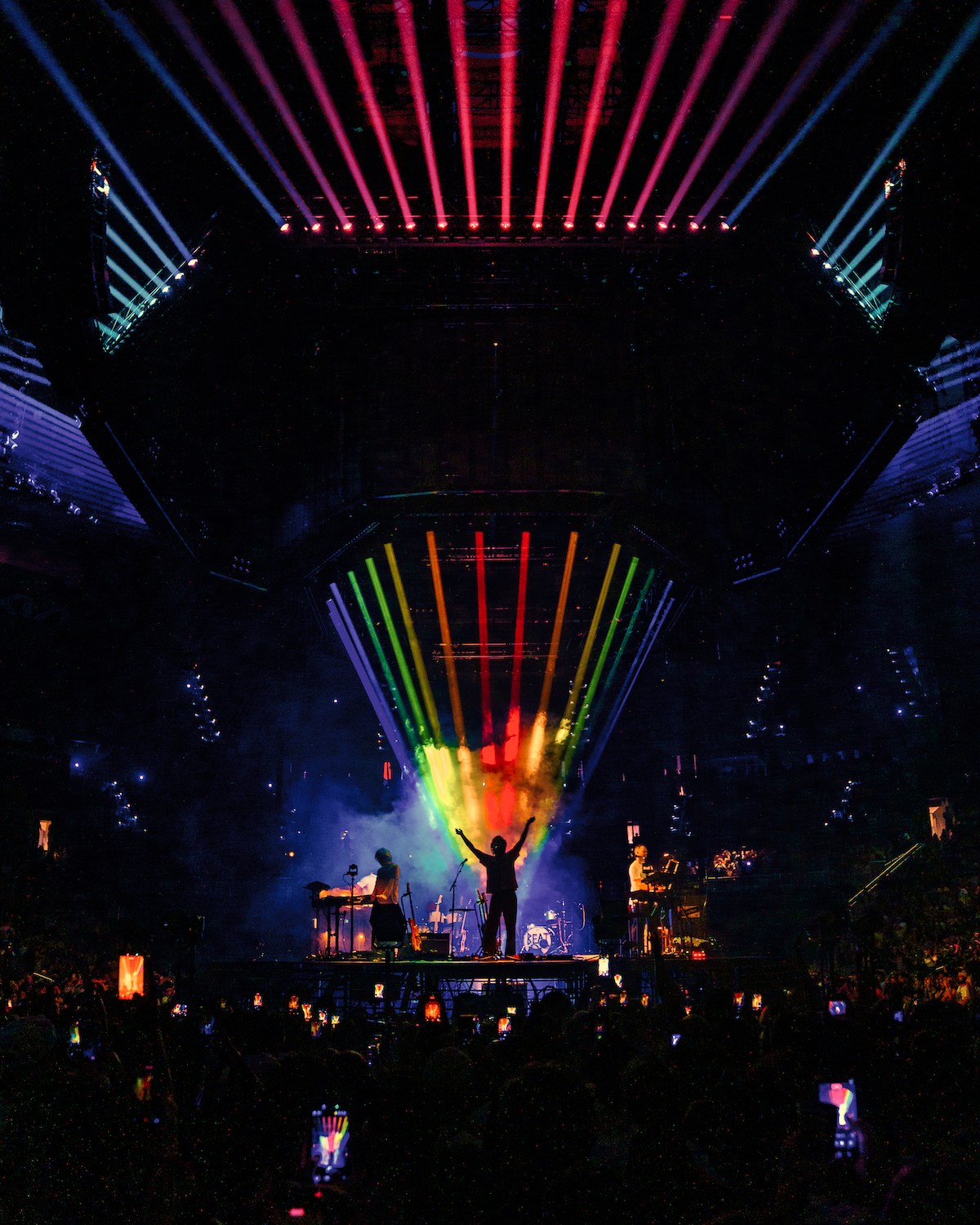
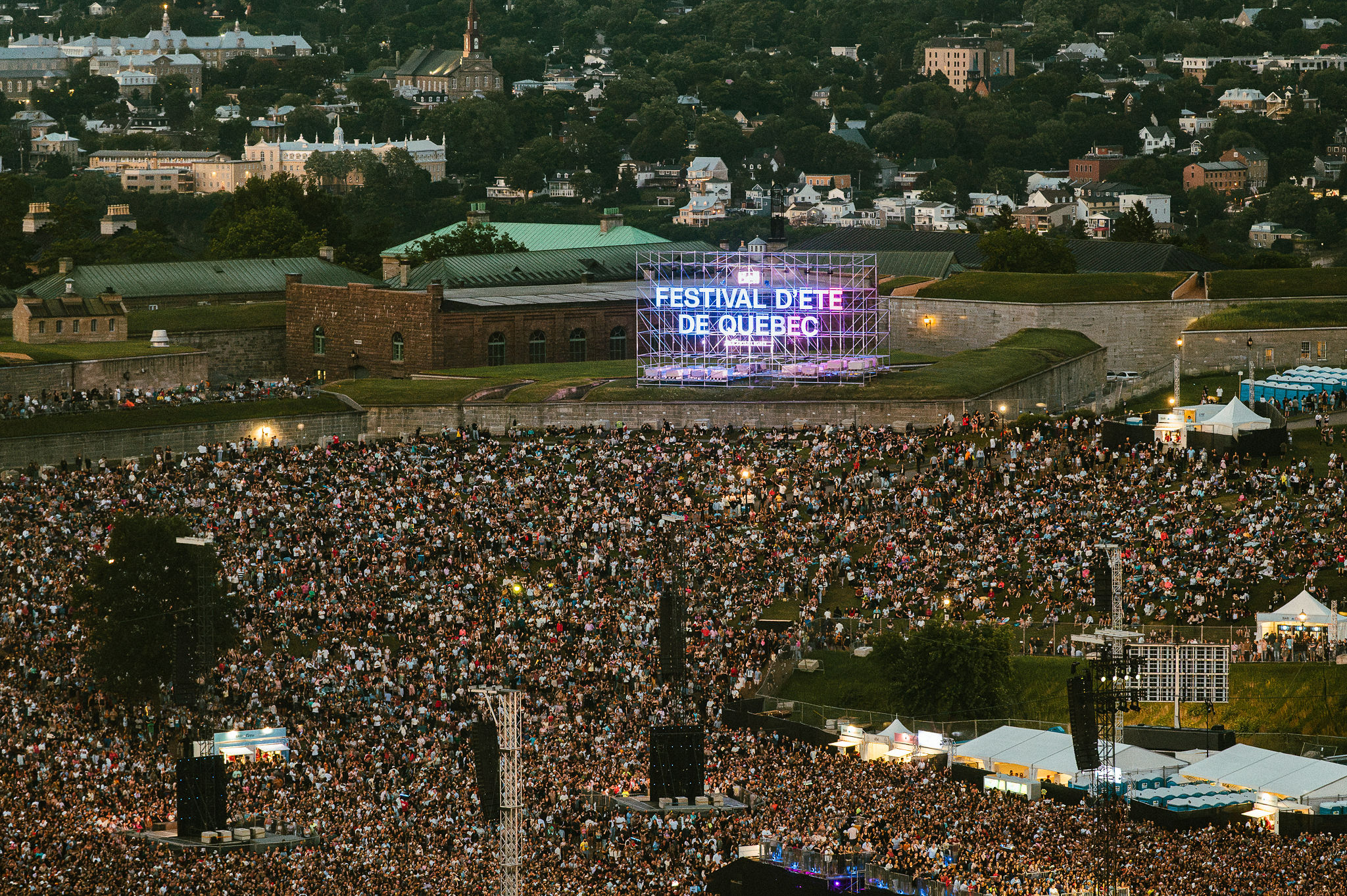
The festival in question was Iron Blossom, a mid-sized two-stage affair in the middle of Richmond, Virginia. It's pretty normie-focused, as festivals go. Just a few years ago, the same fest booked comfy folkateers Hozier, Lord Huron, and Noah Kahan as headliners. But the 2026 edition steered things into the buzz-band universe. I missed the first night of Iron Blossom to see Militarie Gun, but that day had LCD Soundsystem, Dijon, and Die Spitz — acts who have benefited from very different generational waves of hype. Sunday's bill worked in similar ways, putting a few different iterations of the buzz-band cycle to work.
The Geese buzz-band experience was basically exactly what I wanted. Midway through their set, Cameron Winter drawled that he likes this kind of festival where there's only one band onstage at a time, that Geese get bigger crowds when they don't have any competition. He was joking. From what I have seen, Geese don't exactly play to crickets, no matter who else is on another festival stage at the same time. In the big-stage immediate-support slot, Geese played to a combination of the faithful and the curious, and they acquitted themselves beautifully. Sometimes, they sound like the Velvet Underground trying to become Pink Floyd in 1968. Sometimes, they sound like Rufus Wainwright's imaginary Strokes tribute band. Sometimes, they sound like the most zoomered-out mutation of '70s hard rockers, their vrooming riffs reconstructed through the language of kling-klang and bing-bang. And when the hammer dropped on "Taxes," I briefly ascended to a different plane.
As near as I can tell, Angine de Poitrine's entire sales pitch is that they're supposed to exist on a different plane. They are not a buzz band in the way that Geese are a buzz band. In a different generation, Angine de Poitrine might've been a warehouse art-noise project, though their commitment to the bit is such that it probably would've gotten them noticed anyway. Today, they are an ideal band for Instagram Reels or YouTube Shorts. You're flipping through vertical videos, and you see two seconds of these masked freaks playing their twitchy, off-kilter microtonal stompers, so you stop flipping for a few seconds — maybe long enough to marvel at the way that they use loops to layer riffs on top of each other, or to catch the slapstick comedy of them communicating via nonverbal pings and urghs, like R2D2 and Chewbacca. There's no press-release manifesto to explain Angine de Poitrine's whole mythology, and thank god for that. They simply are what they are. Fill in your own explanation.
Angine de Poitrine are a gimmick band, which is maybe slightly different from being a buzz band. There's nothing derogatory about that. Gimmick bands can accomplish great things. Kraftwerk were a gimmick band. So were Daft Punk. You could argue that the early Beatles were a gimmick band, that they truly solidified their legend on the day that they agreed on a matching haircut. Gimmick bands can last forever, too. Slipknot and Mudvayne still pack them in at racetrack festivals. Gwar's fake-blood supplier has never gone out of business. Devo still strap the flowerpots — sorry, "energy domes" — on their heads. In a few decades, we might remember Angine de Poitrine as an embarrassing fad. Old friends might make fun of each other for getting too into them, like they were Kaiju Big Battel or something. But they could just as easily be universally revered weirdos, Wyld Stallyns for our strange new future. That's the hype lottery. It can go in any direction.
Angine de Poitrine happened to hit Richmond just as their own hype was near escape velocity. When people get nostalgic about the buzz bands of the past, this cresting of the wave is the moment that they remember. The duo played the smaller of the two festival stages right in between Geese and headliner Jack White. This was the perfect time to see them. If you weren't already familiar with Angine de Poitrine, you'd already seen kids rocking those polka dots all day, so you were at least curious. At one point, a sixty-ish stranger leaned over to me and mused, "Sounds kinda like Mars Attacks." His tone was not disapproving. It was more like: "Huh. Wouldja look at that."
The worst part of Angine de Poitrine's set was when a human roadie came out to fix some drum issue mid-song. He worked quickly before scooting offstage, but the mere presence of a regular-ass person was enough to briefly shatter the gimmick. The guy who changes out Jack White's guitars wears a cool hat, so an Angine de Poitrine stagehand should at least have to strap on a prosthetic dick-nose, right?
Angine de Poitrine are fun to watch. The drummer's eyes light up! I didn't know about that. That was cool. It's interesting to see the way they structure their tracks, adding more and more riffs before stripping everything away at climactic moments. It's also interesting to see the crowd cheer those breaks and attempt to clap along, a difficult thing to do when the band keeps playing with time signatures. But as complicated as their music might be, it has a direct punch to it. It's more like Primus than like Lightning Bolt — both of whom, come to think of it, are kind of gimmick bands, too. Like Battles' "Atlas," probably the father of the duo's whole style, plenty of Angine de Poitrine tracks have parts that would work just fine as pro-wrestler entrance music.
As fun as it is to watch Angine de Poitrine, though, it's way more fun to watch people react to Angine de Poitrine. I spent the second half of their set at the back of the crowd, the point right in between the sitting-on-blankets section and the dancing-with friends section. If regular people didn't actually like Angine de Poitrine, if the buzz didn't connect, then that section would've all been people looking at their phones and complaining to one another, a fate that all kinds of bands routinely suffer at festivals. That didn't happen here. People were feeling it, and expressing that in ways that I found hugely entertaining. I'm talking about the drunkest middle-aged couple you've ever seen, two-stepping together like they were at a country bar. I'm talking about a guy making his date laugh by inventing orc-spider dances. I'm talking about little kids running around, waving glowsticks and making wild-animal faces. Can you imagine how much fun it would be to be a little kid running around, waving glowsticks and making wild-animal faces, to Angine de Poitrine? At that point, hype has nothing to do with it.
My Iron Blossom experience kept bringing me back to the mysteries of hype, making me think about the different ways that it manifests. Consider Portugal. The Man, who took the stage just as I walked into the park. That's not a hype band — or, if they are, then the hype never landed with me. I always thought of them as none of my business. They're an alt-rock radio band from 10 years ago, which is the opposite of a buzz band. But Portugal. The Man made "Feel It Still," the "I'm a rebel just for kicks, man" song that became a bigger pop hit than anything that anyone else on the lineup ever made or will ever make. (I'm pretty sure they didn't play it, thankfully.) The aforementioned Chris DeVille caught Portugal. The Man on Modest Mouse's cruise earlier this year, and said words to the effect of "Hey, pretty good!" They did seem pretty good, I guess. I didn't pay that much attention, to be honest.
The Stews, another band that I caught, are emphatically not a hype band. We never cover them on this website. Maybe we should! I liked them! They're a touring regional indie rock act that started off at Alabama's Auburn University, and they've run up some decent Spotify numbers. They've got kind of a ragged Southern-Strokes sound, a bit like Kings Of Leon back in the day. But Kings Of Leon had the look and the backstory to become a buzz band, and the Stews don't, so they're just a band. Honestly, it's nice to see a band thrive entirely outside of that hype ecosystem.
Jack White, our evening's headliner, might be the ideal example of where hype can take you. (Booking '00s buzz bands as headliners and '20s buzz bands on the undercard of your festival: A sound business model.) Once upon a time, the White Stripes were the greatest gimmick act of the early-'00s garage rock explosion. If the term "psyop" was in regular usage in 2001, if it had reached buzzword status by then, people would've definitely used it while complaining about White Blood Cells. But that album fucking rules. All of the White Stripes' albums fucking rule. When they hype ebbed away, the White Stripes were legends. They're in the Rock And Roll Hall Of Fame now, attaining a level of institutional embrace that none of their peers have touched. White is now a legacy-act titan who will be able to headline festivals like this one for a long, long time.
As a legacy-act titan, Jack White gets to do what legacy-act titans love to do, which is to play incendiary blues solos and sing his own songs in yelpy, off-kilter ways that don't always encourage singalongs. He's a great entertainer who can rip even when he's being indulgent, and whenever it looks like he's about to lose the people, he can always bust out "Dead Leaves On The Dirty Ground" or "Steady As She Goes" and pull everybody right back in. His live show is a bit like what late-period Prince once did — a virtuosic fuck-around that deploys hits as secret weapons.
Here's something funny about Jack White's current live show: His keyboard player, one Bobby Emmett, is a guy looks and dresses, at least from a distance, a whole lot like Julian Casablancas. That's weird, right? That's some galaxy-brain shit for the buzz-band scholars out there. What if Nirvana hired a backup singer who looked and dressed like Chris Cornell? What if Blur recruited a Jarvis Cocker lookalike to play the bongos? I'm not saying that Emmett doesn't shred on the keyboard. He definitely does. I'm just saying I noticed.
These days, Jack White tours with a small three-piece backing band and clearly has a ball onstage. But even if his set fell apart and went to shit, he would still have "Seven Nation Army" on deck. Earlier that day, I heard the M&T Bank Stadium crowd chant that riff on my TV speakers, right before the refs royally fucked the Baltimore Ravens and handed a win to the Saints via ghost touchdown. (I wore a Lamar Jackson jersey to the fest, and every conversation I had with strangers all day was about the Ravens.) The "Seven Nation Army" riff has transcended space and time to join the collective unconscious. Hype cannot bring you to that place, but it can start you off with a little nudge. From there, nobody knows anything.