Skip to Content
Columns

The Alternative Number Ones: U2’s “One”

April 4, 1992

  • STAYED AT #1:1 Week

In The Alternative Number Ones, I'm reviewing every #1 single in the history of the Billboard Modern Rock Tracks/Alternative Songs, starting with the moment that the chart launched in 1988. This column is a companion piece to The Number Ones, and it's for members only. Thank you to everyone who's helping to keep Stereogum afloat.

Achtung Baby was U2's grand reinvention, the moment when they threw out their old playbook and tried to figure out who they could be in a changing world. They looked outside rock 'n' roll for inspiration, pulling sounds from the worlds of dance and industrial. They adopted a winking, ironic pose and actively repudiated the kind of sincerity that they'd put into the world in the '80s. They went for flash and spectacle and gaudiness, and they were supremely successful at all of it. Achtung Baby got great reviews, sold a kajillion copies, spun off a gang of hit singles, and launched an enormously successful stadium tour. All of that had a tremendous effect on U2's future, to the extent that they just opened the Sphere in Las Vegas with a run of shows pegged to an Achtung Baby anniversary.

So there's something funny about the most enduringly successful song from Achtung Baby being the grand, aching, sincere power ballad. The whole idea of Achtung Baby pretty much disappears on "One." Instead of going for choppy, clubby barrage, "One" hits the kind of magisterial grandeur that U2 always brought to their ballads. U2 talked a big game about tearing the Joshua Tree down with Achtung Baby, but with minor adjustments, "One" could've easily appeared on that record. But then again, "One" is also the song that allowed U2 to make Achtung Baby in the first place. Without "One," you don't get Achtung Baby.

Decades after its release, "One" has entered into the realm of grand, swaying sentimental-spectacle balladry. The song isn't technically in the public domain, but it might as well be. It belongs to the world. You don't necessarily hear context when you hear "One" anymore. You might not even hear the song at all. It might simply become a barely noticed hiss playing over gas-station speakers when you're asking the clerk to put $40 on pump two. "One" has never been my favorite Achtung Baby track, but you can't deny a song that's reached that level of cultural ubiquity. Anyway, good track. I like it.

Before they wrote "One," U2 were stuck. They were off in Berlin, recording with their old producers Daniel Lanois and Brian Eno, trying to be inspired by the changes all around them. Bono and the Edge had one idea of how the new album should sound, and Adam Clayton and Larry Mullen Jr. had another. They fought bitterly. Sessions at Hansa Studios, the facility where David Bowie recorded much of his Berlin trilogy, were going nowhere. The band micromanaged itself, playing around with sonic ideas that stubbornly refused to resolve into actual songs. Everyone was depressed.

Amidst all that mess, U2 struggled with the demo for what would eventually become "Mysterious Ways." The Edge had a couple of chord progressions, and while he noodled on them, the rest of the band joined in. Together, they improvised an entirely new song, one that had nothing to do with "Mysterious Ways." Bono freestyled a gibberish vocal melody, then put words to it later. This was the lightning-bolt moment, the point where U2 understood that they still had a beast of an album left in them. The band members, who must've told that story so many times, continue to speak about that moment with a bewildered sense of rapture.

"One" went through a lot of changes before it reached its final form. U2 continued messing with the mix until the night before they had to turn in the final masters of Achtung Baby. U2 went through different mixes with Brian Eno, who reportedly never liked "One" very much, eventually stripping away lots of the extra overdubs to get the song back to its core. Eno played keyboard on the finished version, and Daniel Lanois added some guitar of his own. Bono sometimes added new lyrics when U2 performed the song live, months after its release. Still, Bono later claimed that the basic skeleton of "One" only took 15 minutes of U2 jamming together.

It sounds like an old soul song, or at least U2's version of an old soul song. For a while, I assumed that some of the sounds on "One" were the Edge somehow running his guitar through pedals and filters that made them sound like church organs, but now that I know Brian Eno played keyboard on the song, maybe some of those organs are actual organs. Maybe some of the strings are keyboards, too. "One" is perfectly well-suited to an acoustic-guitar coffeehouse open-mic arrangement, and god knows it's been covered that way a million times. But there's more going on with the track. The blend of sounds -- the soft strums, the murmuring noodles, the understated cymbal-splashes -- is remarkably smooth. By this point, U2 were so attuned to the art of the lighters-up stadium anthem that they could make one that didn't bash you over the head with its stadium anthemness. That was "One."

By the time the song reaches its conclusion, there's a lot happening on "One." All the elements of the mix are about as loud as they ever get, and all of them blur into one another. In classic U2 fashion, you have no idea what sounds are coming from what instruments. It's an overwhelming blanket of feeling. But even when Bono reaches up into the highest reaches of his register, hitting a few remarkably clean falsetto notes, he never quite blends with the mix. He's out front of everything, making a spectacle of himself. This is the Bono way.

At this point, there's probably a whole canonical list of songs that sound like love songs but are fundamentally not love songs -- songs that get played at weddings, and then the writers scoff about people playing them at weddings. It's the classic "Every Breath You Take" thing. "One" is one of those songs. Bono has specifically described the song as "anti-romantic." His lyrics depict a bitter fight between two people who put each other through constant shit but who also cling to and depend upon one another. At least, that was always my interpretation. As it turns out, there are tons of different ways that you could read the "One" lyrics, and the members of U2, to one degree or another, have encouraged most of them.

So: "One" is about a couple breaking up but maybe also not breaking up. It's about the Edge's divorce. It's about the internal forces within U2, the personalities butting up against each other in pursuit of making something beautiful. It's about the reunification of Germany. It's about someone dying of AIDS and coming out to his religious, repressive father. It's about a conversation that Bono once had with the Dalai Lama. Most of those explanations look like utter bullshit to me, and they bolster my conviction that you should never let any of the members of U2, especially Bono, tell you how to interpret a U2 song. But I like this line that Bono gave the BBC in 2021: "I like to think that the frame of this song is strong enough to hang a lot more stories on than the ones I was not finishing. 'One' feels like an unfinished song. The listener finishes it."

That means "One" is what you make it. It's an all-purpose vector for emotion, an empty vessel into which you can dump the biggest of feelings. I once read an interview where Linkin Park, a band who will eventually appear in this column, talked about intentionally stripping anything specific out of their lyrics, allowing the widest possible audience to identify with whatever they were singing. Parts of U2's "One" lyrics are too pointed and intentional to be dismissed as that kind of vague mush. "You act like you never had love and you want me to go without." "You gave me nothing; now it's all I got." "You ask me to enter, but then you make me crawl." Those lines are evocative, and I wouldn't be shocked if some of them were ripped straight from intense fights, or therapy sessions. Still, the bitterness of "One" isn't what really comes across. Instead, it's the searching, grasping need of it.

Bono sings "One" as if it's a love song, which is one of the reasons I get annoyed about him insisting that it's not one. It's a great vocal, craggy and communicative and masterly without being showy. Bono can sound like he's spilling his guts in front of you and also like he's maybe flirting with you a little bit; it's one of his great gifts. There's a certain discordance built into the way that he sings "One." He gently pulls you in while complaining that you're pushing him away. Maybe that's the incoherent push-pull of Bono's form of rock stardom -- you want to be everything to everyone, but you still hold yourself as a separate figure, the guy onstage in the stadium who could never be the guy in the crowd.

I was a kid when "One" came out, and I didn't really like it. My own innate contrarian tendencies probably had something to do with that. Even then, if too many people liked something, I didn't want to hear about it. But I did love Achtung Baby. It has all these weird sounds and exciting ideas, and the song that always seemed to be on the radio was the album's boring slow-dance number. But "One" never went away, and I developed a certain affection for it. Even if it's not the song I liked, it's the one that could make everyone in the car, including me, sing along when it came on the radio. There's power in that.

My wife just walked into my office and sang along with the falsetto notes at the end of "One." She has her own story. Her ouija board once told her that the boy she liked would ask her to dance to "One," so she got obsessed with the song, playing it over and over. Then the dance happened, the DJ played "One," and the kid didn't ask her to dance, so she immediately stopped liking the song. I love stories like that: The impossible lives that songs take on when they're out in the world, the ones that the writers could've never possibly foreseen. You might have your own "One" story. Millions of people probably do.

U2 knew that they had something with "One." They probably knew it from the moment that the song started coming together. There are lots of undeniable songs on Achtung Baby, but U2 saved the "One" single release for the moment just after they went through the whole reinvention storyline. "One" first made the Modern Rock chart in early January 1992, but the single officially dropped in February -- three months after the release of Achtung Baby and a couple of weeks before the Zoo TV tour kicked off outside Tampa.

The Zoo TV tour was a huge deal -- a multimedia extravaganza with sets and dancers and costume changes and characters and prank calls to the White House and the UN. It started in arenas before moving to stadiums, and it went all over the world. It was by far the highest-grossing tour of 1992, and it didn't wrap up until the very end of 1993. Pixies opened the first run of shows, and then U2 picked a fascinating range of support acts over the next two years: Public Enemy, Primus, Big Audio Dynamite II, Einstürzende Neubauten, Stereo MCs, Utah Saints, the Ramones, PJ Harvey, the damn reunited Velvet Underground. The tour went on for long enough that Björk opened shows both as the leader of the Sugarcubes and as a solo act. SPIN’s Jim Greer wrote a "Sinatra Has A Cold"-style Zoo TV cover story that didn't include a U2 interview but did have a postscript about how the band tried to squash the story. I bet that made for some fun editorial meetings.

Obviously, U2 played "One" on every night of the Zoo TV tour. They had to. The song arrived early at every show, but I bet it felt like a climactic moment anyway. "One" was a worldwide hit, not just a modern rock one. Adult contemporary stations played it. So did mainstream rock ones; it topped that chart. So did pop stations. On the Hot 100, "One" went as high as #10. In other countries, the song did even better. U2 released the "One" single as a benefit for AIDS research, and I have to imagine that it raised some serious money.

U2 made three videos for "One." That wasn't necessarily the plan, but it was how things worked out. Anton Cobijn, the longtime U2 collaborator and future Control/The American director, took the photos for the Achtung Baby artwork, and he also shot the first video in Berlin. But U2 dressed in drag for part of that clip, and they worried that those scenes would somehow detract from their AIDS-research benefit, so they pulled it.

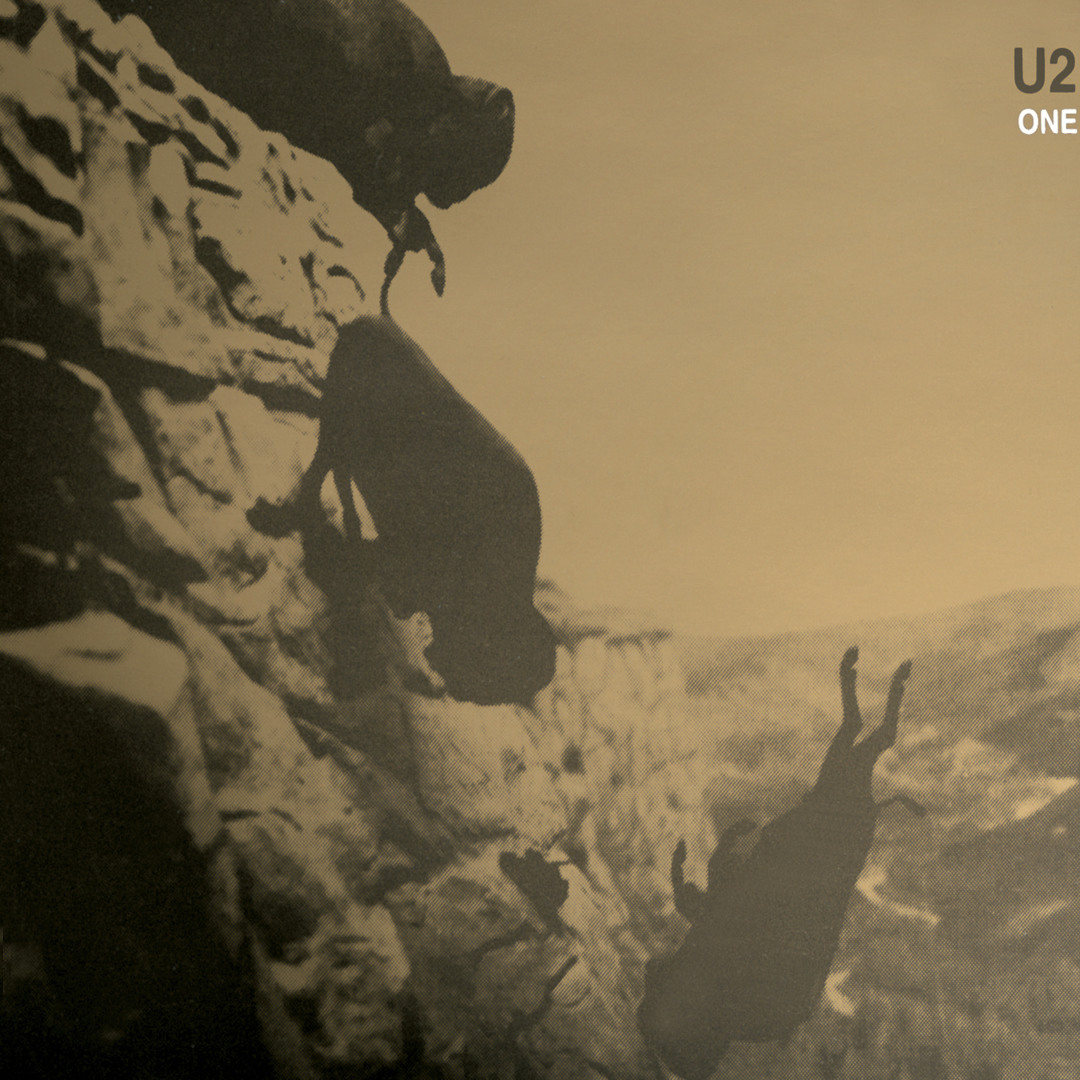
Future Arlington Road director Mark Pellington made the second "One" video. For the "One" single cover, the band used a photo of buffalos falling off a cliff from David Wojnarowicz, an artist and activist who died of AIDS in 1992. Pellington's clip was a kind of abstract art piece built on references to that photo, and it wasn't going to help sell the song, so U2 didn't really use it as anything other than promotional material. Instead, they turned to Rattle And Hum auteur Phil Joanou, who filmed his video after the "One" single was already out. That one, which became the default "One" video, is just footage of U2 playing live and Bono drinking and smoking cigarettes at a Manhattan nightclub, back when you could still smoke in nightclubs. That was one thing about smoking in clubs: You could look really cool doing it. You'd smell like an ashtray for days, and so would everyone around you, but you would look cool.

"One" stuck around, achieving a mantle as an all-purpose meaningful song, like "Imagine" or something. U2 leaned into it. Bono eventually started a charity called the ONE Campaign. The band played "One" at tons of benefit shows. In 2005, Mary J. Blige joined U2 to sing "One" at a Hurricane Katrina telethon and sang her motherfucking face off. Blige included a studio version of that song on her album The Breakthrough. As far as I'm concerned, the MJB version of "One" is definitive. It's too good to be a Bonus Beat.

In its moment, "One" wasn't quite as big a pop hit as "Mysterious Ways." Today, however, "One" has more streams than any other Achtung Baby track. The album sold eight million copies in the US alone, and it's a huge part of U2's myth. Tons of tracks from Achtung Baby got alternative radio play all through 1992. Even before "One" reached #1, "Until The End Of The World," which never got a proper push as a single, peaked at #4. (It's a 10.) The "Even Better Than The Real Thing" single came out in June, and it got a really cool Kevin Godley video. The song was only a minor pop hit in America, but it got as high as #5 on the Modern Rock chart. (It's a 9.) A full year after the album's release, another ballad, "Who's Gonna Ride Your Wild Horses," had enough juice to reach #7. (It's an 8.)

Even with their busy Zoo TV schedule, U2 capitalized on all the energy around them, using their off-time to bash out another album. Zooropa came out in July 1993, and it was the first CD that I ever bought. (I stuck with tapes for as long as I could.) Essentially, Zooropa is an Achtung Baby companion-piece album -- Amnesiac to its Kid A, Evermore to its Folklore. That's not a complaint. I really like it. U2 got even busier with the dance beats on Zooropa, to the point where they released "Numb," the Edge's post-industrial quasi-rap experiment, as its lead single. On the Modern Rock charts, that song made it to #2. (It's a 7.)

After three different Achtung Baby tracks topped the Modern Rock chart, none of the Zooropa songs went all the way, and the album stalled out at double platinum -- still not bad for one of those extend-the-era records. On alt-rock radio, Zooropa songs stayed in rotation, and the arch and disco-fried "Lemon" made it to #3. (It's a 6.) As different currents swept through alternative nation in the '90s, U2's star remained bright. We'll see them in this column again.

GRADE: 8/10

BONUS BEATS: The Ben Stiller Show only lasted for a few months in 1992 and 1993, but I thought it was great. Stiller devoted a huge chunk of one of its 13 episodes to a pretty devastating Bono impression. Along the way, he reimagined "One," OG Anton Corbijn video and all, as a jingle for off-brand Lucky Charms. Check out young Bob Odenkirk as Adam Clayton:

BONUS BONUS BEATS: MTV held its own ball for Bill Clinton's 1993 inauguration, and the show featured Adam Clayton and Larry Mullen Jr. joining R.E.M., with the six-piece band being billed as Automatic Baby. Here's R.E.M.'s version of "One":

BONUS BONUS BONUS BEATS: Here's the raspy, funereal take on "One" that the late Johnny Cash released in 2000:

(Johnny Cash's only Modern Rock hit, his version of Nine Inch Nails' "Hurt," peaked at #33 in 2003.)

BONUS BONUS BONUS BONUS BEATS: The late Chris Cornell used to keep himself amused onstage by singing the lyrics of Metallica's "One" to the tune of U2's "One." Here he is, doing it in 2013:

(As a solo artist, Chris Cornell's highest-charting Modern Rock hit is "Can't Change Me," which peaked at #7 in 1999. It's a 5. Cornell will eventually appear in this column, but only as a member of Audioslave, not as member of Soundgarden. Metallica's highest-charting Modern Rock single, 2008's "The Day That Never Comes," peaked at #5. It's a 7.)

BONUS BONUS BONUS BONUS BONUS BEATS: Despite not actually being American, U2 got the Kennedy Center Honors in 2022. Eddie Vedder covered "One" at the ceremony. Here's that:

(Solo Eddie Vedder's highest-charting Modern Rock single, 2007's "Hard Sun," peaked at #13. Vedder will eventually appear in this column as a member of Pearl Jam.)

GET THE STEREOGUM DIGEST

The week's most important music stories and least important music memes.