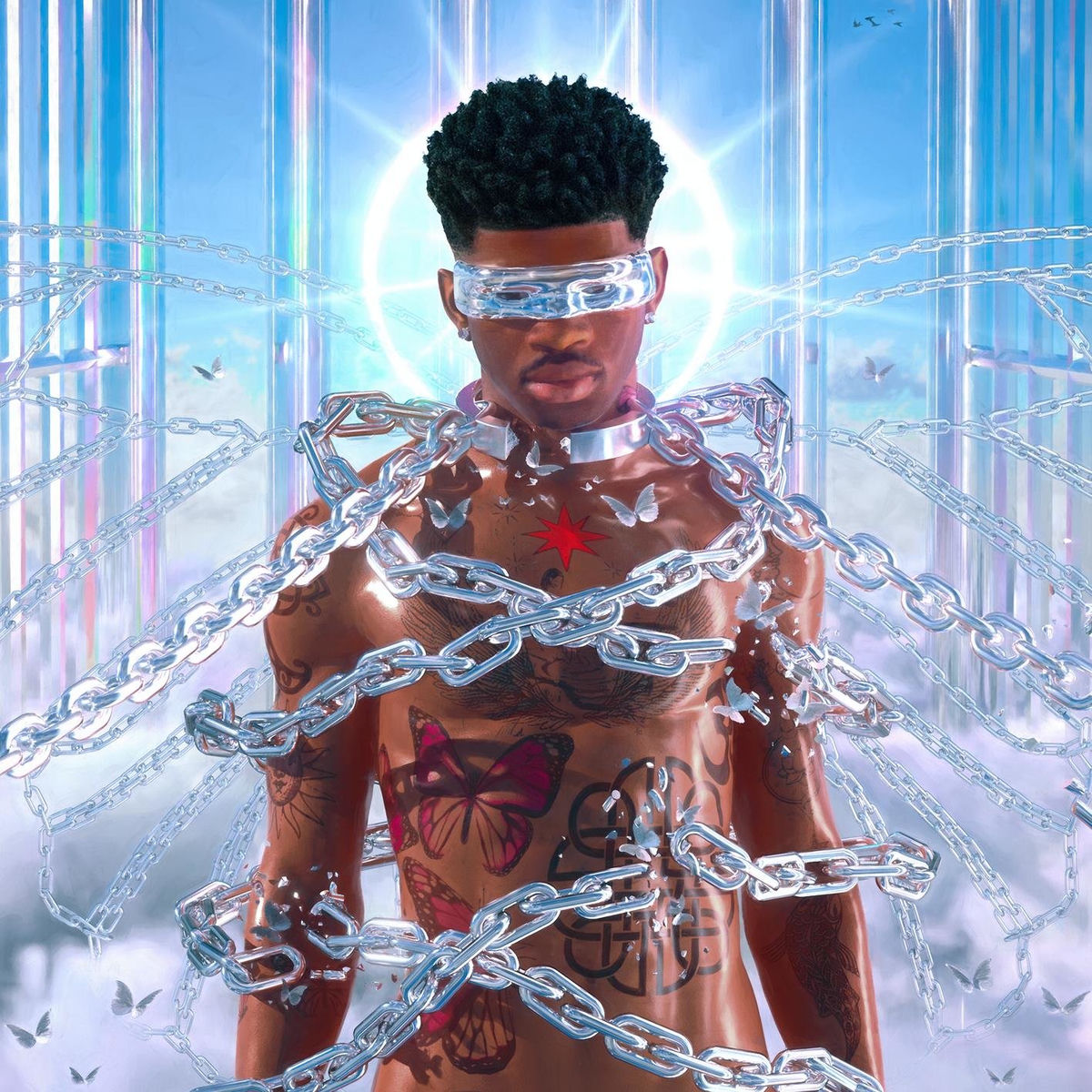


April 10, 2021
- STAYED AT #1:1 Week
In The Number Ones, I'm reviewing every single #1 single in the history of the Billboard Hot 100, starting with the chart's beginning, in 1958, and working my way up into the present. The column is now biweekly, alternating with The Alternative Number Ones on Mondays. Book Bonus Beat: The Number Ones: Twenty Chart-Topping Hits That Reveal the History of Pop Music.
It's an old story, one you've heard a million times. An unknown kid comes up with a song that captures the whole world. He's not the first to try combining two genres (in this case, country and rap), but he does it in a casual, offhand, disarming way that doesn't put off too many of the people who love either of those genres. More importantly, the song grabs children, to the point where it causes near-riots to break out on schoolbuses. The song smashes records, and the kid becomes instantly famous. He seems destined to go down in history as one of the all-time great one-hit wonders, since there is absolutely no way that he could ever equal the impact of that one hit. (The quickie EP that he cranks out to capitalize on the one hit has another hit, but it's the kind of other hit that doesn't stop people from calling him a one-hit wonder.)
During the long stretch of time when the song sits at #1, the kid emerges as a sharp, charming internet character. He also comes out as queer. He makes that revelation casually, as if he doesn't think it's a big deal, but he knows that it is. In the months after the song conquers the charts, a deadly disease descends upon the world, and everything stops. The kid uses that time to bunker up, deciding how he'll present himself as a fully-formed pop star once the song's novelty wears off. He figures out a bright, canny sound, a version of genre-fluid pop built on rap production. And he makes his grand return with a music video where he rides a stripper pole to hell and gives Satan a lap dance, then murders Satan and becomes the new Satan. You know. That old story.
Lil Nas X did not seem to struggle in the wake of "Old Town Road," the way almost anyone else would do. He seemed to struggle with very little, at least until his story shifted dramatically in the past few years. (We'll get to that shift, but it won't be in this column, and I'm not looking forward to talking about it.) Lil Nas X was great at reacting to the hysteria around him with funny sidelong Twitter bits, and he seemed to genuinely enjoy the sudden gigantic level of fame that he'd almost accidentally earned. But that shit can't be easy, even before you factor sexuality into the conversation. In a very short period of time, this young man had to learn to live his entire life in public, and he had to figure out how to make a career transition, novelty hitmaker to career artist, that's tripped up plenty of people who had a lot more time to prepare.
At least where Lil Nas X was concerned, COVID must've been perfectly timed. He got to enjoy the full attention blitz of the "Old Town Road" summer just before everything shut down, and then he was granted some relative isolation to figure out his next move. The logical thing would've just been to turn "Old Town Road" into a formula and to see if it still had any juice after its tremendous run. (The song that eventually tied the "Old Town Road" chart record, interestingly enough, is one that refined the "Old Town Road" concept and got the country-industry respect that evaded Lil Nas X. That's a story for a future column.) But Lil Nas X didn't want to do the same thing twice, and he found some collaborators who understood where he wanted to go.
As "Old Town Road" rampaged across the planet, Lil Nas X quickly went to work on 7, the 2019 EP that was clearly planned and received as an "Old Town Road" cash-in. (It still got an Album Of The Year Grammy nomination despite quite clearly not being an album, which was funny.) For that EP, Lil Nas X recorded a couple of tracks with Take A Daytrip, the New York production duo who already appeared in this column for working on Travis Scott and Kid Cudi's "The Scotts." One of those Take A Daytrip productions was "Panini," the "Old Town Road" follow-up single that peaked at #5. (It's a 6.) I think that's a slight, forgettable song, but it must've represented a way forward for Lil Nas X. Soon afterward, he asked Take A Daytrip to serve as executive producers of his debut album.
There's a very funny Genius video where Lil Nas X, wearing a breastplate and what I guess you'd have to call armored finger sleeves, spends 11 minutes explaining every lyric from "Montero (Call Me By Your Name)," even though the song itself is barely longer than two minutes. He even explains things that don't qualify as lyrics, like the humming that he does on the hook: "It's kind of used as a mating call, almost. It's a whole different way to communicate with somebody." During that verbal marathon, he says that he moved out to LA and rented an Airbnb during the early COVID days. He used the place to brainstorm album ideas, and he sent lots of messages back and forth with the Take A Daytrip guys. He didn't make too many social connections in those days, but he did have one notable encounter, and that's what he describes on "Montero."
About that title: Montero is Lil Nas X's name. He's Montero Lamar Hill; his parents named him after a Mitsubishi. Call Me By Your Name is director Luca Guadagnino's lyrical 2017 queer romance, starring Timothée Chalamet on his way to stardom and Armie Hammer on his way to vividly fucked-up allegations. In the scene that gives the movie its name, Hammer whispers, "Call me by your name, and I'll call you by mine." The two characters then spend a few seconds whispering their own names to one another. That scene didn't stick in my memory like the Psychedelic Furs dance party, but it meant something to Lil Nas X. It gave his song a romantic conceptual resonance: "It's my name. The song is my name. But it's the person's name because I'm calling them by by own name, you get it?"
Lil Nas X grew up in the church; his father was a gospel singer. He came out to his family just before he came out to the rest of the world, which means that he started living as a gay man at almost the same moment that he became a celebrity. Everything was new to him. He hadn't even seen many explicitly gay movies before Call Me By Your Name. One night during the COVID summer, an unidentified guy invited Lil Nas X to his house. (In the Genius video, Lil Nas X describes the guy as "an artist." That word can mean a lot of things, but the way he says it makes me think that this is a public-facing pop musician with at least some level of success.) Lil Nas X was scared to be around other people in that moment, and some of the things that he saw in that house scared him further. But he was into the guy, and that feeling led him to the song.
There were drugs at the house. That's what scared him. On the song, Lil Nas X croons, "Lookin' at the table, all I see is weed and white/ Baby, you livin' the life, but n***a, you ain't livin' right." This was a kid who was new to LA celebrity party culture, and that world was at least a little bit seductive, but it was also stereotypical bad shit. I think you can hear those conflicted feelings at work on "Montero." The song isn't too complex, but the sentiment might be.
In any case, conflicted feelings weren't enough to keep Lil Nas X from wanting to have some fun. The song is about flirtation, mutual seduction. Lil Nas X wants to sell what you're buying. He wants to feel on your ass in Hawaii. He wants to shoot a child in your mouth — a jarringly raunchy image, especially coming from someone who was still known as a cute kid.
In the context of the "Montero" video, though, that line barely registers because of all the similarly explicit visual shit happening. We'll get to the video, but even when we're just talking about an otherwise innocuous song, he was knowingly making a statement. He's also expressing something. There's real feeling in his voice when he belts out this line: "Never want the n***as that's in my league/ I only wanna fuck the ones I envy." You could hear that as a flex, a lament, or an actual personal insight. Maybe it's all three.
In the Genius video, Lil Nas X says, "Sometimes, you get too simp. You become the simp too hard. You down too bad. And that's how I felt at that moment." When you're a musician who's caught in a moment of life-altering infatuation that you know isn't good for you, the best thing that you can possibly do is write a song about it. That's what Lil Nas X did, maybe as early as the day after the encounter that he describes.
At home by himself, without any music behind him, Lil Nas X came up with the hook: "Call me when you want, call my when you need/ Call me in the morning, I'll be on the way." (In the Genius video, he says all the interactions with this guy were over DM but that the word "call" works better in a song. He's right.) He sent a phone recording of that hook to Take A Daytrip, who were in the midst of working with Omer Fedi, the Israeli producer who has already been in this column for working on 24KGoldn's "Mood." Fedi immediately recorded the song's fluttery, expansive guitar part, and the people involved all built the track from there.
Take A Daytrip and Omer Fedi co-produced "Montero" with New York native Roy Lenzo, who'd worked with Lil Nas X and Take A Daytrip on "Rodeo," the Cardi B collab from the 7 EP. I like that song. (It peaked at #22.) Lenzo doesn't have too many big credits outside of his work with Lil Nas X, but the four producers involved in "Montero" all spent months on alternate versions of the track, doing tiny tweaks here and there. There's a 2021 Vulture interview where Take A Daytrip go deep into all the musical ideas at work on "Montero" — the use of Phrygian mode, the tension of the minor chord progression. It's fun to read that stuff, though it basically means nothing to me. I do like that they used a heavily treated banjo, one that you might not even hear as a banjo, just as an inside joke about "Old Town Road." That's funny. That's some shit that I'd want to do if I could make music.
When you listen closely enough, you can hear all the tiny flourishes that the producers added to "Montero": The swirling handclaps, the subtle counter-melodies, buzzing and distorted synths that sometimes threaten to invade the mix. The song sounds vaguely Middle Eastern — that's the Phrygian mode — without positioning itself neatly within any specific musical tradition. All those layers of acoustic guitar are inviting and seductive, but they also sound unfamiliar, which neatly mirrors the lyrics. That kind of deceptively rich production can elevate a very short, somewhat slight song. It can keep things interesting.
"Montero" is ultimately short and slight, though. That's not a terrible thing. Plenty of good songs are short and slight, though probably no great ones. Lil Nas X's voice is pretty limited, but it's got personality, and he knows how to use it, layering things up and leaning into his lower register. He pulls off the neat trick of sounding casual while making it clear that the things he feels are not casual. I don't hear the song as much more than a cool little idea, but it works on that level. It doesn't sound like a hit to me, and I don't think it would've been one if not for the video. This is one of those situations where the video is a whole lot more impactful than the song itself. The video, more than the song, is what introduced Lil Nas X as a whole new artist.
Lil Nas X co-directed the "Montero" video with Tanu Muino, a Cuban-Ukrainian director who had just made Cardi B's similarly garish "Up" video. Muino had COVID when it came time to shoot the video, so she had to do her directing remotely, watching screens. I'm sure that was a pain in the ass, but the video is mostly computer imagery, so maybe it didn't make a difference. I'm glad we've mostly moved past the hyper-colorful Trapper Keeper surrealism of this particular music-video moment, but nobody ever did that stuff better than Muino, who builds a whole CGI dreamworld full of heavy and obvious symbolism.
In the beginning of the "Montero" video, Lil Nas X sprawls with an acoustic guitar under a white tree in an Edenic purple field. A creepy-looking snake demon with a cat face, who I think is also played by Lil Nas X, winds his way down the tree, performs some kind of magic seduction ritual, and plants a kiss and a lick on Original Lil Nas X, possibly calling himself by his own name or whatever. Then we're in a fantastical marble coliseum, where a bunch of Lil Nas Xes in Marge Simpson wigs stand in judgment of another Lil Nas X, a pink-wigged prisoner. (Wikipedia calls them Marie Antoinette wigs, which makes more sense thematically, but I know Marge Simpson hair when I see it.) The stands are full of other Lil Nas Xes, some of whom are living statues? The prisoner Lil Nas X is knocked out by a thrown object. I can't really tell what it is, but Wikipedia says it's a buttplug. This time, I believe Wikipedia.
The buttplug head impact seems to kill the prisoner Lil Nas X, whose face suddenly appears beatifically plasticy and who immediately ascends heavenward. But no, it's a fake-out, since there's the giant CGI stripper pole taking him straight to hell. A couple of years earlier, FKA twigs rode a stripper pole to heaven in her "Cellophane" video, and you can make a strong case that the "Montero" video is a ripoff rather than a tribute, but twigs was publicly into the Lil Nas X twist on what she'd already done.
The last minute of the "Montero" video is the bit that everyone remembers — the lake of fire, the elaborate lapdance for Beelzebub, the neck-snap, the theft of the horns. Even before Lil Nas X kills Satan and becomes the new king of hell, he seems pretty comfortable, intrigued, and turned on in the inferno. He definitely seems like he's having fun through all of it. This is clearly shock-value theater, and that's how the world took it. But I think there's artistic intent in there, too. This is a gay guy who grew up in the church and who was only just learning and accepting who he was, and the video literalizes the idea that the things you grew up demonizing can be the things that bring the most pleasure when you give in to them.
But then, actual artistic intent always fades into the background when we're dealing with a cultural product that goes this far over the top in its transgressiveness. Lil Nas X posted teasers for "Montero" online for months. He was in a 2021 Super Bowl commercial for something called Logitech that used a good chunk of the song, without really hinting at the aesthetic experience of the video. So when the song and the video arrived at the same time in March, it really did feel like an out-of-nowhere leap.
Old-school sacrilegious shock value has been a pop-music salesmanship tool for generations, but people weren't really hitting that button in 2021. Cardi B and Megan Thee Stallion went for maximum bawdiness on "WAP," but even that didn't invite condemnation in quite the same way that Lil Nas X did in the "Montero" video. He got it, too. Certain elements of society were just waiting to go into moral-panic mode, and the "Montero" video offered them a flashpoint. The more outwardly homophobic wings of the rap world got theatrically upset about "Montero"; I remember Boosie Badazz, in particular, posting a lot of videos about how incensed he was. The worst elements of the Christian right took off running with it, too.
I should get into the Satan Shoes. At the same time as he dropped "Montero" and its video, Lil Nas X teamed up with an art collective called MSCHF to sell 666 pairs of so-called Satan Shoes — customized Nike Air Maxes covered in pentagrams and inverted crosses, supposedly with single drops of human blood mixed in with the paint. Nike had nothing to do with this promotion, and the company immediately sued MSCHF and got a cease-and-desist. All the shoes got recalled, and I bet that was Lil Nas X's plan the whole time. It was a transparent publicity stunt, and it worked. Publicity followed.
Kristi Noem, one of the most extravagantly despicable people who has come out of this country in my lifetime, was governor of South Dakota at the time, and she tweeted, "Our kids are being told that this kind of product is, not only okay, it's 'exclusive.' But do you know what's more exclusive? Their God-given eternal soul. We are in a fight for the soul of our nation." Never let these fuckers try to take the moral high ground on you. Lil Nas X's response: "ur a whole governor and u on here tweeting about some damn shoes. do ur job!" It was funny at the time. Now, Kristi Noem's job is to send heavily armed death squads into American cities to kidnap and terrorize entire populations wantonly and then to go on TV and say that the victims are domestic terrorists when the death squads kill innocent people. I wish she would stop doing her job.
The publicity-stunt stuff worked well enough that "Montero" debuted at #1, largely on the strength of many, many YouTube views. Lil Nas X now had a second chart-topper after "Old Town Road." And even though the song had absolutely zero chance of becoming as big as "Old Town Road," it was impactful enough to reshape Lil Nas X's public persona forever. There was an SNL cold-open skit where Chris Redd, as Lil Nas X, attempted to rebalance the scales by giving God a lapdance. It wasn't funny. Shortly therafter, Lil Nax X performed "Montero" on SNL, and he had to abruptly cut his pole-dance routine short when his pants split down the middle. That was funny.
At that summer's BET Awards, Lil Nas X did an Egyptian-themed "Montero" performance, which he ended by making out with one of his backup dancers. I'd argue that this was a genuinely brave act, and it set him up for another round of hate from Boosie Badazz types. The day that he released "Montero," Lil Nas X posted a letter to his 14-year-old self: "i know we promised to die with the secret, but this will open doors for many other queer people to simply exist." I think he meant it. And while I'm generally suspicious of the idea that popular music can enact meaningful cultural change, I think he really did forcefully yank the Overton window a few degrees with the "Montero" rollout.
— ☆ ‧dreamboy··‧̩̥˟͙冬˟͙‧̩̥l (@LilNasX) March 26, 2021
On Slate, my colleague Chris Molanphy argued persuasively that "Montero" was the gayest #1 hit in Hot 100 history. I'm in no position to judge where "Montero" ranks next to, say, "Father Figure" on the queerness scale, but it's definitely more explicit about its meaning. There were many, many #1 hits from queer pop stars before "Montero," but almost none of those artists were publicly out of the closet when they were making those #1 hits. Almost none of them celebrated their own queerness that visibly. More visibly queer hits would follow, and we'll cover some of them in this column.
From where I'm sitting, "Montero" is a work of personal expression that effectively disguised itself as a work of shock-value publicity stunt — the kind of thing he could've learned by studying Nine Inch Nails, the band sampled on "Old Town Road." I guess "Montero" can be both. But I think most of the public took it as pure shock value. The thing about the shock-value tactic is that it only works for so long, and it doesn't guarantee success for anything beyond the one moment. On the SNL episode where his pants split, Lil Nas X also debuted his follow-up single "Sun Goes Down," and that one peaked at #66. In 2024, Lil Nas X tried to kick off another album cycle with the release of "J Christ," a song and video that repeated the "Montero" playbook. It didn't work. The song peaked at #69, and the album never came out.
"Montero" only got a week at #1, but the song stuck around the top 10 for a while, and it's now seven times platinum. Lil Nas X's run in the spotlight didn't end after "Montero." It kept going for reasons mostly unrelated to shock value. In September 2021, he released Montero, a sharp and canny debut album with a lot of hooks and with appearances from past Number Ones artists like Doja Cat, Megan Thee Stallion, Miley Cyrus, and Elton John. The genre combinations weren't as audacious as what Lil Nas X pulled off with "Old Town Road," but the LP showed him to be a born synthesist who could hold lots of ideas together. He wasn't done making hits. We'll see him in this column again.
GRADE: 6/10
BONUS BEATS: Here's pop prospect Dove Cameron, AKA Maleficent's daughter in Descendents 1-3, covering "Montero (Call Me By Your Name)" during a 2022 visit to the BBC Live Lounge:
(Dove Cameron's only Hot 100 hit, 2022's "Boyfriend," peaked at #16. She's in our latest pop column covering the Arctic Monkeys.)
The Number Ones: Twenty Chart-Topping Hits That Reveal The History Of Pop Music is out now via Hachette Books. You're cute enough to buy the book tonight.