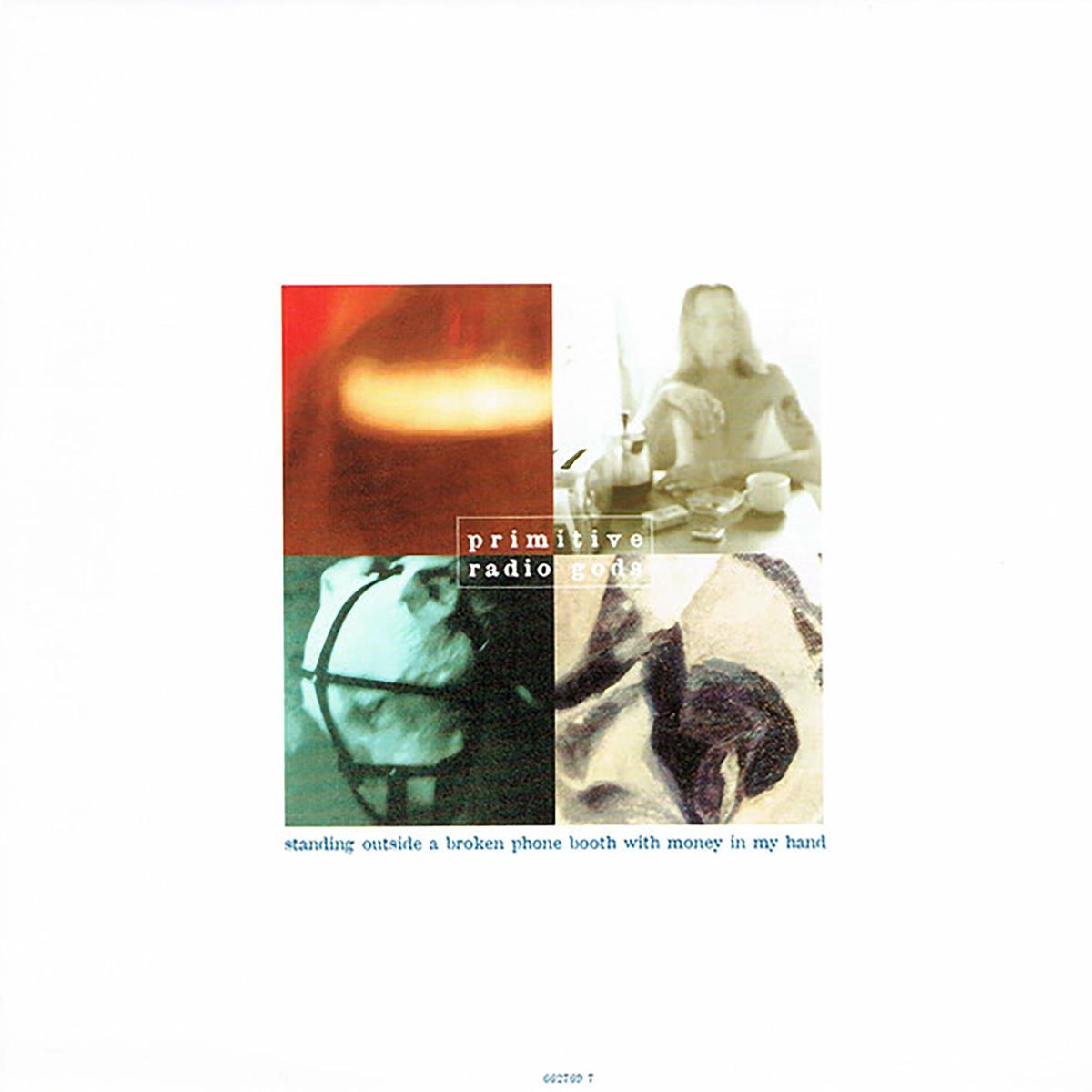
July 27, 1996
- STAYED AT #1:6 Weeks
In The Alternative Number Ones, I’m reviewing every #1 single in the history of the Billboard Modern Rock Tracks/Alternative Songs, starting with the moment that the chart launched in 1988. This column is a companion piece to The Number Ones. The column is now biweekly, alternating with The Number Ones on Mondays.
The term "one-hit wonder" is inherently derogatory. It implies failure. If you're a one-hit wonder, that means you got your foot in the door. You made it happen. You caught the elusive zeitgeist, and then you let it slip through your fingers. Presumably, record-label people invested some serious capital in you, and they probably didn't see a return. You blew it, and now you are consigned to the realm of novelty acts and where-are-they-now human-interest stories. Good job, stupid.
For plenty of one-hit wonders, that's definitely how the whole story looks. Most of them probably hate being called that. Plenty of them would probably argue that they are not one-hit wonders, that their third single made it to #13 on the Bubbling Under chart or something. Plenty of them are probably right! But sometimes, one-hit wonder status represents unlikely achievement. That's where I would file Primitive Radio Gods, the not-a-band band who had exactly one contemplative, bittersweet post-Beck smash that ruled the alt-rock airwaves for the second half of summer 1996. For a minute there, Primitive Radio Gods became actual radio gods. They were not especially well-suited for this job, and they didn't hang onto it for long.
There's really only one Primitive Radio God, though he recruited a bunch of friends to head out on tour with him when his one big hit was hitting bigly. His name is Chris O'Connor, and he had some questions that he wanted to ask the world. Such as: Is he alive or thoughts that drift away? Does summer come for everyone? Can humans do what prophets say? And if he dies before he falls asleep, can money pay for all the days he lived awake but half-asleep?
I'm sorry, but I'm going to be doing that a lot in this column. The lyrics for Primitive Radio Gods' "Standing Outside A Broken Phone Booth With Money In My Hand," much like the song title, are pure ecstatic whoa-dude arglebargle. They probably mean nothing. (In a 2015 Songfacts interview, O'Connor said that the song is about "a light that never goes out," which is neither helpful nor original.) But when I heard O'Connor sleepily, morosely chanting those lines in the summer of 1996, I was right there with him. I was feeling it.
With its BB King sample and its looped breakbeat and its tingly, muffled piano solo, "Standing Outside A Broken Phone Booth With Money In My Hand" conjured a narcotic mood, one that clicked right in with its moment. No other Primitive Radio Gods really carried that same feeling, and if they did, I wouldn't have known. O'Connor somehow sold 500,000 copies of the Primitive Radio Gods album Rocket, but I didn't know anyone who owned a copy, and I would've probably judged anyone who had the CD in their car wallet. I was 16 when that song hit, and I'd already been through enough trial and error to know that you don't buy the Primitive Radio Gods album. You simply enjoy the one hit while it's in heavy radio rotation, and then you let it drift off into memory, where it belongs.
The '90s are full of stories of would-be one-hit wonders who defied that narrative and became actual artistic forces with serious legacies. Beck, the guy who created the environment where a song like "Standing Outside A Broken Phone Booth With Money In My Hand" could become a radio hit, was one of them. But the Primitive Radio Gods were not, and you could tell that it wasn't in the cards for them. The people who did buy copies of Rocket were not especially satisfied, at least judging by how often I saw the album in used-CD bins. They were never going to have a second hit, let alone a lasting and impactful career.
But with their one hit, Primitive Radio Gods captured a fleeting feeling and preserved it in amber. Today, "Standing Outside A Broken Phone Booth With Money In My Hand" is a time machine. When I hear that song today, it's like encountering the smell that hung in the air outside the dining hall at the summer camp where I used to work. The song always had a sense of dreamy, contemplative nostalgia, and now it is an object of dreamy, contemplative nostalgia. It has achieved its destiny.
The backstory of "Standing Outside A Broken Phone Booth With Money In My Hand" is something that I never once considered before I started writing this column, but that backstory does exist. The song did not simply appear out of nowhere on radio airwaves that one summer. Instead, it was something that Chris O'Connor made after he'd almost entirely given up on music as a calling.
There's not a whole lot of information about Chris O'Connor out there, which makes sense because there's not a tremendous market for deep Primitive Radio Gods lore. He's from California, anyway. In the late '80s, he was living in Visalia, and he started a band called the I-Frames with some friends. From what I can tell, the I-Frames were essentially replacement-level college-rock. Eventually, they moved to Ventura. In a 1990 LA Times profile, writer Bill Locey notes, "Often, the band members take requests from the audience and they can do just about everything from 'Purple Haze' to 'Sesame Street' and stuff even stranger than that." I wish we still had newspaper reporters who covered local bands like they were high-school baseball games. (Do local reporters still cover high school baseball games? I hope they do.)
Chris O'Connor sang and played bass in the I-Rails. One of his bandmates was singer/guitarist Jeff Sparks. He and O'Connor had been childhood friends, and he's the one who taught O'Connor to play guitar in the first place. In that LA Times interview, Sparks lays out the band's influences: "The third Replacements album, Hüsker Dü, R.E.M., stuff like that." You will not be shocked to learn that the I-Rails never came close to what those bands were doing. Please enjoy this video of the I-Rails playing on what appears to be a local public-access show in 1990. O'Connor introduces himself as "Chico Ramrod," and the clip goes really, really hard on wipe edits.
Between 1986 and 1990, the I-Rails self-released four albums, all of which appear to be cassette-only. Being an I-Rail wasn't going to pay anyone's bills, so they all kept day jobs. O'Connor worked as an air traffic controller at LAX. Based on his profession, you'd think O'Connor would know that a plane could not take off from Baltimore and touch down on Bourbon Street. It could land at the New Orleans airport, but certainly not on Bourbon Street. Bourbon Street is way too narrow. There are buildings and people everywhere. Those people are usually shitfaced, so they might not even notice the plane heading for them. It would be a bloodbath. The end of Con Air, when a plane lands on the Las Vegas Strip, is ridiculous, but the Strip at least has multiple traffic lanes. Bourbon Street does not.
Anyway. The I-Rails broke up in the early '90s, and Chris O'Connor had some songs that he'd originally intended for the band's next album. At the time, he'd just bought a sampling keyboard, and he was teaching himself to use it. He spent a thousand bucks to record his songs by himself in a friend's garage on a 16-track Ampex recorder, and he called the project Primitive Radio Gods after a track from one of the I-Rails' albums. When he made a bunch of tapes and sent them around, he got no response. A few years after that, he was cleaning his house, and he found a box of leftover tapes, so he tried sending them out again. This time, an A&R guy at Columbia heard "Standing Outside A Broken Phone Booth With Money In My Hand," and he fell in love and signed O'Connor.
"Standing Outside A Broken Phone Booth With Money In My Hand" is a weird song, and it's weird in a good way. It's built on a slowed-down version of the drum loop from Soul II Soul's immortal 1989 classic "Back To Life," which itself was built from a couple of stitched-together breakbeats. There's another sample on the song, and that's what everyone remembers. It's blues great BB King howling that he's been downhearted, babe, ever since the day we met. That's from "How Blue Can You Get," a blues song that dates back to 1949 and that King recorded multiple times, starting in 1963. The version that O'Connor sampled is from King's 1971 album Live In Cook County Jail. (BB King doesn't have any Modern Rock chart hits, but he did appear on U2's "When Love Comes To Town," which peaked at #10 in 1988. It's a 4.)
On "Standing Outside A Broken Phone Booth," King's voice is muffled and far-off. He's a downhearted ghost in the machine, doomed to repeat the same line again and again, and there's something terribly evocative about how that sample works with the sleekly dusty breakbeat and the moody keyboards all around it. A few years after "Standing Outside A Broken Phone Booth," Moby released Play, a mega-successful record mostly built around the combination of old folk-blues samples and boutique-y, upwardly mobile dance tracks. I definitely had at least one drunken conversation with friends where we arrived at this mutual epiphany: "Yo, Moby is biting! Primitive Radio Gods got there first!" (Play is still good, though. Moby's highest-charting single is the Gwen Stefani version of the Play track "South Side," and it peaked at #3 in 2001. It's an 8.)
It's not just the sample, though. "Standing Outside A Broken Phone Booth" is this weird, alchemical combination where all of its janky little pieces add up to so much more than the sum of their parts. O'Connor laces his breakbeat with hazy synth tones and softly clanging church bells jet-engine vrooms and plaintive little piano notes. He sings all of his lyrics in a drowsy coo but still enunciates everything clearly. If trip-hop had been invented in California and not Bristol, it might sound something like "Standing Outside A Broken Phone Booth." (DJ Shadow arguably did invent trip-hop in California, or at least the term was coined to describe his music, but that's not what I'm talking about here.)
O'Connor's lyrics are all cryptic, absurdist, faux-philosophical musings. "Ma Teresa's joined the mob, unhappy with her full-time job," "The seconds ticking killed us all a million years before the fall." The most heavily quoted line is also the least explicable: "You ride the waves and don't ask where they go/ You swim like lions through the crest and bathe yourself in zebra flesh." There's no a Genius annotation for the "zebra flesh" part. Nobody wants to even try to explain that one. But my favorite image on the song might be the simplest: "Moonlight spills on comic books and superstars in magazines." Damn right it does. The "doo doo doo" parts are nice, too. This was a good time for songs with "doo doo doo" parts; this column will get to another one pretty soon.
The radio edit was probably shorter, but "Standing Outside A Broken Phone Booth" sprawls lazily over five and a half minutes. There's no real structure. Instead of a chorus, it has that BB King sample and the "doo doo doo" part, and then it eventually has O'Connor singing along with that sample. Instead of a bridge, it has a piano solo that dissolves into fuzzed-out psychedelic guitar haze. The song never jams a hook down your throat. Instead, it swirls gently, hinting at big feelings that it never names. I'd just learned to drive when "Standing Outside A Broken Phone Booth" came out, and whenever it played over the car radio, I felt like I was in my own little movie montage. A little while later, the Verve's "Bitter Sweet Symphony" had a similar effect on me. ("Bitter Sweet Symphony" peaked at #4 in 1998. It's a 10.)
Just like "Bitter Sweet Symphony," "Standing Outside A Broken Phone Booth" had a sample that presumably cut into royalties. Leonard and Jane Feather, the married songwriting team responsible for "How Blue Can You Get," got songwriting credits, even though Leonard died a couple of years before "Standing Outside A Broken Phone Booth" came out. (I can't find any stats on Jane; maybe she was still around. There's a Jane Feather who writes historical romance novels, but I'm pretty sure it's not the same one.) The song title is kind of a sample, too. Chris O'Connor took the name from a 1978 Bruce Cockburn song called "Outside A Broken Phone Booth With Money In My Hand," even though the two songs have nothing to do with each other. In that Songfacts intervew, O'Connor says, "I threw 'Standing' in front, but at the time I would have swore I lifted it word for word." No reason given.
Chris O'Connor still had his air traffic control job when he signed to Columbia, but he reportedly took three sick days to go shoot a "Standing Outside A Broken Phone Booth" video in London, near Heathrow. That's why we get all those shots of O'Connor with planes overhead and both inside and outside those red phone booths, which still existed in London at the time. We had payphones in the US, but they were usually just mounted on a wall with a bit of plexiglass. You didn't see glass booths very often. Superman would've had no place to change into his costume. Now, those payphones are all gone, too, unless you're in jail. (Do they still have payphones in jail?) I wonder if that title phrase would even mean anything to younger folks today, when the rough equivalent would be something like "Standing Next To A Broken Electrical Socket With A Phone Charger In My Hand."
The "Standing Outside A Broken Phone Booth" video ran surprisingly often on MTV, considering how generally ungrabby it is. It's shot in grainy, often unfocused Super 8 style, and it's mostly the fairly nondescript O'Connor staring off into the middle distance while the lyrics appear on the bottom of the screen. (They leave out the "bathe yourself in zebra flesh" part, though.) The single came out in March 1996, and it didn't go anywhere for a few months. The song might've gotten a slight bump when it appeared on the soundtrack of Ben Stiller's famously unsuccessful Jim Carrey vehicle The Cable Guy, though I don't remember hearing that song in the movie and I can't find the scene online. Mostly, I think "Standing Outside A Broken Phone Booth" took off because it fit right into the summer where everyone was trying to sound like Beck.
If I've got my math right, there's a good chance that Chris O'Connor recorded "Standing Outside A Broken Phone Booth" before Beck's "Loser" came out and became a crossover sensation; O'Connor's song just didn't get a proper release until years later. O'Connor definitely doesn't sound like Beck. There's a little syncopation in his delivery, but he's not trying to rap. Still, the combination of loops, samples, and non-sequitur lyrics was all that rage by the time Beck dropped Odelay. "Standing Outside A Broken Phone Booth" was the song that knocked the Butthole Surfers' "Pepper," another distinctly post-Beck song, out of the #1 spot on the Modern Rock chart. That was just what people wanted to hear that summer. We'll get to more post-Beck songs in this column soon.
When "Standing Outside A Broken Phone Booth" popped off, Chris O'Connor got all the other former I-Rails to come in and fill out his touring band. They did a whole lot of radio-station appearances and evidently burned themselves out pretty hard. O'Connor doesn't do too many interviews these days, but most of the ones that I've seen are about how he felt completely used up and disillusioned by his time in the spotlight.
Primitive Radio Gods' album Rocket sold enough to go gold, probably mostly because there was no "Standing Outside A Broken Phone Booth" retail single. (The song did reach #10 on the Hot 100 Airplay chart, so pop stations were playing it, too.) But the album really isn't any good, and the group's follow-up single went nowhere. It's called "Motherfucker," which probably didn't help its chances at radio. But even if it wasn't called "Motherfucker," I don't think it would've gotten much airplay.
After that one album, Primitive Radio Gods got caught up in record-label limbo. After getting bounced around the corporate system for a few years, they finally released their follow-up White Hot Peach independently in 2000. They went on to crank out another four albums, most of them self-released. They've got a Bandcamp page and everything. Their last album is literally called untitled final LP, and it came out in 2020. But it wasn't actually their final record because they put out an EP called James Of The Open Heart in 2024.
Primitive Radio Gods don't have a career. All the guys in the band have jobs. They don't tour. I don't think they even play live shows. Instead, they continue as a part-time hobby, which is really what they were before their one hit. They are one-hit wonders in the truest sense of the term. As far as I can tell, none of their other songs ever charted anywhere. But that one hit? That one hit takes me back. That one hit is the good shit.
GRADE: 9/10
BONUS BEATS: I wish I could find a real Primitive Radio Gods Bonus Beat. If I could find the song's scene in The Cable Guy, that would fit in here beautifully. I can't. So instead, here's BB King and an all-star band performing "How Blue You Can Get," the song sampled on "Standing Outside A Broken Phone Booth With Money In My Hand," in the 1998 film Blues Brothers 2000:
THE ALTERNA-TWOS: Garbage's acid-tongued, Clash-jacking neo-new wave shimmer-snarl "Stupid Girl" peaked at #2 behind "Standing Outside A Broken Phone Booth With Money In My Hand." What you need is what you get, and I need to give this song a 10.
(Garbage will eventually appear in this column.)
THE ALTERNA-10S: Oasis' string-soaked hands-to-the-sky full-stadium singalong "Don't Look Back In Anger" peaked at #10 behind "Standing Outside A Broken Phone Booth With Money In My Hand." All the things that you've seen will slowly fade away, but not this song. It's a 10.
After the minute's silence in St Ann's square, a quiet, spontaneous rendition of Don't Look Back in Anger broke out in the crowd #Manchester pic.twitter.com/zS97nhD7Dv
— Daniel Hewitt (@DanielHewittITV) May 25, 2017