
July 6, 1996
- STAYED AT #1:3 Weeks
In The Alternative Number Ones, I’m reviewing every #1 single in the history of the Billboard Modern Rock Tracks/Alternative Songs, starting with the moment that the chart launched in 1988. This column is a companion piece to The Number Ones. The column is now biweekly, alternating with The Number Ones on Mondays.
This wasn't supposed to happen. All the forces of God and man lined up to ensure that this would not happen. The Butthole Surfers themselves were active conspirators in their own obscurity from the very moment that they chose the name "Butthole Surfers." For the longest time, the Butthole Surfers operated as a semi-successful institution precisely by being the kind of band who could not get played on alternative rock radio. Their music was frantic and ugly and quite often intentionally unlistenable. Instead, they made their name as a fucked-up circus act that would roll through town every so often and get banned from venues by setting shit on fire. This was the path that they chose in life. It's why people loved them.
In '80s underground rock circles, the Butthole Surfers' live show was the stuff of legend. Strobe lights went off incessantly. Dry ice billowed all through the room. Two drummers flailed away at stand-up kits while evil murk-wallow riffs filled the air and a big, scary fucker heaved beer cans directly at people's heads. Over the years, things got more elaborate. A naked woman with a shaved head and a psychedelically painted body danced ecstatically, and grisly medical films were projected over the band. There were stories about one particular clip — medical footage of a guy getting penis reconstruction surgery after an accident involving farm equipment — that would cause people to pass out or throw up. A Butthole Surfers live show was an experience. You didn't go for the music.
They did make music, though. In their glory years, the Butthole Surfers were creatures of the underground, and they gave their albums dada potty-humor titles like Rembrandt Pussyhorse. Despite all the evidence to the contrary, they insisted that they wanted to make money. They laughed at the notion of punk rock community. When the Nirvana phenomenon happened and a major label shoved a contract their way, they eagerly signed. But a major-label contract couldn't turn the Butthole Surfers into a radio band. Even with the assistance of an actual rock legend, the best that they could manage was a deranged riff-rock anthem that got minimal airplay. When the post-Nirvana signing rush ended, that should've been curtains. Instead, the Butthole Surfers stumbled ass-backwards into the biggest alternative rock radio hit of 1996. Whether accidentally or not, they landed on the kind of approachably edgy weirdo novelty sound of that moment, at least for one song.
The song is good. Does that matter? I think it matters. You could have a great time telling the saga of the Butthole Surfers without acknowledging that the song was good. You could make fun of them as fluke one-hit wonders who used up all their underground goodwill, as if they weren't happily doing that in the first place. You could talk about all the utterly lame shit that they did before or after the one hit. But none of that extra context turns the one hit into anything other than a good song.
Honestly, I think the one-off success of "Pepper" is a pretty good coda for the Butthole Surfers' story. For so many years, these guys were all in love with trash culture; they were doing it in Texas. They reacted to the perceived stupidity of everything around them by transforming themselves into a deranged funhouse-mirror exaggeration of that stupidity, reinventing scuzz-rock quasi-stardom as perverse carnival-barker performance art. Then they had one hit that was just big enough to ensure that they would become part of trash culture themselves. It makes sense. It wasn't supposed to happen, but maybe it's what needed to happen.
The Butthole Surfers might have the best chapter of the absolutely essential Michael Azerrad book Our Band Could Be Your Life, even if that chapter slowly becomes a repetitive parade of unbelievable but probably half-true shit/piss/vomit stories. Our Band Could Be Your Life tells the story of the '80s underground through its bios of 13 extremely important bands. Some of those bands actively sought commercial success or at least stability, while others were happy to remain on their own cultural islands. Only one of those bands, the Replacements, has ever appeared in this column.
By 1996, the Replacements were long gone, having broken up too early to take any advantage of the commercial explosion of alternative rock. The same was true of plenty of the other bands in the book. The ones that were still around had their audiences, but they'd mostly accepted the idea that they were never going to become stars. Sonic Youth or Fugazi could play to huge crowds, but they weren't getting rich. The Butthole Surfers probably didn't get rich, either. but they did end up getting a whole mess of radio play thanks to a halfassed experiment — and, again, a good song — that sounded like Beck at a moment when alternative radio stations really wanted more music that sounded like Beck. But we'll get to that. First off, let's speed-run our way through the band's squalid backstory.
Lead Butthole Surfer Gibby Haynes grew up in Dallas, where his father was a locally famous kids' TV host known as Mr. Peppermint. Guitarist Paul Leary is from San Antonio, where his father taught accounting at Trinity University. Haynes and Leary went to Trinity at the same time, and Haynes, the captain of the school's D3 basketball team, became one of Leary's father's star students. Even then, though, both Haynes and Leary were into some freak shit.
Before they made music together, Haynes and Leary published a zine called Strange VD, which included pictures of some of the strangest, most upsetting medical photos they could find. After college, Haynes got a job at an accounting firm, but legend has it that he lost it after accidentally leaving one of his fucked-up medical photos in the work copy machine. Leary dropped out of his MBA program to move to California with Haynes, and then they came back to San Antonio and started making confrontational pisstake music, playing their first show at an art gallery and using different band names for every performance. Our Band Could Be Your Life immortalizes some of those one-off band names, including Nine Inch Worm Makes Its Own Food and the Inalienable Right To Eat Fred Astaire's Asshole. They did not have a lot of fans.
The Butthole Surfers chose the "Butthole Surfers" band name when someone accidentally used it while introducing one of their performances. (In fairness, they did have a song called "Butthole Surfers.") Haynes and Leary found a rhythm section, brothers named Quinn and Scott Matthews, and they set out for California, where they thought they might find more receptive audiences. That didn't happen at first, but Dead Kennedys frontman Jello Biafra caught a San Francisco show, loved it, and took the band under his wing. The Buttholes opened for the Dead Kennedys, and they put out a couple of extremely janky noise-rock EPs on Biafra's Alternative Tentacles label in 1983 and 1984.
Soon enough, the Matthews brothers quit the Butthole Surfers, and the band again moved back to San Antonio, a city that didn't really have much of a punk scene yet. Teenage hardcore drummer King Coffey caught an early set and became a Butthole when his band broke up, and an Austin art musician named Teresa Taylor, then known as Teresa Nervosa, joined up and became their second drummer soon thereafter. If you've seen Richard Linklater's Slacker, Taylor is the lady on the poster, the motormouth who tries to sell Madonna's pap smear. (Linklater, as it happens, was the first film projectionist for the Buttholes' live shows.) The band had a bunch of bassists, most of whom stuck around for little while and then got sick of all the chaos around them. Leary also had a pet pitbull named Mark Farner Of Grand Funk Railroad, who was always with them on tour and who was sometimes listed as a member of the band.
After a couple of Alternative Tentacles releases, the Butthole Surfers moved to Touch And Go Records, a label that was first based in Michigan and then Chicago. The label, run by Necros bassist Corey Rusk and his wife Lisa, started out releasing early hardcore records from bands like Negative Approach and the Meatmen, and it eventually became the world's greatest source for the kind of guttural, sardonic noise-rock that the Butthole Surfers made. The Rusks learned about the Buttholes through punk tape-trading networks, and they were fascinated. For long stretches over the next few years, the Buttholes, a band who had no permanent residence, would crash with the Rusks in Chicago while setting up their DIY tours.
The Butthole Surfers' full-length debut Psychic... Powerless... Another Man's Sac came out on Touch And Go at the end of 1984, and they cranked out another four LPs in fairly quick succession. The Buttholes produced themselves, and they specialized in a kind of noisy, bugged-out clatter. Haynes shrieked like a maniac and used studio effects to twist his voice into unrecognizable shapes, and his bandmates surrounded him with ecstatically ugly acid-fried riffage. Some of their songs were basically sneery parodies of classic rock nuggets from the Guess Who or Black Sabbath.
Irrevocably and permanently damaging the civil rights of dozens of ICE guys by playing the Butthole Surfers' 1988 album "Hairway To Steven" from a boombox outside the Hilton Garden Inn in suburban Minneapolis where they're all staying. JD Vance does a tweet about it that starts "Wow. Really?"
— David_j_roth (@davidjroth.bsky.social) 2026-01-26T06:32:38.164Z
If you go back and listen to old Buttholes records, you will hear some absolutely sick wild-eyed noise-punk bangers, tracks that don't have memorable hooks but that might make you want to break cinderblocks over your own head, and you'll also hear some of the most annoying bullshit that you ever heard in your life. That's just how they were. Nothing was serious. Everything was an opportunity to fuck around. The best opportunities to fuck around were the live shows, where Gibby Haynes would gobble-howl through a megaphone and light cymbals on fire.
Over the years, those live shows earned the Butthole Surfers a reputation. People might go see them live even if they didn't like the music, just because they knew they'd get to see something. Lots of the alt-rock stars of the early '90s had their minds blown at Butthole Surfers shows. Kurt Cobain loved them. So did Eddie Vedder, who must've wore the same Butthole Surfers shirt at a million shows when Pearl Jam were touring behind Ten. I remember being a little kid flipping through metal magazines, coming across pictures of Vedder, and wondering why his shirt said "Butthole." This wasn't making the Buttholes any money, but there's real appeal in being the freakiest freaks in a whole world of freaky freaks. They leaned into their own outsized characters.
Eventually, Teresa Taylor left the Butthole Surfers after suffering an aneurysm. She'd been dealing with seizures that might've been brought on by the band's strobe-light abuse. She suffered health problems the rest of her life, and in 2023 she passed away from lung disease at the age of 60. After Taylor's departure, the remaining band members moved into a group house outside of Austin. When the UK press fell in love with the Buttholes, they left Touch And Go for the London label Rough Trade. There, they released one album, 1991's piouhgd, and a bunch of side-project records before the label went bankrupt. The Buttholes even got some college-radio and late-night MTV burn for their intentionally shitty cover of Donovan's "Hurdy Gurdy Man." A few years later, it was on the Dumb And Dumber soundtrack for some reason.
The Butthole Surfers made some actual moves in 1991. That's when they joined the first Lollapalooza tour, playing right after openers Rollins Band and freaking out the other acts by firing a shotgun onstage. They also trashed Nine Inch Nails' tour bus on camera. (Nine Inch Nails will eventually appear in this column. The Rollins Band's highest-charting Modern Rock hit, 1992's "Low Self Opinion," peaked at #25.) That same year, Gibby Haynes recorded the berserk rockabilly vocals on Ministry's industrial metal head-crusher "Jesus Built My Hotrod," a song that I probably like better than any Butthole Surfers track. ("Jesus Built My Hotrod" peaked at #19 in 1992. Ministry's highest-charting Modern Rock hit is the even better "N.W.O," which reached #11 that same year.)
In the wake of Lollapalooza and "Jesus Built My Hotrod," not to mention the whole Nirvana situation, Capitol offered the Butthole Surfers a deal. They were sick of living in vans, and they jumped at it. Capitol paired them up with a new producer: John Paul Jones, from motherfucking Led Zeppelin. He's the least famous member of Led Zeppelin, but he's still from Led Zeppelin. Jones produced the Buttholes' 1993 major-label debut Independent Worm Saloon, easily the best Buttholes album in my book. I have vivid memories of encountering their single "Who Was In My Room Last Night?" and having my wig peeled back. Beavis And Butt-Head loved that one, too. They didn't even really make jokes about the video. They just endorsed it. The song became the Buttholes' first entry on the Modern Rock chart, where it peaked at #24.
Independent Worm Saloon did about as well commercially as a Butthole Surfers album called Independent Worm Saloon could reasonably be expected to do, but it didn't cross over. Jeff Pinkus, who'd been the band's steadiest-ever bassist for a few years, left shortly thereafter. Gibby Haynes had serious issues with cocaine, heroin, and alcohol. He moved out to LA and joined Johnny Depp and Flea in a side project called P. They released one instantly forgotten major-label album in 1995, but their real legacy is that River Phoenix overdosed and died outside one of their shows at the Viper Room, the club that Depp owned, in 1993.
Paul Leary started producing records for bands like the Meat Puppets and the Supersuckers. (The Meat Puppets' biggest radio alt-rock hit is "Backwater," which peaked at #11 in 1994. That's a Leary production.) Around the same time, the Buttholes also launched into an extended legal battle with Touch And Go over the rights to their old records. They eventually won the lawsuit, and the label mostly stopped releasing new music shortly afterward. In the process, the Buttholes destroyed any of the underground goodwill that they had left. If the major-label thing didn't work out, they couldn't exactly go back home again.
Electriclarryland, the Butthole Surfers' second Capitol album, came out in 1996. Paul Leary co-produced it with Steve Thompson, an industry veteran whose random-ass list of credits somehow includes both Natalie Cole and Korn. For the most part, Electriclarryland is a fun, unhinged hard rock album that's still a whole lot more hinged than the band's old records. It also has by far the ugliest, most repellent cover art of any Butthole Surfers album, which is saying something. If you spent enough time flicking through used-CD bins in the late '90s, then you saw that clip-art pencil sticking into that clip-art ear way too many times.
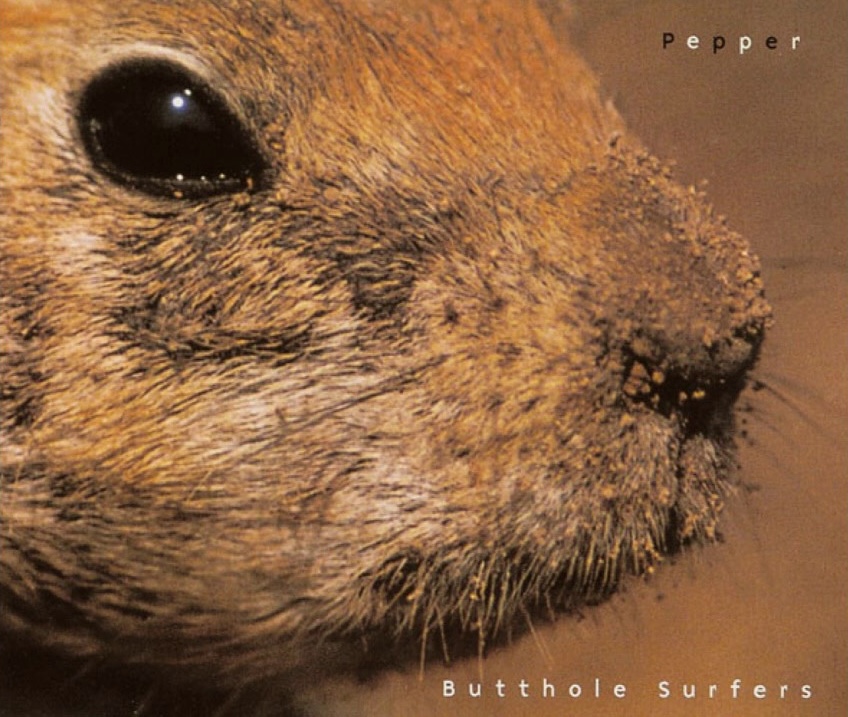
Nothing else on Electriclarryland really sounds like "Pepper," the song that became the Butthole Surfers' one random-ass hit. Nothing else in the band's discography sounds much like it, either. The song opens with a lysergic oscillating drone before a dusty looped breakbeat kicks in. Breakbeats like that were all over alt-rock radio in 1996. Two years after Beck's "Loser" conquered the airwaves, that kind of breakbeat was all the rage, usually paired with deadpan non-sequitur quasi-rap vocals and psychedelic guitar effects.
Beck himself was still making that kind of thing in 1996. He was doing it better than anyone else, and he was rewarded for his efforts. That year's best-reviewed album was Beck's big follow-up Odelay. It sold millions, and a couple of its singles were in heavy alt-rock rotation. (The biggest of them was "Where It's At," which peaked at #5. It's a 7.) But a bunch of other songs that adapted the Beck playbook did even better and became quasi-novelty hits. This column will soon cover a bunch of songs that fit that basic mold.
In interviews, the Butthole Surfers insisted that they weren't ripping off Beck. They'd been messing around with tape loops since long before "Loser," and they claimed that they were really more interested in trip-hop stuff like Massive Attack and Tricky. But Gibby Haynes had been at Beck's first SXSW show and told Beck, "Man that was the best fucking thing I’ve ever seen!" (That's per a 1999 SPIN cover story on Beck.) In any case, Haynes delivers all his "Pepper" verses in a slackjawed rhythmic mutter that he wasn't really using pre-Beck. Also, there's one chorus played backwards, just like the one on "Loser." The Buttholes are not beating the ripoff allegations that easily.
But I liked most of the Beck ripoffs that were getting airplay in 1996, and "Pepper" is no exception. In a way, the song presents the Butthole Surfers' freeform nothing-matters sensibility in a way that actually made sense on the radio, which is its own kind of minor miracle. In his verse, Haynes rattles off a series of disconnected character-sketch anecdotes about people who were all in love with dying and doing it in Texas. Apparently, most of their names belonged to people who Haynes knew in high school or on the early Texas punk scene, but we don't hear much emotional connection from Haynes. Instead, we hear about all these sad fates in quick, detached succession, like we're flipping through cable channels.
Mostly, the people of "Pepper" do not sound like people who you would like to know. Mikey had a facial scar. Bobby was a racist. Tommy played piano like a kid out on the rain, and then he lost his leg in Dallas; he was dancing with a train. Pauly caught a bullet, but it only hit his leg. Well, it should've been a better shot, caught him in the head. The one line about the "ever-present football player rapist" is extra-jarring now, but it ranks pretty low in the history of Butthole Surfers shock-value stunts. In any case, "Pepper" is not a tale of karmic justice. We don't learn anything else about this ever-present football-player rapist. It's just scary to be told that he's out there.
On the chorus, the whirling psychedelic guitars kick in, and Haynes snaps out of his quasi-rap trance. He goes into a different trance instead, breaking into a baritone chant: "I don't mind the sun sometimes, the images it shows!" Gothy synth-plunks find their way into the mix, and everything seems to swirl up around Haynes' voice. The choruses and verses don't have much to do with each other, but you never know just how you look through other people's eyes. Like Folk Implosion's "Natural One," another underground band's Beck-esque diversion that became a freak radio hit, "Pepper" unfolds according to its own logic and creates its own ominous but ecstatic vibe. You don't really know what's going on, but it's a cool place to spend five minutes. ("Natural One" peaked at #5 in 1995. It's a 10.)
The "Pepper" video, which got surprising levels of MTV play, finds ways to riff on both the Kennedy assassination and the Manson Family murders without getting too obvious about either of them. In newreel-style black-and-white footage, a mob of cowboy-hatted cops, including CHiPS star Erik Estrada, catch the Butthole Surfers at a motel room and arrest them, with Gibby Haynes obliviously lip-syncing his lyrics to the newscasters who ask him for comment. We flash between those scenes and shots of the band playing a surreal variety show a lot like the one from Nirvana's "In Bloom" video. Just like the song, the "Pepper" video offered a lot of surreal spectacle while still matching the cultural moment. This was the first and last time that the Butthole Surfers would manage that.
"Pepper" didn't do much business outside the alt-rock world, only reaching #26 on the Mainstream Rock chart. Electriclarryland went gold, and none of its other songs got any attention. Critics didn't take the single or the album seriously, and maybe that's a side effect of all those years the Buttholes didn't take themselves seriously. Later in 1996, Rolling Stone ran a long profile of the Buttholes, who were utterly depressed and burnt-out while on an endless European tour. Paul Leary's dog and mother had both died just as "Pepper" took off, and he was done: "I just hate it when somebody congratulates me for having a #1 song on the Modern Rock charts or something. Just get me the fuck out of here."
The Butthole Surfers recorded another album called After The Astronaut that was supposed to come out in 1998, and the band even sent out advances to press, but Capitol canceled the release. I wonder how that happened. Capitol signed the band when they were anarchic underground noisemakers, and the label stuck with them even after Independent Worm Saloon didn't sell. After they made a hit, the label should've logically been behind them more, not less. That's not how it worked out, though. Maybe they pissed too many people off — not in a "freaking out the squares" sense but in a "these people are upsetting to be around" sense. More often than not, those two things are the same thing.
The band split from Capitol and remained in between-labels limbo for a few years before they found a deal with the Disney-owned Hollywood Records, which feels like the last label that should release a Butthole Surfers record. In 2001, five years after "Pepper," the Butthole Surfers finally came out with another LP called Weird Revolution. It was their last. Lead single "The Shame Of Life" made it to #24 on the Modern Rock chart. That song sucks. It's a transparent attempt to make another "Pepper," except way sleazier and way more produced, and it's got a hook that motherfucking Kid Rock wrote for the band. There was a whole backstory for that.
Way back in 1992, Kid Rock was just coming off his brief moment as a post-Vanilla Ice major label white rapper and trying to remake himself as an underground rap-rock cult hero. He sampled "Sweat Loaf," the Butthole Surfers' deranged 1987 Black Sabbath bite, on a track called "Pancake Breakfast." Then Kid Rock unexpectedly became a giant star in the late-'90s rap-metal moment, and I guess the Butthole Surfers found out about that sample. Instead of suing him, they got him to write that chorus. I get mad whenever I hear about a sampling lawsuit, but they should've sued him instead. (Kid Rock's highest-charting Modern Rock hit is "Cowboy," which peaked at #5 in 1999, and I'm sorry to report that it's an 8.)
The Butthole Surfers weren't really a functional band when they released Weird Revolution. The album got terrible reviews and was otherwise ignored, and the Buttholes just kind of farted out. They've only been intermittently active since then. There was a reunion tour with Jeff Pinkus and Teresa Nervosa in 2008, a coffee table book in 2019, a live album in 2025. A documentary called The Hole Truth And Nothing Butt played at some festivals last year. I bet that's a fun watch. At one of those fests, the Buttholes played a surprise set, their first performance in eight years. They only did three songs. Last month, they got an illogical-ass namecheck and needledrop on the second-to-last Stranger Things episode. Stuff like that will probably keep happening every so often, whenever a new generation learns that it's fun to say "Butthole Surfers" out loud. I don't know if it'll have much effect on the band's legacy.
I never caught a Butthole Surfers live show. I was supposed to go to one. Had tickets and everything. They were coming to the Capitol Ballroom in DC with fellow Texan bands the Toadies and the Rev. Horton Heat, and I showed up at the venue to find that there was no one there. Someone yelled to me that the show was canceled. Pre-internet, sometimes you just had to find out that way. But how did everyone else find out? Why was I the only one there? Life has many mysteries.
I don't remember when that canceled show was, but it was probably around the time of "Pepper," and I probably wouldn't have gotten the fabled fucked-up spectacle of a Butthole Surfers show anyway. Those days were done. Once upon a time, those live shows made a huge impression on a whole lot of people. Just based on the way people talk about them, the Butthole Surfers should be underground legends today. But they also alienated and terrorized way too many of their peers, and then they made a cheesy novelty radio hit. It's hard to achieve legend status when you've got those things working against you. I hope it's at least some consolation that the cheesy novelty radio hit is a cool song.
We won't see the Butthole Surfers in the column again. But in the summer of "Pepper," Paul Leary produced an album that became a tragic and unexpected smash. In that capacity, he'll be back in here pretty soon.
GRADE: 8/10
BONUS BEATS: Last year, own own Scott Lapatine saw S.G. Goodman play a countrified "Pepper" cover at the Newport Folk Festival, and he took this video: