

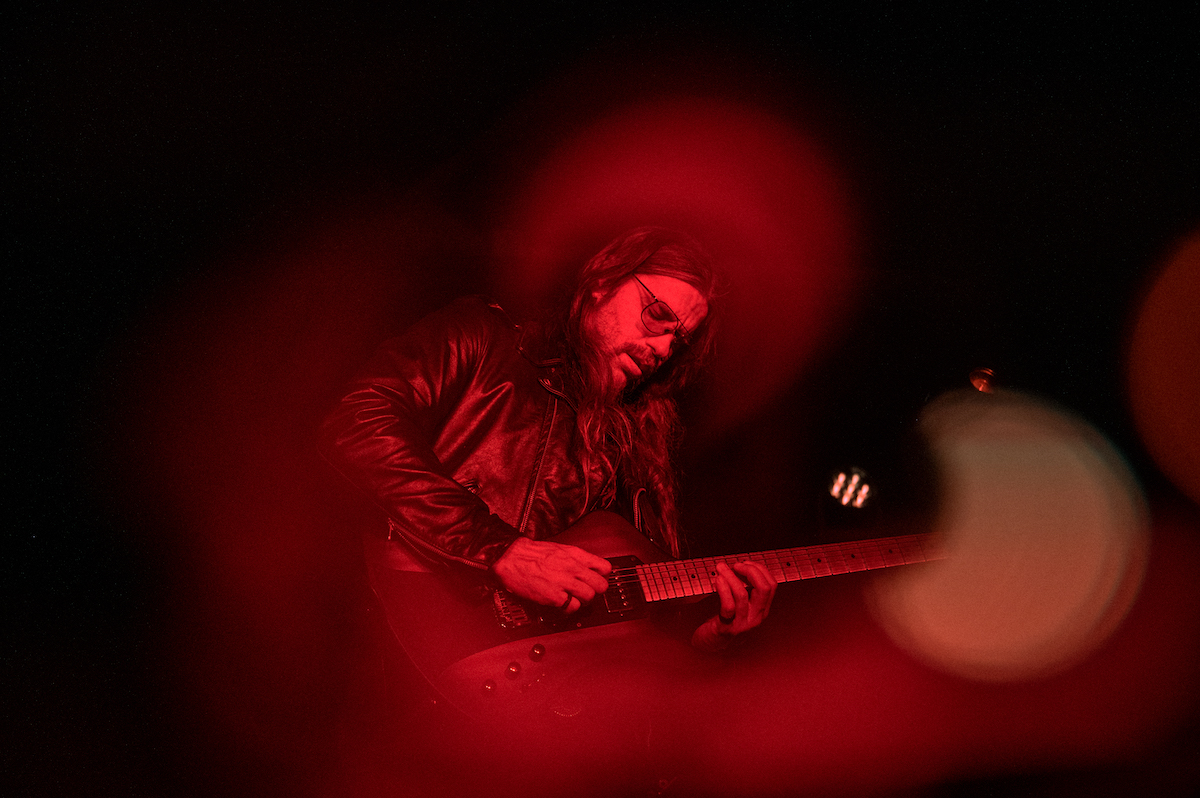
I didn’t see Dave Lombardo play at Big Ears. When I was figuring out a way to get myself to Knoxville for the city’s annual modern and experimental music festival, the former Slayer drummer’s appearances with a pair of different John Zorn projects figured heavily into my thinking. I decided that I’d go down to Tennessee to listen to heavy music, wherever I could find it, and the guy who played on Reign In Blood seemed like a pretty good place to start. The first Zorn/Lombardo combo, Awakening Ground, was set to perform at midnight of an already long Friday, so I decided I’d see Cobra the following day at noon. No luck — I pulled up about 45 minutes early, but the line was already wrapped around the building, and parking on that side of downtown was scarce and expensive. I gave up, made it to Haley Heynderickx’s 12 o’clock set with time to spare, and started writing this paragraph in my head.
Big Ears provides an object lesson in rolling with the punches. The festival’s app sends out push notifications when shows reach capacity, and with 35,000 attendees and some venues as small as 100-cap, my phone was blowing up all weekend. I made a plan to be early for everything I really wanted to see, and I mostly stuck to it. But no, I didn’t see Dave Lombardo. I also didn’t see John Zorn, Robert Plant, David Byrne, Flying Lotus, Thurston Moore, Laurie Anderson, Richard Thompson, MJ Lenderman, or most of the other large-font names on the poster. Big Ears is big enough that no two attendees will have the same experience, and in my dual quests to find the lineup’s heaviest music and to see a bunch of my favorite singer-songwriters, I had what felt like a typically atypical one.
It’s worth noting that there’s no actual metal at Big Ears, and hardly anything I’d unambiguously call punk. The festival’s diverse programming offers many potential lanes for showgoers – jazz, ambient, dance, drone, contemporary classical, folk, noise, and just about anything "avant-garde" – but heavy music isn’t one of them, at least not in the sense that metalheads usually think of it. Yet it didn’t really feel like my work was cut out for me. A lot of the sets I saw stretched that conventional definition of heaviness, in ways that excited me and put me on the back foot. Apart from the folk and country sets I saw, everything I took in had something heavy to attune my ear toward. (It’s here that we must leave Henderickx, Jimmie Dale Gilmore and Butch Hancock, Ken Pomeroy, Anna Tivel, and Annahstasia; all magnificent, none within the scope of this column.)
My first set of the festival was Deerlady, the former Stereogum Band To Watch led by bassist and vocalist Mali Obomsawin. What was once a duo with Obomsawin and guitarist Magdalena Abrego has been retooled as a full five-piece band, with drummer Joshua Mathews and guitarists Alana Amore Colvin, Nathan Chamberlain, and Andres Abanente flanking Obomsawin onstage. That Iron Maiden triple-guitar attack was a welcome development, adding depth and nuance to the loud/soft dynamics of 2024’s shoegaze-y Greatest Hits and anchoring the killer new songs the band played. All three guitarists ripped shredding solos, and along with the set I saw from ’90s 4AD mainstays His Name Is Alive, they provided the fest’s most unabashed invitation to rock the fuck out. Deerlady played at sunset with the stage lights turned off, and by the end of their set, they were awash in total darkness. It was a striking bit of no-budget stagecraft that served to emphasize the dark, roiling undercurrents of songs like “Masterpieces” and “Bounty.” Heaviness check — passed!
Obomsawin was also a part of perhaps my favorite set of the weekend, by the Raven Chacon-led ensemble Lazyhorse. To attempt to describe it in detail would only do it the disservice of underselling it, but it was adventurous, theatrical, admirably weird, raucously heavy, and deeply moving. Chacon has a Pulitzer Prize in Music and a MacArthur genius grant, but he started his music career playing in metal bands, and you could hear him tapping back into some of that instinctiveness at Big Ears. (He’s also going to be performing with Sepultura founder Iggor Cavalera at several festivals later this year.) Conceptually, Lazyhorse is a commentary on the mythology of spaghetti Westerns, and there were parts of the set that sounded like Goblin rewriting an Ennio Morricone soundtrack from memory — though the band never lingered in one sonic mode for long. Chacon sat almost offstage with his synthesizer, subtly conducting but mostly ceding the spotlight to his collaborators, including Obomsawin, vocalist Miriam Elhalji, and Chacon’s old Tenderizor bandmate Steve Hammond, whose effects rig gave new meaning to the words “pedal steel.” Thrillingly, the single the band put out last week, which is featured in the track roundup below, barely feels representative of what I saw them do onstage. I can’t wait to hear whatever else came out of those sessions.
Apart from Chacon and Hammond, one of the few Big Ears players with a Metal Archives page was Ryan Clackner, the guitarist behind black metal oddities Primeval Well, Crestfallen Dusk, Vile Haint, and more. Clackner lives in Knoxville, and he’s a mainstay of the experimental music scene in town. His set with drummer Tyshawn Sorey – another MacArthur recipient and Pulitzer Prize winner – was a masterclass in improvisation that ran the gamut from spacious, almost minimalist world-building to dense, molten shred. Interestingly, it seemed like Sorey was the one pushing the duo into the more extreme sections, peppering in fills that sounded suspiciously like blast beats and daring Clackner to joust with him. Clackner and Sorey had collaborated before, when they were both outsiders in the New York jazz scene more than 20 years ago, and their reunion proved they need to play together more often.

Just as essential was Clackner’s even more outré set with his band Nuiscientia, at the Pilot Light’s counterprogrammed What For? festival. In addition to Clackner’s beguilingly alien guitar work, that performance offered the chance to see upright bassist David Kline jam a plastic bottle between the strings of his instrument and strike his bow against it. Without the pressure of the Big Ears audience proper, the band sounded liberated to push even harder on the limits of good taste. It was the strangest set I saw all weekend, and one of the best. Stumbling out of that set and into the backyard improv party of the Joyful Noise Players, featuring Patrick Shiroishi, Kishi Bashi, and more, was one of the most gloriously disorienting stretches of the festival.
The only night-closing headline set I took in was by the avant-garde guitarist and composer Marc Ribot, who teamed with a new ensemble to perform his 1994 cult classic SHREK at the Bijou Theatre on Thursday. It’s arguably Ribot’s most metallic work, and the imperial-march qualities of pieces like “Forth World” and “Hoist The Bloody Icon High” felt screamingly extravagant in that beautiful old space. Ribot was joined by co-guitarist Mary Halvorson, who met up with him for a series of harmonies that felt like the downtown-scene equivalent of the NWOBHM’s signature twin leads. Countering the lively instrumentals of SHREK were the more drone-based sets by Setting and Walt McClements — each heavy in their own right, and without a guitar in sight.
Still, the traditional rock-band configuration drove the two heaviest sets I saw at the festival. AD 93 labelmates YHWH Nailgun and Moin are both fundamentally guitar bands, even if the way they function has as much in common with dance music as it does metal. Vocalist Zack Borzone led YHWH Nailgun through skittering, Battles-like songs with what often sounded like strangely tuneful grunts, and his stage presence reminded me of a young Elias Rønnenfelt crossed with Samuel T. Herring. The rest of the band was relentless, only briefly breaking concentration when a heckler yelled out, “Free Palestine, bitch! Say it!” (Borzone mouthed “Free Palestine” off-mic in response. YHWH Nailgun have removed their music from streaming services in Israel as a part the No Music For Genocide campaign, so it was a little annoying that someone wanted them to break their show’s dark spell to reiterate that position.) Moin’s set embodied an intensely physical form of heaviness, with beefy, propulsive grooves engineered to get a dancefloor moving. Their pitch-black instrumentals sounded something like Russian Circles and Unwound teaming up for a residency at Berghain. Both YHWH Nailgun and Moin struggled to get their crowds in motion the way they presumably do at their own shows, but their urgency and unwavering intensity won over even the most perpetually arms-crossed old heads in the room.
The Big Ears motto that’s plastered on posters, shirts, and the load screen of the app is just one word: Listen. The attendees take that motto seriously, which is why I’m calling for Big Ears to book some actual metal bands next year. The listeners who show up to this festival engage deeply with the music that’s put in front of them, and metal deserves to be heard that way, the same as any other genre. Sunn O))), Earth, and Liturgy have all made appearances in the past, so it’s not exactly a stretch to think Big Ears could book a Yellow Eyes, a Worm, a Messa, or a Tomb Mold. Adventurous festivals like Roadburn in the Netherlands and Prepare The Ground in Canada have been bringing the deep-listening model to the metal world for years now, to wide acclaim. I found plenty of excellent heavy music at Big Ears this year, but I think it’s time for the best festival in America to take its own advice. When booking agents send in metal bands for consideration, listen.
TEN NAILS THROUGH THE NECK
Dahjyn – "Are You Ok?"
Location: Queens, New York
Subgenre: industrial/drone metal/post-punk
The music Dan Ahrendt makes as Dahjyn is only intermittently metallic, but when the NYC-based experimentalist decides to lean into his metal influences, the results tend to be compelling. The first track on Peace Medal, "I Was Ten When," begins with a very similar chord progression to the iconic opening of Pallbearer's "Foreigner," close enough that it feels deliberate. The next song, "Talk Like A Prison," finds Ahrendt testing out a black metal rasp, a vocal shadow self that emerges whenever the material turns dark enough to warrant it. At various points throughout the album, distorted guitars do battle with pneumatic percussion and hissing electronics, while Ahrendt’s mellifluous vocals glide over the din. Voice is the core of Peace Medal, and Ahrendt has a great one. His cleans are a little Scott Walker circa Sunn O))) collab Soused, a little Nick Cave circa Skeleton Tree, and a little Peter Steele circa World Coming Down. The most ambitious (and satisfying) Dahjyn track to date is “Are You Ok?”, an industrial-doom slow-burner where Ahrendt asks the listener if they “need a hug” before inviting his metalized alter to roar about “killing everyone you meet” over blown-out noise and, perversely, what sounds like twinkling harp. “Are You Ok?” is a big swing, but Ahrendt is in total control. [From Peace Medal, out now via Éditions Appærent.]
Bekor Qilish – "Emptiness-Wrought Cognition" (Feat. Mick Barr)
Location: Milan, Italy
Subgenre: avant-garde prog metal
Bekor Qilish could – should – be exhausting. The solo project of Milanese mad scientist Andrea Bruzzone specializes in nutty, technically demanding progressive metal that’s as structurally dense as it is musically eccentric. But Bruzzone has the instinct to keep things moving and the ear to keep them interesting, and it’s to his credit that Bekor Qilish never sounds like a browser with too many tabs open. “Emptiness-Wrought Cognition” opens Consecrated Abysses Of Dread, the project’s third album, with a bang. The barrage of twitchy riffs, bubbling keyboard parts, and mechanized drums is a lot to take in at first, but an internal logic reveals itself in time. The song ends up somewhere between Voivod-style tech-thrash, weirdo-mode Devin Townsend, and avant-black metal à la Krallice — whose own Mick Barr jumps in for a guest guitar solo. [From Consecrated Abysses Of Dread, out now via I, Voidhanger Records.]
Cruel Force – "Savage Gods"
Location: Mannheim, Germany
Subgenre: speed metal
Done right, speed metal scratches an altogether different itch than its close cousins, traditional heavy metal and thrash. It should be fast and melodic (but not too melodic), and it should be more concerned with forward momentum than outright aggression. Exciter are the gold standard here, and for whatever reason, there aren’t too many modern bands who can credibly rip off Exciter. Cruel Force started life with a lot of black metal in their DNA, but over the years they’ve become the world’s premier Exciter worshipers. “Savage Gods” is one of a handful of songs on Haneda, the band’s fourth LP, that sounds like it came from a lost session between Heavy Metal Maniac and Violence & Force where Dan Beehler inexplicably tried on a German accent. GG Alex’s drums are the key. He keeps perfect, blitzkrieg-speed time while playing kit-spanning fills almost constantly, paying homage to Beehler’s intensely physical style while carving his own path. Alex’s performance elevates Haneda to speed-metal greatness. [From Haneda, out now via Shadow Kingdom Records.]
Exodus – "Violence Works"
Location: San Francisco, California
Subgenre: thrash metal
Exodus briefly existed as a live act in the late ’90s, but they didn’t make an album between 1992’s Force Of Habit and 2004’s Tempo Of The Damned. Just about every other major thrash band was forced to reckon with the era dominated by nü metal and post-grunge, absorbing these uncomfortable influences to very mixed results. Not Exodus. They don’t have a Load, a Risk, a Stomp 442, a Roots, or an Endorama. I’d like to think "Violence Works" is their late entry to the thrash-gone-nü canon. That squeaky, funky intro riff and the post-Pantera grooves that follow in its wake feel like new territory for the Bay Area legends, and because there’s no real chance of a mainstream breakthrough, they sound like they’re coming by it honestly. It works, against all odds, and newly rejoined hardcore barker Rob Dukes is the right frontman to sell it. [From Goliath, out now via Napalm Records.]
Rosa Faenskap – "Jeg våkner snart"
Location: Oslo, Norway
Subgenre: post-black metal/hardcore
It’s funny to hear a Norwegian black metal band that sounds like Rosa Faenskap. Ingenting Forblir is essentially the archetype of what truer-than-thou, corpsepaint-coated dorks would consider false black metal. It’s atmospheric black metal mixed with indie-friendly shoegaze and modern hardcore, played by a band with a nonbinary member that operates from a stridently leftist political POV — a welcome but still provocative riposte to the Norwegian scene’s Nazi-harboring origins. Yet here Rosa Faenskap stand, unapologetic and ass-kicking in the heart of Oslo. A lot of people will want to compare Ingenting Forblir to Deafheaven and Agriculture, which isn’t completely unfair. But I’m hearing an old-world grandeur that American bands in this milieu don’t typically capture. There are whispers of Waldgeflüster, Dödsrit, and especially the left-wing standard-bearers Terzij de Horde in what Rosa Faenskap are doing on Ingenting Forblir, and it all comes together on the album-closing colossus “Jeg våkner snart.” [From Ingenting Forblir, out now via FysiskFormat.]
Lureplasm – "Luridysic Heirloom (Red Vase Hallucinogens)"
I don’t know if the real goregrind hounds will get as much out of Lureplasm’s Luridysic Heirloom as I did. If that’s your subgenre of choice, let me know. What I know is that Garry Brents (Gonemage, Sallow Moth) cooked on this thing. By adding some textural lushness to goregrind’s typically bone-dry production, Brents has created something that, to my ears, sounds totally new. Call it atmospheric goregrind — eerie and engrossing rather than merely gross. (The grossest element is Brents’s vocal performance, which falls more or less in line with goregrind’s signature guttural barfing noises.) The guitar parts are interesting, the electronics are deployed with deep intention, and crucially, Brents' understanding of the baseline genre that he’s riffing on runs deep. [From Luridysic Heirloom, out now via Lilang Isla.]
Lazyhorse – “Are There Bars in Heaven?”
The first recorded document of Raven Chacon’s new ensemble Lazyhorse is “Are There Bars in Heaven?,” a high-volume haze of noise, feedback, distortion, clanging percussion, and ghostly vocals. It’s an enormous (and enormously nuanced) piece of music, even at its relatively diminutive scale, and each listen reveals additional musical figures emerging from its fog. Chacon isn’t simply indulging in drone cliches here. He’s providing containers for his talented collaborators to fill up with their own expressive, richly detailed, extremely loud playing. On “Are There Bars in Heaven?”, their combined power is overwhelming. [Single out now via Out of Your Head Records.] [Single out now via Out of Your Head Records.]
Neurosis – "First Red Rays"
Location: Oakland, California
Subgenre: sludge/post-metal
There isn’t much to say about the return of Neurosis that hasn’t already been said. It feels like a miracle. A decade after their last album Fires Within Fires, and four years after founding member Scott Kelly announced his retirement from music and admitted to abusing his family, a new Neurosis album suddenly appeared online. No teaser, no singles, just an hour of the band’s signature transcendental post-metal. An Undying Love For A Burning World is exceptional, a triumph on par with 21st Neurosis classics A Sun That Never Sets and Given To The Rising. You’re probably aware that Kelly’s replacement in Neurosis is Aaron Turner, vocalist/guitarist of the much-missed post-metal band Isis, and current frontman of Sumac and Old Man Gloom. An overlooked aspect of the Undying Love rollout has been the fact that this is the closest thing to an Isis album that Turner has appeared on since 2009. I’ll let the real Neurosis scholars go deep on the album, but speaking as someone who was slightly too young to experience Through Silver In Blood firsthand, there are moments on here (like the spacious middle of "First Red Rays") where I can close my eyes and imagine I’m hearing Oceanic for the first time again. [From An Undying Love for a Burning World, out now via Neurot Recordings.]
Eternal Champion – "Friend Of War"
Location: Philadelphia, Pennsylvania / Austin, Texas
Subgenre: epic heavy metal
The first place that Eternal Champion’s Friend Of War EP appeared was on the merch table at Up The Hammers, the Athens festival that has become a home away from home for the true metal giants. Eternal Champion headlined the weekend, and by all accounts, it was a triumphant return to that stage in the shadow of the Acropolis. It was also an emotional one; the band’s longtime bassist, Brad Raub, died unexpectedly not long after their 2024 appearance at Up The Hammers.
Friend Of War is the band’s first new music since Raub’s death, and it’s a poignant tribute to their fallen brother. It’s just two songs, the 13-minute title track and the 18-minute instrumental "Yslsl," and it’s clearly a stopgap release meant to clear the creative queue before the next proper Eternal Champion LP. It’s also perhaps the strangest, most experimental thing the band has ever done.
"Friend Of War" is frontman Jason Tarpey's epic-length retelling of Karl Edward Wagner’s Dark Crusade, replete with atmospheric keyboards, dirgelike doom guitar, and dramatic spoken word. It’s still an Eternal Champion song, too, and the middle section led by John Powers and Arthur Rizk’s muscular riffing and heroic solos rivals the most stirring moments on The Armor Of Ire and Ravening Iron. There’s also gang vocals – “DARK CRU-SADE! DARK CRU-SADE!” – that betray the band’s hardcore roots, plus an extended interlude centered on Connor Donegan’s martial drumming and some Basil Poledouris-inspired synth work. It makes sense that “Friend Of War” didn’t fit on the next Eternal Champion album, but treat it like a throwaway at your peril. It’s the sound of the best traditional heavy metal band of the past decade flexing the breadth of their powers. [From Friend Of War, out now via No Remorse Records.]
The Silver – "My Lone Dark Lantern"
Location: Philadelphia, Pennsylvania
Subgenre: gothic/post-black metal
Jonas Renkse, ironically one of extreme metal’s most emo vocalists, sang it like a mantra on Katatonia’s “Passing Bird” in 2001: “Too much fucking emo/ It’s false, I know.” Thankfully, the Silver didn’t hear him. The Philadelphia supergroup with members of Horrendous and Crypt Sermon plays melodic black metal, basically, but they make room for a host of other influences — shred-happy NWOBHM, gleaming prog metal, ’80s goth and deathrock, and most controversially, swoopy-haired 2000s mall emo. It’s not like Looking Glass Hymnal Blue is a full-blown Saosin album or anything, but it’s pitched in a heightened emotional register that most of The Silver’s peers would be skittish about using. That naked emotionality gives the killer performances a sense of stakes and serves to underpin the band’s adventurous, wide-ranging songwriting. “My Lone Dark Lantern” gets at some of that awesome range, with vocalists V. and N. trading heartfelt croons and spectral shrieks over a bed of guitars that are sometimes Maiden, sometimes MCR, but always melodic and, yes, deeply emotional. It’s false, I know. But this shit rules. [From Looking Glass Hymnal Blue, out now via Gilead Media.]
JOURNEY TO THE WORLD BEYOND
Dude *begins rapidly male pattern balding* there’s a new Neurosis *flannel materializes on my body* with Aaron Turner *double IPA appears in my hand* from Isis *beard spontaneously grows*
— snarling (@SNARLING_) March 20, 2026


