
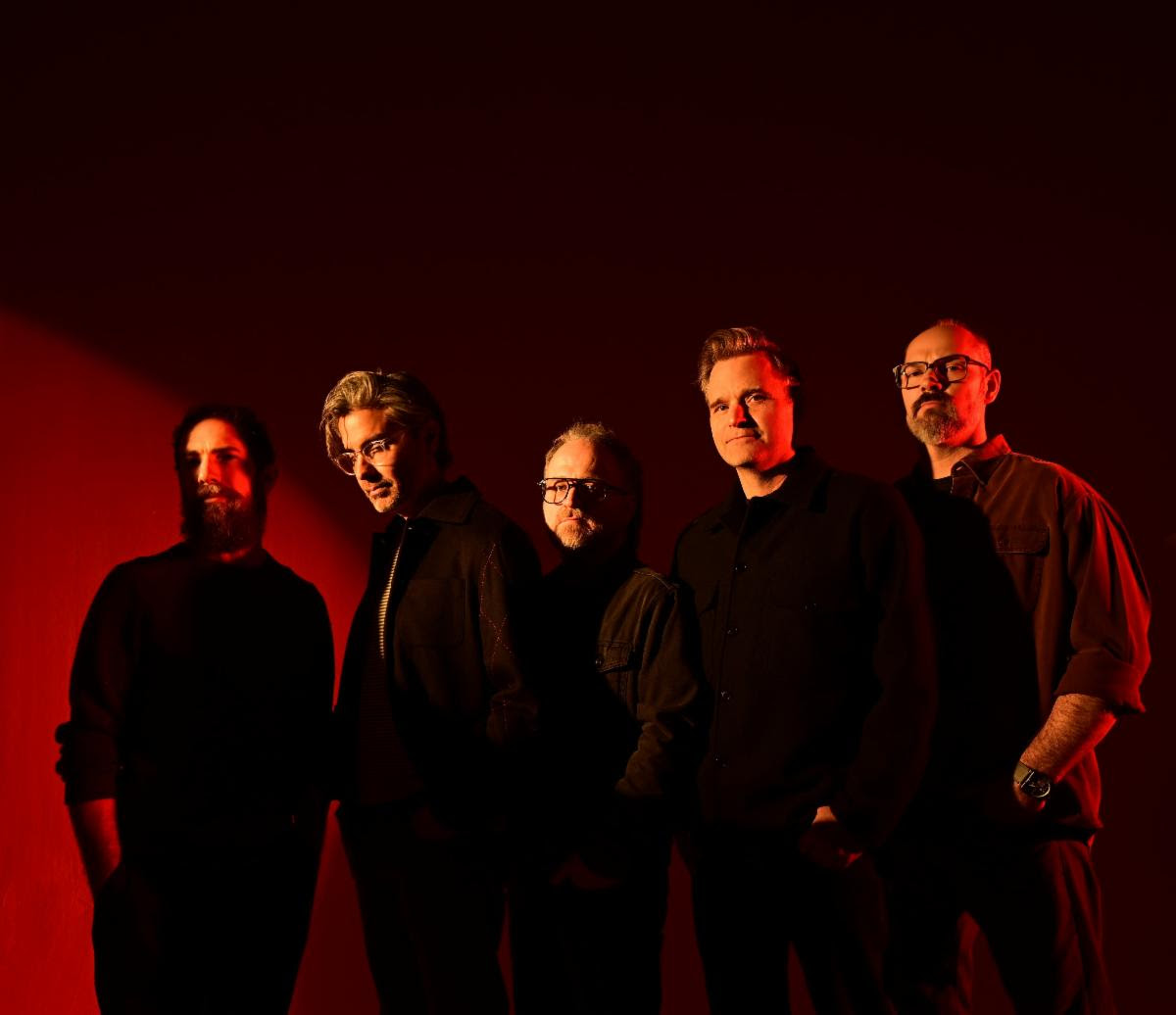
The last time Death Cab For Cutie dropped an album that wasn't on Atlantic Records, The O.C. was TV's new sensation, and a portion of the band's fanbase had not yet been born. That album was Transatlanticism, an indie classic that launched Death Cab to real-deal rock stardom. Now the band is finally returning to the world from whence it came. Friday, for the first time in 23 years, Death Cab will put out a new LP on an independent label.
Set for release on the storied Epitaph subsidiary ANTI- Records, I Built You A Tower marks a new era for one of the bands that defined a generation of indie rock, and they're starting this new phase off with a bang. The follow-up to 2022's Asphalt Meadows matches some of Benjamin Gibbard's hardest-hitting songs with returning producer John Congleton, a Steve Albini disciple who knows how to accentuate the aggression in a recording. Yet alongside aggro outbursts like "Punching The Flowers" and "How Heavenly A State," there are stylistic excursions like the acoustic opener "Full Of Stars" and the keyboard-driven "Trap Door." It's another accomplished chapter in what has been a middle-mile renaissance for the band.
The music's alternately tumultuous and tender nature matches the circumstances that yielded it. In the years after Asphalt Meadows, Death Cab and Gibbard's other band the Postal Service headed out on an arena tour celebrating the 20th anniversary of Transatlanticism and Give Up. The gigs were demanding on Gibbard, the frontman of both groups, and not just physically. Throughout the tour, he was going through an immensely painful divorce. I Built You A Tower is named for his efforts to compartmentalize his grief during some of the biggest shows of his life.
A few months back, I hopped on a video call with the three longest-tenured members of Death Cab For Cutie — Gibbard, bassist Nick Harmer, and drummer Jason McGerr — to discuss the differences between working with indie and major labels, the making of the new album, navigating their career by thinking like Death Cab superfans, becoming the old guys at music festivals, and why they'll never throw their own cruise. Read our conversation below.
You've got a new record label. How does it feel to be back on an independent record label and kind of getting a fresh start at this point in your career?
BENJAMIN GIBBARD: I mean, we're psyched. ANTI-, we all were fans of their label before we started talking with them, and I think that they have done a really great job of building a roster that spans some legends like Tom Waits down to some younger bands like Slow Pulp and the Beths, bands that we've toured with and are friends with. And Fleet Foxes, another band that we're friends with, here from Seattle. It just feels really good to be on a label that has such a wide breadth of artists that kind of span different ages and styles, and feels it feels like the right home for us.
JASON MCGERR: I'll just add that it feels like we've been on a big hike and we just rolled into a village with all our friends. Seeing things on the same level. Nothing against Atlantic. Atlantic was amazing for us. But this just feels like right time, right place.
GIBBARD: In the first meeting we had with ANTI- at their offices, I was pretty starstruck just hanging out with Brett [Gurewitz], because I I grew up a Bad Religion fan, as I think a lot of people did. So it was kind of crazy to be like, “Wow, I'm in a room with a dude from Bad Religion, and we're talking about signing our band.” It really hit me in that moment. Nothing against Atlantic. We had 20 really successful years there. We've built relationships that we will maintain for the rest of our lives with people who are at that label. But there is a stark difference between a record label run by people in the music industry and people who are in bands. It's just a very different feel.
I assume there was a shopping around process. Were there certain things you were looking for? It sounds like being run by bands might be one of them.
NICK HARMER: There wasn't much of a shopping around process. It was interesting. We definitely went into that phase of “What are we going to do next?” with an open mind, but we were really hoping that someone who was enthusiastic about working with us would find us more than we would have to go out and knock on doors. And thankfully, ANTI- really came forward early on.
There was a lot more handwringing and us shopping and figuring out what it is we want and don't want when we were making the transition from Barsuk to the major. Coming out of the last 20 years on Atlantic, we knew what was important to us, and really there was no question about who was the frontrunner early on. So it wasn't a long protracted shopping around kind of experience, which was nice. It just felt really great right away. Our earliest meetings with them just felt like something really clicked, just philosophically, and that was really important to us.
GIBBARD: Yeah, and we had no desire, or didn't feel it was realistic to talk to other major labels. This really isn't like rose-colored glasses looking back on it, but we had in virtually every way the exact opposite experience on a major label that most bands talk about. We came in, we signed to Atlantic in 2004. We were allowed to make our records the way that we'd always made them. Our successes and failures were obviously shared by the label, but any creative successes or failures were really on us.
It wasn't as if somebody from the label was telling us to change anything or do music a certain way or have these features or whatever bullshit. It was really just that we got to make our records, and they did a great job of promoting them. We accomplished what we set out to accomplish in signing to a major label, which was we wanted our music to reach more people in a manner that was authentic to who we were as a band, and we did that. So the idea that we would sign to another major label, certainly in 2025, was just an insane idea. We knew there was no way we were going to have an experience that was going to be anything but a pathetic facsimile of what we'd experienced with Atlantic.
HARMER: The landscape’s changed so much. You gotta go with your gut these days about what you should be doing. And that's the benefit of being a band as long as we have — a lot of these decisions, whether it's in a studio deciding what to record, what to play, how to tour, venues to choose, bands to take out, labels to work with, publicists, everything, it just becomes a lot more clear the longer we've done this. And so it was a pretty easy gut decision, something that everybody in the band was on board with. There was no pushback. Like, “I don't know, what about these guys?” “I really like this label.” Like, “Yeah, this makes sense.”
It feels like a lot of your peers are at a similar point in their trajectory, like Modest Mouse just ended their run with Epic. You mentioned being at a different point in your career 20 years ago versus now, but is the landscape different too? As in, there's less reason to go on a major now than there would have been in 2004?
HARMER: I think so. The very nature of promoting music and certainly breaking new music has shifted a lot. I don't think that major labels any longer are focused necessarily on building long legacy artists and careers. They're very focused on bringing new things to the forefront right away and exploding them huge worldwide. After they get that initial hit, then they're kind of on to the next thing. Some of that is just the pace at which the internet moves and pop culture moves right now. There's just so much churn that you have to just stay on top of the quicksand. But I'm not saying that's necessarily a right or wrong judgment in that. I just think that if you're a band like Modest Mouse or us or a band that is focused on doing this for a very long time, and this is your career and this is your life's work, at a certain point, that's just a whole different brain model for support and development. The landscape has shifted. There's just no doubt about that.
GIBBARD: And to build off what Nick's saying, when we signed to Atlantic in 2004, two of the main promotional vehicles were radio and to a certain extent MTV a little bit still then. One of the many reasons we signed to Atlantic, or wanted to sign to a major label, was to get our music on the radio. Because our music wasn't on the radio. It was on college radio, but it wasn't on commercial alternative or AAA or anything like that. A massive advantage that that major labels had at the time over indies was in-house radio departments that were able to promote us and other bands on that format.
Today, alternative radio still exists. I want to be very clear about that because we'd like to be played on it. But it's not as much of the cultural driver as it used to be. And as Nick said, people are finding out about music on TikTok. Most of them are not finding out about music on terrestrial radio in the same numbers they did 20-plus years ago.
It sounds like you had all the creative freedom that you wanted in the previous arrangement, but did the fact that you were going into this new frontier impact the way you approached the new album at all?
GIBBARD: Not necessarily. I would say that when we were on Atlantic, if I'm being honest with myself, as I was writing some songs for some of those records, I wasn't ever trying to write a quote-unquote hit. There was never this conscious effort to write a hit. But whenever we got towards the end of the writing process of the record, we were ready to go in the studio, that became a conversation that was happening, internally and with our management. And there was an intentionality around, like, “Well, what song is the radio song? What song is the single?” And there seemed to be — not necessarily a pressure that I was intentionally putting on myself, consciously putting on myself — but I think there was a subconscious pressure around, “Well, we need to have at least one or two songs that we can get on the radio.” Maybe now that I'm being honest to myself, there might have been a small sliver of that entering into my subconscious mind as a songwriter.
And going into this album with ANTI-, obviously we would like to have songs that get played on the radio, but I did feel a particular kind of unspoken pressure, a specific weight, had been lifted off my shoulders. ANTI- is far more concerned with the album than making sure we have songs on this that can get played on the radio. That has not been something they have said to us explicitly, but that was something that we took away from our meetings with them early — that the people that were in that room, Andy [Kaulkin] and Brett and Alison [Crutchfield], these were album people, and we are an album band. Having that weight lifted off my shoulders, even just a little bit, was a welcome relief.
HARMER: I think you're onto something. I definitely also felt like this sense of release when we were done with Atlantic. There was less talk about what was going to happen after the record was done in this hopes and dreams and plans kind of way. For us, whether it was conscious or not like Ben was saying, there was suddenly a lot more conversation and a lot more reflection of us just saying we can turn internal again, and in some ways, we can stop thinking about what's gonna happen with the record, how it's going to be received, and really just concentrate on playing music with each other and enjoying the process of making a record with with John Congleton. I don't want to say a return to form because I don't ever really feel like we got out of step with that. We've always been able to do that. But I felt a lot less outside ears and opinions suddenly, and there was some relief in that, for sure. It felt very small again, in a good way. I liked that.
MCGERR: This is the first time since I've been in the band, since Transatlanticism, that we've made a record, the idea of a label or people from the label having an opinion, or anyone outside of this band — there was no outside influence. It was us in the studio with Congleton. That was the goal. That was going to work. That's who you saw. That's who you talked to every day. We weren't sending music to even management. I mean, maybe towards the end. But we started this process basically at the tail end of our term with Atlantic, and we were just out in open pasture again, just looking at each other.
This combination of the band is now 12 years old. I was just doing the math the other day. I was like, “How many shows have we played?” I just wanted to think about it in that sense. Like, we're going to the studio having done a certain amount of work, a certain amount of muscle, having a certain amount of skill. We know each other. We trust each other. How long have we been doing this? I mean, you can do the math with the years, but I wasn't sure what the number was, even though someone in our camp does. But I had to look up, and it was 1,800 shows. And when you look at legacy bands, how long they've been playing, most of them are lucky to reach 1,000.
And what we're going into the studio with when we make up our minds about what needs to happen, and also having this mutual respect for each other, and trust to be able to just step up and do what we all do well and stay in our lane? That was the over-encompassing feel of making this record for me. It wasn't about a label. It wasn't about writing a single, like Ben said. There wasn't anything. And I could tell it in Ben. I could see it in Nick. I could see it in everybody, that no one was thinking about that. It was like, how can we make this the best record possible?
You guys mentioned Congleton, who produced the album. How did you decide to work with him this time?
HARMER: We didn't really have much of a conversation about working with anyone else at all. We had a great experience working with him on Asphalt Meadows, and we knew early on with the material that Ben was writing that Congleton was going to be another great fit for that. Also, in the interim between Asphalt Meadows and this record, he had completed and opened up his own studio in LA. We were excited about working with him in a space that was his own, of his own mind and his own creation. We knew that would be an extra boost.
When we came in and there was a level of getting to know you during Asphalt Meadows, feeling each other out, being — I wouldn't say polite, necessarily, but there was this level of, we're just building some trust here. This time, we really knew what John brought to the table and what we were bringing to the table, and there was a whole lot more trust in his process as a producer. And we knew that going in that we were going to basically let him take the lead a little bit more in the full production and vision of stuff.
And that was exciting to us. It meant that we could get down to work with him quicker and faster and get to the meat of what we were doing without this “get to know you” process. And that felt great.
He did work on the last record, but I think I sense his signature a little bit more on this record. Obviously, he's done a bunch of different kinds of records, and maybe I'm just thinking about what he brings to his own music. But I imagine him bringing out kind of a harder edge, and I feel like I hear that on this record. I mean, Nick and Jason, you guys are going nuts on some of these songs. Was that an aesthetic choice that you guys were pursuing intentionally?
HARMER: Certainly from the rhythm section side of things, a lot of the ideas… We knew that there was going to be a little bit more of an edge to this material before we started working with John, and we knew John could really take it into the end zone. That's why he's a good fit for the material, certainly. But Ben, I think you can talk about that a little bit more, in how intentional you were early on. I could hear in the earliest demos that there was a little bit more rawness to it, in a way. And we had conversations about trying to preserve that all along the way.
GIBBARD: If you hear the demos for the record, and I don't say this as a slight to John, you're not like, “Holy shit, how did John get it to that point?” I mean, John brought his sauce, and he made a number of production choices that elevated the energy of the demos, and in that sense really improved them. But it wasn't like we went in the studio with John and he's like, “You guys gotta amp it up, man! Let's go!” He was just like, “Cool, these demos really fucking rock. Let’s really refine it.”
Between both my demos and some of the stuff that we worked on as a band, I would argue that the final album is more similar to the demos than maybe any record we've ever made. And you guys can refute this if you think I'm wrong, Nick and Jason. But we brought in songs that were more fully formed, probably, than any songs that we had brought in, maybe since Narrow Stairs. So there wasn't this, like, “Well, how are the drums gonna go?” or, like, “Is the bass gonna be distorted here?” or, like, “Is this the part where the guitar does this thing?”
We made this record in 3.5 weeks, because everybody knew what they were doing. Everybody had a roadmap, and John just knew how to bring the extra sauce to it and make things really hit when they needed to hit and make them beautiful when they needed to be beautiful. And he did a really wonderful job with that. So it wasn't so much that we went to him and said, “Please make us rock.” He had heard all the demos, like, “Yeah, this shit fucking rocks, let's just do it right,” you know?
Sometimes when bands try to knock out an album quickly, it’s by necessity. “We only have so much time to work with,” or whatever. And sometimes, they're intentionally choosing to do it quickly. It sounded like this is all the time that you needed because everybody had their stuff down. But was there a conscious choice that “We're gonna move quickly here and not belabor this?”
GIBBARD: I wanted to bring in songs that were as complete as I possibly could, at least in the core of the song. And we all had conversations, together and in little cliques in the band, of, “I don't wanna get in a situation where we are in the studio trying to find the perfect tone for the double of that part in the chorus,” you know? Or it's like, “OK, here's the lead line, and now we're doing it on three different synths as well to flesh it out.” I was listening to a lot of music that I grew up loving and realizing that a lot of this stuff — I mean, Fugazi is a perfect example — it's not adorned music, but everything in it has a lane, tonally and musically. Everything that's in those songs needs to be there, and there's not really room for anything else without making the whole house fall in on itself.
It turns out when you're not putting like 80 tracks in every song, you can work pretty fucking quickly. Like when you do the drums three times and Jason kills it and it sounds awesome, like, “OK, moving on to the next one.” Or Nick kills the bass line, or Zac [Rae] plays some awesome thing on the keyboard. Like, great, we don't have to overthink this.
HARMER: John's strengths as a producer melded well with that philosophy that we brought in, because he works that way. As a producer, he doesn't lean on you for speed, like, “Hurry up, we gotta wrap this up.” But he's really reassuring that, “Hey, we got it. Look, it sounds good. Don't overthink it. Let's move on.” And that's extra helpful to have that kind of a steward in the process saying, “Hey guys, it's there.” That just makes it so you're not doubting a lot, getting full of self-doubt.
GIBBARD: One thing John would say, the lines you would hear every day, is, “I mean, you can do it again if you want, but I got it.” Like, “You don't need to do this again.” That that's really a reflection of John's tutelage under Albini.
Yeah, I was going to ask about that. It's kind of like the Albini version of a Death Cab album.
GIBBARD: Yeah, I mean, a little more compression than an Albini record. John was a student of Steve's, and he brings a lot of Steve's MO into it, which was great. Certainly after making the two records we made before John, those records took forever to make, for a myriad of reasons. Some of them with the songs and what we were bringing in, and the levels of completion, and work that needed to be done in the studio. But it was also the process. It was breathtakingly slow. So it was really refreshing to get in and out of there in three weeks, 3.5 weeks. To the point where — we'd have conversations with the band where somebody might be like, “Wait, should we really have spent another week on this?” And I was like, “I don't think so.” We didn't need to spend another week on it ’cause I'm very happy with everything. It seems like everybody else is, as well.
Ben, the promo materials for the album reference you dealing with grief and personal collapse animating these songs. What happened there?
GIBBARD: I went through a divorce, and I'll just leave it at that. Anybody who's gone through a divorce or a separation understands how painful it can be, and for me, I felt like I kept coming back around to this theme of — I wanted to write about it entirely from my perspective. I wanted to write about what I was feeling and what my quiet evenings and mornings or whatever were about. Rather than writing a record that was to exist more in the court of public opinion of, “He said, she said,” whatever it might be. I don't see this record as a breakup album. I see it as a record that is about coming to terms with oneself in the wake of a breakup, which is very different. You know, a breakup record is like, “You said this, and I said that, and I was mad, and then I got sad, and then we broke up.” The great breakup albums have a lot of vitriol in them, and they have a lot of anger. They exist as one side's emotional accounting of a painful period in their lives, from their perspective. And I think oftentimes they are like, “This is how you wronged me, this is how I was done dirty.” And I'm too old to be doing that.
For me, the record really exists in the space of… It was an incredibly painful and difficult time, and a lot of it was occurring while we were on tour, doing Transatlanticism and Plans. So I have this juxtaposition in my life where we are playing arenas, celebrating these albums, and I am onstage performing, and then immediately have to get offstage and deal with some kind of heinous shit. Or going from dealing with some heinous shit right onto stage, and then coming back off and having to deal with it again. So to me, that's the record. The record is about my journey, I guess I should say, through what I was dealing with at that point, and not about another person. The record is really about me; it's not about the relationship.
The lyrics definitely have an “in your head” quality, and maybe the tower imagery that you've created speaks to that. It definitely feels very interior. Like you're saying, it doesn't feel like a conversation. It feels like a conversation with yourself.
GIBBARD: When we deal with loss or grief or pain, or any kind of divorce, separation, etc., etc., we still have to exist in the world. We still have to get up in the morning and do our jobs. We still have to deal with our responsibilities, in all forms and fashions. And that requires compartmentalizing what you're going through that's incredibly difficult, so you can get through the day and handle your responsibilities. And that can be incredibly difficult at times. And sometimes, just when you think you've got it under wraps enough that you can handle your day, something flies out of nowhere and brings you right back into that pain, or that grief, or that trauma for that matter, and you have to reset. You have to try to figure out, “OK, how do I get back on track?”
So I started to keep coming back around to this idea as I was writing this record, and when I wrote “I Built You A Tower,” the first one. I really settled into that. That was really a reflection of, and inspired by, having to go out and do these shows and be like, “Hey guys, great to be here,” you know? And to be there for both our bands, not to mention the people coming to the shows. I had to put that shit aside. I had to do my fucking job. And I did my job, but it doesn't change the fact that there were some kind of tracers from that, and it was rather difficult at times.
“Riptides” was the lead single. You guys were just talking about not having to think about “What's the single? What's the song for radio?” But what made that song the choice for introducing this body of work?
HARMER: It was a label choice. The thing that was liberating about this time is we turned the album in, and we were like, “You pick!” It sounds maybe a little bit flippant to say, but I think every song on the record is a radio single and should be played in some fashion or another. But obviously, they're good at what they do. They have people in-house. They can listen to albums and think about things that we don't have to think about. They've identified some songs early on that they think really work for that. That's the great thing about a partnership with a good label full of good people. There's this trust early on, that they're gonna represent you right or they're gonna pick the songs that — obviously we're proud of everything — but they're gonna introduce people to this album in a way that maybe we're not aware of how to do that.
GIBBARD: I'm also really proud of the fact that “Riptides” is the first single for a myriad of reasons, and the fact that ANTI- was so high on it. Because it's basically a noise song for the first two and a half minutes. There's no changes in it. Not to sell them short, but I really can't imagine the radio apartment at Atlantic being like, “Let's have this song that has no chords for the first two and a half minutes be the lead single from the record we just invested in.” But actually, as I'm saying that, I do have to give Atlantic credit because they thought that “I Will Possess Your Heart” should be a single, and that thing's eight and a half minutes long, right? So you know what, I'm gonna retract what I just said. But I do think [“Riptides”] does a good job of representing the tension in the record and the tone of the album. We're psyched.
This is probably true to varying degrees throughout the album — there are some songs that seem more explicitly relationship-y than others, or more interpersonal than others. But “I’m too tired to start/ I can't bring you up to speed/ There's too many riptides in this ocean to proceed.” Or the part before that, “I’m too tired to talk/ Too tired to end the war/ And I can't seem to hold it together anymore.” It feels broadly applicable. It feels like a sensation that a lot of people could probably relate to, just sbeing exhausted by modern life, even if their experience doesn't align with what you're actually writing about here.
GIBBARD: It doesn't give me a lot of joy to say that I think you're right about that. We're all experiencing this incredibly unstable world at the same time. So if something that I've written and that we've put together can speak to that moment and make people feel like they're not alone in that feeling, then I feel like we've done a successful job.
But the song is about when you're dealing with your own shit and the world is on fire. It's an emotionally destabilizing juxtaposition. Because you are in your own head, you're in your own heart dealing with all this stuff, but at the same time you're comparing what’s happening to you to what's happening throughout the world. And it just has a crippling effect on one's ability to allow themselves the space to feel what they need to feel. Because people are dying. People are starving. Horrible things are happening. And I can speak for all of us; we certainly did not want this song to be as topical as it has been over the last month.
You’ve got a lot of lyrics about feeling drained, depleted, at your wit’s end, whereas the music is so energized. Were you conscious of that tension? Was that something that you were leaning into?
GIBBARD: I've always liked the juxtaposition of upbeat music with sad lyrics or vice versa. I was joking to somebody that a lot of these songs seem to be raging against the dying of the light. I mean, we are older men now. By the end of the year, more of the band will be over 50 than below it. And I have felt personally, and I think we all have felt this way in some form or fashion, that we don't wanna go out with a whisper. We don't want to start making quiet, mature music that reflects the years of our birth, you know? From the jump, I wanted to make a rock record. I wanted to make songs that were gonna sound good, that we're gonna have fun playing live. Songs that people weren't gonna be checking their phone during, hopefully, while they wait for the upbeat songs from 20 years ago or whatever. I didn't wanna do that. I don't wanna do that.
We've all become erstwhile students of long career arcs in music, and it feels like one of the moments where things start to go off the rails is when, bands or performers, all of a sudden, things start getting slower. The drummer can't play the way he used to be able to play. The band doesn't like playing loud anymore. Now they wanna tell you a story. They wanna really tell you about life and their lived experience. And the strings come out, and the acoustic guitars get going, and that's just boring. It's just boring. And I don't wanna be in a boring band if I can help it.
HARMER: To me, it's also just an extension — for years, people have always talked about the experience of seeing our band live versus what our records might suggest the show would be like. We hear it all the time. People are like, “I just didn't think you guys were that energetic onstage. I'm so surprised at how raw and how there's a ferocity to what you guys do.” I've always really liked that there's been two different experiences of Death Cab, that you can come and see a real sweaty show, and we're very animated — not intentionally; it just kind of flows out of us, this physicality that the albums over time might not suggest. I love that.
But because of the way we went in with the material, the philosophy of recording this album and keeping everyone in a lane and really going for that rawness in the studio —really extends itself. That's a philosophy that Ben early on had. He's like, “I want this record to sound like it is when we play live,” and really try and bring some of that energy that we have back to it and keep that going. Even as our ages get higher in number, I don't see the physicality of our live show slowing down at all. It makes sense that we would also make a record right now that not only rages against that, like Ben's talking about, but also just continues to be a true extension of the players that we still are and naturally how we make music together.
MCGERR: Yeah, it's been a throughline for the entire catalog. You have both sides. You have the energy always. It'd be one thing if our first album was like a James Taylor or Fleet Foxes, but then we turn this in. I'll admit I was a little bit worried at first in the studio, especially with John Congleton's tendency to give things a lot of teeth. We were all really into it, but there was a couple quiet evenings when I was like, “Man, is this a bit much for Death Cab fans?” Like, “Is this gonna be too rock?” But then, no. If you see a live show and you zoom out and come back, it's exactly who we are, who we have been, very much like you see the band live on stage. So it's gonna be super fun. We cannot wait to play live because the energy is gonna be there, just like it was in the studio.
In your press release, you talk about how the anniversary tour wrung all the nostalgia out of you and you’re ready to move forward. Is any part of you tempted to stay in nostalgia mode, or does the thought of that horrify you?
GIBBARD: I wouldn't say it horrifies me. For me, and I think for all of us, we're music fans first and foremost, right? And oftentimes, we ask ourselves, if we were fans of this band, what would we be psyched about? Like, what would you wanna see?
We're all huge fans of the Cure. If we could get inside Robert Smith's head and make him do stuff, what would we make him do? Well, we'd probably have him make a record like he just made because that record is fucking amazing, right? We'd probably be like, do what he's done before, which is like, “Oh, you're playing the first three albums at Royal Albert Hall, and all the B-sides? That's awesome. I'm a huge fan. I wanna see that.” Or, “Oh, you're gonna go do Disintegration in its entirety? Yes, I'm a huge fan. I wanna see that.”
So first and foremost, it's not so much that we want to exist solely in the band's nostalgia or lean into that. But it really is a reflection of how I make the setlists, how we go about our business, that we try to always keep it in front of mind: What do fans of this band want? And try to serve that as much as we can while still trying to make music that sounds like the music that is made by people who have our lived experience.
But I do think that by the time we got through — we toured Asphalt Meadows starting in 2022. We had a month off. We started immediately preparing for Death Cab/Postal Service. We did that off and on for a year. We had some time away. We came back, we did a handful of shows to celebrate the Plans 20th anniversary. And by the time we were finishing up those shows, it might have been Zac or you, Nick. I mean, we all said it to each other in varying kind of combinations — like, “Man, I just really wanna play some new songs.”
I can't imagine any of us, given who we are as people and as musicians, ever deciding that we wanted to just continue on as a catalog band — “Oh, we go on tour during the summer and we play state fairs and play the hits.” That's just not something that any of us are gonna be interested in. At a certain point, it becomes not about why you started doing this in the first place. And right now, I think we're all really excited about having new songs to play for the first time in almost four years.
You mentioned getting older. When we posted the Outside Lands lineup at Stereogum, one of our commenters pointed out that you guys and Modest Mouse were the only artists on it that released music in the 1900s. Do you feel like elder statesmen at those kinds of events?
GIBBARD: Yeah, definitely. I don't know about statesmen, but you definitely feel old [laughs]. When we play our own shows, we're looking at a crowd of people who specifically paid their well-earned money to come to see us play our music and our music alone, along with probably whatever support act we have. But usually, it's safe to say the overwhelming draw of our shows is the fact that we are playing. So you see a wider breadth of ages at our shows.
But you go to a festival, and there are moments where we're watching a band that's on right before us, and there are these awesome-looking young people and everybody in the crowd is young and they're just going nuts. And I'm just like, “I feel 1,000 years old.” But then we start playing and we realize, no, a lot of those people are there to see us, too. Maybe I'm saying this to make myself feel better, to psych myself up to play festivals, but it really feels like now more than ever, there's a lot less ageism in music than there was, certainly when we came up. That obviously benefits us as the dads of indie rock.
HARMER: Ben, you've pointed this out before, and it plays out in these kinds of experiences too, that people don't find out about music in a linear way anymore. You've got these playlists that are getting in front of kids that have a Turnstile song right before a Tears For Fears song, and they're loving it equally, without a sense of era or time. Ben, you probably made a more eloquent point about it, but a good festival these days, to me, is one where there is a community feeling to it. You can see how all of the bands are connected in this strange way — that you become part of something, and it's not just a collection of individual acts. For them, a festival is like a living playlist these days, in the way that people experience music in their own ingestion. The age delineations have become a little bit less crisp over time, in a good way. I love that about how music is finding its way into people's lives these days.
GIBBARD: When we were coming in the ’90s, I felt like you heard, “God, those guys are still playing?” a lot more often than you do now. Probably for a lot of reasons. I might subconsciously be saying this in a self-serving manner, but when I go to shows, if it's an older band, you just see a much wider age group at these shows, and at our shows as well, than I think anybody did 25 years ago.
MCGERR: I have a couple of teenagers, and they, on their own, without any help from me, just discovered Karate.
HARMER: Oh, really?
MCGERR: They're freaking out about Unsolved. I hear them practicing and learning the tunes in the other room, and they're asking me all kinds of questions about their production. And I mean, they're 15 and 17 years old. And that led to June Of 44, and that led to Shipping News, and that led to — I mean, all of a sudden it was like they were in the Midwest in the ’90s.
HARMER: That's amazing, dude. That's awesome.
MCGERR: On their own accord, and through their own friends. There was a time not that long ago, five to seven years ago, where it seemed like every kid that was making music was in a laptop by themselves. And the trend has definitely moved towards, “I want a real instrument in my hands, and I want people in the room.” That is as much of a testament to the way we like to make records and how we made the record, but I see it happening all over this small town that I still live in. And no one has a computer onstage. Everyone has a shitty guitar that they've picked up somewhere, or an amp that we used to laugh at, or some cobbled-together drum kit, or they can barely sing. But the energy and the vibe of a lot of these new bands is just so exciting to see. I know we're going to see it at festivals as we take this record on tour.
But to circle around to what you're seeing at festivals, how it encompasses just so many generations and so many genres, it's all one big celebration. If you're not psyched when you hear “Everybody Wants To Rule The World” as much as you're psyched about hearing the Gorillaz track or something from Wet Leg. I mean, everyone is equally excited. I was really worried when it seemed like everyone was leaving the idea of a band off the table, but it’s coming back with such incredible force. It's really exciting.
Speaking of getting older: Recently, for journalism, I went on the Modest Mouse cruise.
GIBBARD: What?! I didn't even know that was a thing. That's a real thing?
Yeah, they had their own cruise. I thought that was another interesting dimension of getting older in indie rock.
GIBBARD: I can guarantee you right now that Death Cab will never do a cruise. I'm not saying this to be snarky about cruises. Being on a cruise ship is my literal nightmare. So we will never do one of those. More power to everybody who does them; that's awesome. But man, being on a boat, I can't do it.
I Built You A Tower is out 6/5 on ANTI-.