
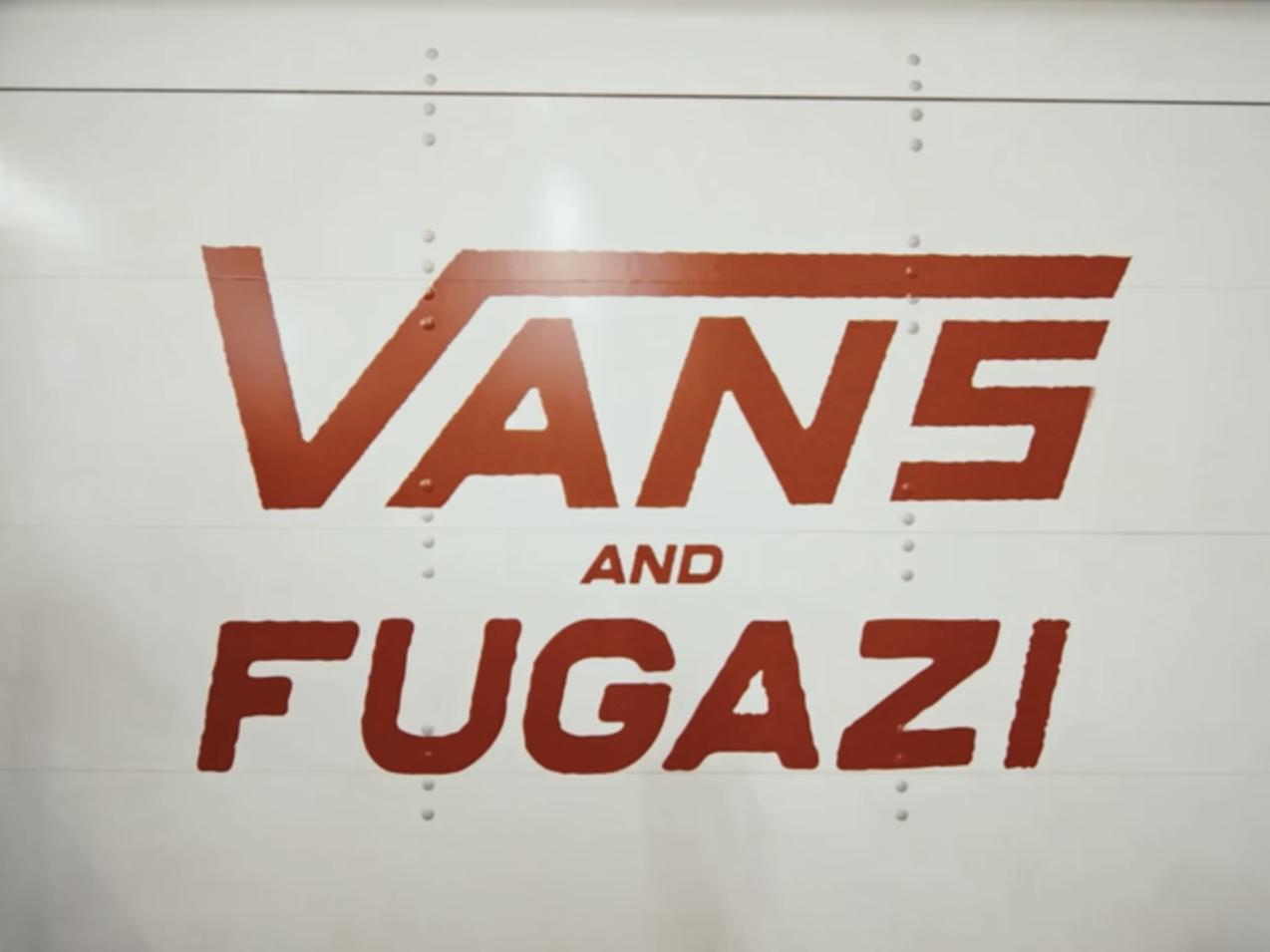
Legendary DC punk institution Fugazi were famously opposed to consumerism, to the point where they wouldn't even print up their own T-shirts; the "this is not a Fugazi T-shirt" T-shirts that were omnipresent in the '90s were all bootlegs. Even at a time when plenty of other canonized '90s cult artists have cashed in on streetwear collabs, Fugazi have continued to abstain from all merchandising. But now there's also a streetwear brand called Fugazi, which has created some confusion, especially after a recent collab between that brand and Vans.
The term "fugazi" was a word before the band Fugazi; it's a street term meaning fake or fraudulent. The term was a New York mafia thing, and it became a lot more widespread after Al Pacino's character explained it in Donnie Brasco — a movie that came out in 1997, when the band Fugazi was already four or five albums deep, depending on how you look at 13 Songs. The band's Ian MacKaye has said they got their name from the Vietnam War backronym Fucked Up, Got Ambushed, Zipped In (as in zipped in a body bag).
To be clear: The streetwear brand Fugazi has nothing to do with the band. Trevor Gorji founded the company in Los Angeles in 2017, and it has only been releasing merchandise since 2019. On June 24, the company posted an Instagram video of Vans exec Steve Van Doren teasing a collaboration on new pairs of Authentics. The video didn't exactly go out of its way to clarify the fact that it has nothing to do with the band Fugazi. Van Doren pronounced the word "Fugazi" like "foo-gah-zee," which is how people usually say the band name, not "foo-gay-zee," which is how people usually use the street term.
Dischord Records, the label that MacKaye co-founded and that released all of the band's records, commented on the Instagram post, writing, "We have nothing to do with this to be clear." That wasn't enough to derail the marketing train, but it was enough to produce plenty of backlash.
Late last week, after the release of the Vans/Fugazi collab, Steve Van Doren posted an Instagram apology for "any confusion," pointing out that the band Fugazi and the brand Fugazi don't have anything to do with each other. He also wrote of his "deep respect" for Ian MacKaye, saying that he'd spoken with MacKaye and that the two of them are "looking at ways to support longtime skateboarders and giving back to the communities we both care deeply about."
It's worth noting that the color used by the brand Fugazi, as seen in its social media avatar, is extremely similar to the shade of red that the band Fugazi used on their 13 Songs cover.
On its website, the brand Fugazi lays out its philosophy like this:
Fugazi® is a post-structuralist commentary on streetwear and the modern-day consumerist phenomenon. The brand’s take on fashion and clothing is rooted in the new sincerity of metamodernism. The brand exists as a study on the nature of streetwear; critiquing how something as simple as an everyday garment holds power within contemporary society while at the same time partaking in the grand charade that is “fashion”. The symbol shatters itself while simultaneously being constructed.
I take that to mean that they intentionally used the name of Fugazi, the famously anti-merch band, as some kind of quasi-ironic intellectual statement, which probably makes the whole thing even stupider.
Oddly enough, this is not the first case of a skate shoe brand misappropriating the iconography of one of Ian MacKaye's bands. Almost exactly 21 years before Steve Van Doren's apology, Nike SB apologized for copying Minor Threat's self-titled EP cover — the famous image of Ian MacKaye's brother Alec with his shaved head resting on his lap — for its "Major Threat" skate tour.