
March 12, 2022
- STAYED AT #1:5 Weeks
In The Number Ones, I'm reviewing every single #1 single in the history of the Billboard Hot 100, starting with the chart's beginning, in 1958, and working my way up into the present. The column is now biweekly, alternating with The Alternative Number Ones on Mondays. Book Bonus Beat: The Number Ones: Twenty Chart-Topping Hits That Reveal the History of Pop Music.
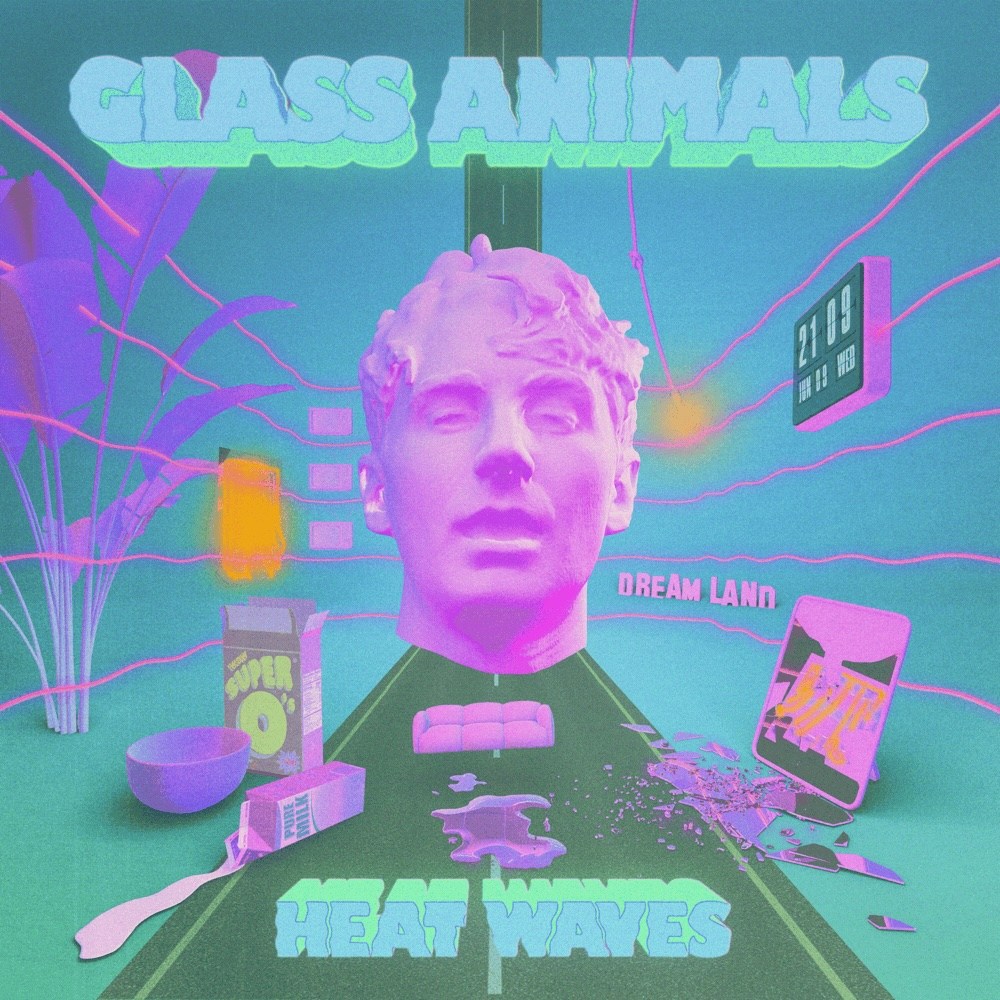
Australia got there first. I don't know why. Glass Animals, the British studio-rock project, were always pretty big in Australia. In March 2021, a full year before the song topped the Billboard Hot 100, Glass Animals' "Heat Waves" reached #1 in Australia. "Heat Waves" wasn't even brand new then. Glass Animals frontman Dave Bayley wrote the song in 2018, and the band released the track during the early days of the 2020 COVID pandemic. Thanks in part to its video and to its inherent sense of unspecified longing, "Heat Waves" became a kind of lockdown standard, and it took off all over the world. But in America, "Heat Waves" took a very, very long time to rise to #1.
It would be great to sit here and tell you that the long-gestating triumph of "Heat Waves" represented a subtle shift in the way Americans listened to music or that it showed the world the true power of a sleeper hit. Glass Animals are a UK act with two members who mostly grew up in the US. Over here, their music first broke through on alternative rock radio, but it was hugely influenced by rap and pop production methods, as well as the streamlined, interlocking-parts process of building tracks on digital workstations. "Heat Waves" is a song that sounds like everything and nothing, existing at a strange node of genre intersection. If this were a different column, maybe I could frame the popularity of "Heat Waves" as a rejection of boundaries, a sign of a beautiful future where any song could cross over gradually, picking up new fans as it rolls along.
Unfortunately, I can't really do any of that. Instead, it's my grim duty to report that "Heat Waves" took off because of Minecraft YouTubers and stuck around because American radio eventually caught on and ran the song into the ground. Maybe that's just this decade's version of old stories about obscure radio station managers falling in love with songs and then playing them until those songs become local hits, then regional hits, then national hits. We don't have those people anymore. On the pop charts, radio's main function is to keep pushing the same tiny handful of tracks until everyone gets sick of seeing them on the Hot 100. Instead, our true tastemakers are people like Minecraft YouTubers and the folks who write fan fiction about them. So it goes.
My kids are blessedly no longer the right age to consume videos where people play Minecraft and yell at each other, or if they do, I don't hear about it. My son used to commandeer the TV for hours at a time, and I became way too acquainted with the specific vocal tics of his rotating cast of extremely loud Minecraft and Pokémon guys. He's got his own phone and some AirPods now, so I don't hear that stuff anymore, and I'm pretty sure the Minecraft guys have largely fallen out of rotation, though the Pokémon guys might still sneak in there sometimes.
During the pandemic, though, the Minecraft guys ran the fucking show. I couldn't escape them. At some point, I waved the white flag in the war against my children's screen time, and they became fully enraptured with this small but elaborate network of doofs. When restrictions lifted enough that my kids could go hang out with their friends outdoors, I was blown away to discover that their friends were also watching all those same Minecraft streamers and that they all had different takes on whatever drama was rocking that world at the time. I had to wrap my head around the idea that this was kid culture now, that I simply wasn't supposed to understand it.
Before I even talk about how "Heat Waves" works as a song, I have to get into the matter of the specific piece of Minecraft-streamer lore that ultimately drove it to #1, mostly because I don't understand any of this shit and I want to get it over with. So there were the two Minecraft streamers, right? Dream and GeorgeNotFound. Dream always used to keep his face hidden behind a smiley-face mask, and his unmasking video was a big online deal in 2022. GeorgeNotFound is British. Beyond that, I don't know what his deal is.
Together, Dream and GeorgeNotFound started a Minecraft server called Dream SMP. People had to be invited to join, and then they played the game together and developed a bunch of long, elaborate storylines that, for whatever reason, appealed to the children of America. These real guys were so kid-famous that people started writing fan fiction about them, like they were Harry Potter and Ron Weasley.
Specifically, someone wrote a fan-fiction saga called "Heat Waves," named for the Glass Animals song, in which Dream and GeorgeNotFound fall in love, or at least develop a bunch of romantic tension. Millions of people read this work of literature, and some of them made tribute videos and memes set to the song "Heat Waves." The song might've been a decent-sized streaming hit without all this extracurricular silliness, but the Minecraft streamer fan fiction was the thing that apparently gave "Heat Waves" the extra push that it needed to achieve escape velocity.
Thanks to that fanfic, "Heat Waves" became a meme among people who pay attention to Minecraft streamers, and then regular, non-Minecraft-streamer TikTok users started making their own videos set to "Heat Waves." That, plus reliable support from alt-rock radio, was probably enough to push "Heat Waves" onto the Hot 100. When it debuted all the way down at #100 in January 2021, that was Glass Animals' first time on the big chart. Over more than a year, "Heat Waves" became more and more omnipresent.
Unlike other TikTok hits, "Heat Waves" never faded, mostly because radio stations discovered that it was the rare newish song that could sustain a passive audience. Alternative, pop, and adult contemporary stations all jumped on board. "Heat Waves" ceased to be a viral hit and became an old-school radio steamroller. More than a year after the song first arrived on the Hot 100, "Heat Waves" finally pushed past its competitors and landed at #1 — not because of some cresting viral trend but because it peaked at a moment when no cresting viral hits were powerful enough to knock it off. The song's 59-week climb up the Hot 100 was the slowest in chart history. (Mariah Carey's "All I Want For Christmas Is You," the previous record holder, took 25 years to reach #1, but it technically wasn't on the Hot 100 for most of that time.)
Weird story, right? I'm not sure what lesson to take from it. When "Heat Waves" got its sudden surge of popularity from Minecraft kids, it didn't exactly spell out the future of the Hot 100. Instead, it highlighted something that was already happening — the way popular culture is increasingly atomized into these tiny shards that just live in separate realities. Occasionally, their little shared reference points break containment and cross over to the rest of the world. "Heat Waves" is a frictionless, anodyne pop song, and you don't have to be up on Minecraft-streamer fan fiction to enjoy it, so it was well-suited to move beyond that initial context.
Let's stop talking about Minecraft now, OK? Please? "Heat Waves" might be a pretty ordinary song by a pretty ordinary streaming-era band, but I at least feel like I'm on stable ground when I'm talking about music instead of Minecraft streamer fan fiction. Glass Animals fit right into the current wave of bands that are really mostly solo projects for the singer/producer types who prefer to package themselves within bands — Maroon 5-type bands, Tame Impala-type bands. I don't think Maroon 5 and Tame Impala sound anything like each other, but Glass Animals somehow sound a lot like both of them.
The main Glass Animal is a guy named Dave Bayley. He was an international kid. His parents met in New York; my internet reseach has only turned up vague information about how both of them worked as some kind of scientists. (When Bayley was born, Michael Damian's version of "Rock On" was the #1 song in America. In the UK, it was the all-star charity single "Ferry 'Cross The Mersey.") Bayley's father is Welsh, and his mother is Israeli. Bayley spent much of his childhood in Texas and Massachusetts. When he was 13, his parents sent him to St. Edwards, a boarding school in Oxford that gave him a music scholarship, and I guess he basically became British there.
At St. Edwards, Bayley became friendly with Drew MacFarlane, the other kid in his class who'd mostly grown up in the US. Bayley, MacFarlane, and a couple of their other school friends started playing music together, and they formed Glass Animals in 2010. The band's lineup has never changed, but they don't function like regular bands. Bayley writes and produces almost everything himself. When he works with co-writers or co-producers, they're not usually members of the band. The other guys add layers, but Bayley mostly constructs their tracks.
Bayley plays a bunch of instruments, and he also takes full advantage of whatever production programs he uses. The two main inspirations he cites are Brian Wilson and Dr. Dre, two obsessive artist-producer types who worked in radically different modes but who achieved tremendous pop success by building their own sonic worlds. Bayley is nowhere near as interesting or inventive as those guys, but he does have their auteur-tinkerer gene. When you listen to Glass Animals, you hear him warp his voice in different directions, treat guitars to make them sound like they're synths, and layer his bandmate Joe Seaward's live drums over the electronic ones that he has already programmed.
Since Glass Animals are from Oxford, it's tempting to compare them to Radiohead, another band that loves to play around with voices and electro-acoustic arrangements. ("Creep," Radiohead's highest-charting Hot 100 hit, peaked at #34 in 1993.) But Glass Animals, even at their most ambitious, are simply not Radiohead. Their songs are way dinkier and lower-stakes than that. Their synths-and-yips sound is a bit closer to Hot Chip, if Hot Chip were a lot less playful.
From the beginning, people heard commercial potential in Glass Animals, and their debut EP Leaflings came out on the XL subsidiary Kaya Kaya in 2013. Paul Epworth, a producer who has been in this column for his work on Adele's "Rolling In The Deep," signed Glass Animals to his indie label Wolf Tone, and their debut album Zaba came out in 2014. Its big song was "Gooey." You might recognize that one as the song where Bayley falsetto-coos something about "peanut butter vibes." It got decent airplay on American alt-rock stations, and it went platinum, though that didn't happen until 2023. "Gooey" wasn't really a chart hit anywhere, but it remains Glass Animals' biggest non-"Heat Waves" song. If someone only wrote a piece of viral Minecraft romantic fan fiction called "Gooey," there's no telling where that song might've gone.
"Gooey" and Zaba earned Glass Animals some buzz-band status, even if websites like this one weren't posting about them. They performed on a couple of American late-night shows, and Dave Bayley started out a side hustle helping to write and produce tracks for American rap and R&B artists like 6LACK and Wale. Glass Animals' second album, 2016's How To Be A Human Being, has a unifying concept where all the songs are supposedly character sketches about different imagined people. It didn't have any sleeper hits on the level of "Gooey," but a couple of its tracks got alt-rock airplay over here. The album got a Mercury Prize nomination. I heard it when it came out, and I was like, "Oh, hmm, interesting," but I didn't like it enough to start writing about the band on this website or anything. I was supposed to write a freelance piece about the record, but I blew the deadline because I completely forgot that I'd agreed to do it. Cost myself some money with that one.
Glass Animals were an alt-rock radio band in an era when alt-rock radio didn't really matter. You'd occasionally get someone like Imagine Dragons or Twenty One Pilots coming out of that world and becoming arena mainstays, but those stories were rare. Glass Animals' peers on those airwaves were other sleepy-voiced white guys who messed around with Auto-Tune and synthetic effects — Capital Cities, Bastille, Walk The Moon Portugal. The Man. Glass Animals could play big venues and get prominent festival placement all over the world, but they weren't exactly stars.
In 2018, Glass Animals drummer Joe Seaward was riding his bike in Dublin when he got hit by a truck. The accident almost killed him, and he needed to go through brain surgery and relearn how to walk, talk, and play drums. Seaward made a full recovery and remained a Glass Animal — not quite as miraculous as Rick Allen remaining in Def Leppard after losing his arm, but cool nonetheless. When Seaward got hurt, Dave Bayley wrapped himself up in a cocoon of nostalgia. He started thinking about his childhood in Texas and writing songs where the lyrics were often loosely strung-together name-drops of pop-culture artifacts from the '90s, and those songs gradually became Glass Animals' 2020 album Dreamland. (The album title presumably has nothing to do with Dream, the Minecraft streamer with the smiley-face mask; that's just a happy accident.)
Glass Animals released a bunch of early Dreamland singles before "Heat Waves" took off, some of which involved prominent collaborators. Miami underground rap great Denzel Curry appeared on "Tokyo Drifting," which eventually went gold. Earlier this year, NASA mission control played that song for the Artemis II crew, causing Curry to celebrate his new status as the "first rapper played in space." Still, "Tokyo Drifting" never touched the Hot 100. (Curry has been played in space, but he has still never been on that chart.)
The same is true of "Your Love (Deja Vu)," a song that Bayley co-produced with his label boss Paul Epworth. Bayley and Epworth co-wrote "Tangerine" with Brittany "Starrah" Hazzard, a songwriter whose work has been in this column a few times. Don't watch that video. Don't even look at the thumbnail embedded below. Ignore it. Those songs all came out before "Heat Waves." I don't think any of those songs are especially memorable, and none of them became hits.
"Heat Waves" is one of the Dreamland tracks made entirely without outside songwriters or producers; Dave Bayley wrote and produced the whole thing himself. On the Song Exploder podcast, Bayley said that he got the idea for the song while toiling in a London studio one night in 2018. He'd been messing around with different sonic ingredients and having little success that day. He was reading a songwriting book that suggested experimenting with longer guitar phrases that tell a story, and he came up with a plaintive chord pattern and played it over and over. Then he tried improvising a vocal melody over it and immediately landed on the central hook: "Sometimes, all I think about is you/ Late nights in the middle of June."
Bayley had a particular person in mind when he wrote "Heat Waves," and he only alludes to that person in interviews. He'd lost an unidentified friend who had a birthday in June, and he thought about that person when their birthday rolled around every year. Bayley wasn't naturally inclined to write confessional songs, and he likes to warp his voice through filters, raising or lowering his pitch to the point where he doesn't sound like himself. On Song Exploder, he said, "Like many people, I really hate the sound of my own voice." He's more of an anonymous technician than a pop star, and that anonymity plays into "Heat Waves." Even though he sings about a heavy subject of great personal significance, he keeps the lyrics vague enough that they just allude to a general kind of sad longing.
The floridly fluttery "Heat Waves" groove does more to evoke that feeling than the lyrics, which are fairly generic breakup fare about needing to let someone go even though it hurts because you know they'll be better without you. He sings in fragile falsetto, half-swallowing his words and taking on an accent that absolutely cannot be placed. At various points in the song, he sounds British or American or Jamaican or Eastern European. On the song's intro, he pitches his voice way down and adapts Project Pat's flow, for no real reason: "Road shim-maaah, wigglin' the vi-shaaahn/ Heat heat waves, I'm swimmin' in a mir-raaaah."
While building the track, Bayley gave his guitar the same treatment that he likes to give his voice, pitching it both up and down so that it doesn't sound much like a guitar. He added some moody synth-tones and some trap-style 808 drum programming, and then he started singing once the loops were set. Bayley did all that during a single night in the studio, when he had the song's skeleton all figured out, he turned around and saw Johnny Depp sitting at a piano behind him, drinking a glass of wine. Depp was apparently working in a different room in the same studio complex, and he got lost on the way to the place where he was supposed to be. That's how Depp ended up becoming the first person who heard "Heat Waves." If I randomly encountered scarf-era Johnny Depp while working late at night, I would probably assume that he was there to murder me. That sounds terrifying.
"Heat Waves" could've been a song for someone else. Dave Bayley pitched the track to Rihanna's team, and the process moved far enough along that he found himself at the Roc Nation offices in New York, playing the song for Rihanna's manager. She eventually passed on it, which definitely worked out well for Bayley. This would've been a couple of years after Rihanna released Anti, which remains her final album. If she'd recorded "Heat Waves," it would probably still be sitting in a vault somewhere. I wonder if there's a vast trove of unreleased Rihanna demos of tracks that songwriters wish they'd kept for themselves. Instead, this will probably be the last Number Ones entry about a song that Rihanna turned down, a surprisingly crowded category. Bayley went back to "Heat Waves" when he was working on the Dreamland album, and he got the other Glass Animals to add their own instrumental parts to the mostly-completed track, then carefully edited all the bits together.
To me, the final version of "Heat Waves" plays out as a perfectly decent but ultimately replacement-level piece of festival pop. It's certainly not unpleasant. The central melody and guitar line have a sleepily hypnotic quality, and everything else about the track seems engineered to stay out of the way. There's no urgency. It just kind of hovers. The song might as well be made for CVS speakers. It's unobtrusive but loosely comforting. You can sing along to whatever lyrics you can make out, or you can completely forget that you're listening to music at all. There's a precise science to making that kind of music, and "Heat Waves" is a well-crafted example of it. In theory, it's interesting to hear an indie-pop singer-songwriter using production techniques that he picked up from rap, R&B, and dance-pop. I just can't get very excited about the result.
The "Heat Waves" single ultimately came out in June 2020, about a month before Glass Animals released the Dreamland album. I'm sure it wasn't supposed to come out in the early days of a global pandemic; that's just how the chips fell. For the "Heat Waves" video, Dave Bayley pulled a wagon full of old tube TVs through abandoned London streets. He got neighbors to film him out their windows on cell phones, and a lot of that footage is in the clip. After passing a double-decker bus with a Glass Animals billboard on the side, Bayley arrives at a deserted music venue and sets the TVs up onstage. When those screens turn on, they show the other Glass Animals, all playing their instruments remotely while Bayley sings to a sea of empty seats.
That video will forever and always link "Heat Waves" to the first pandemic summer, and it's kind of funny that it finally reached #1 at a time when the COVID variants were finally subsiding and people were getting used to gathering in large groups again. The song just slowly built up steam in all chart metrics as more and more audiences were exposed to it. It did big streaming numbers and bigger radio numbers, and it was right there when the "We Don't Talk About Bruno" moment finally faded away. Thanks to its radio support, "Heat Waves" lingered on the Hot 100 long, long after its run at #1. It ultimately spent an absurd 91 weeks on the Hot 100, breaking a record previously held by the Weeknd's "Blinding Lights." (Another song has since lasted even longer on the Hot 100, and we'll get to that one later.)
"Heat Waves" stuck around for far too long to be considered a meme hit, but it did turn out to be a true one-off for Glass Animals. The single went diamond in 2024, though the Dreamland album stalled out at gold. Glass Animals released a follow-up album called I Love You So F***ing Much in 2024, and none of its singles charted or earned RIAA certifications. I'm not even sure I noticed when the record came out. Bayley has continued to work on songs from other artists, like one on Florence + The Machine's 2025 LP Everybody Scream, and I suppose it's possible that he'll strike gold again. But the chart success of "Heat Waves" required a lot of weird happenstance, and I wouldn't count on that happening for Glass Animals ever again.
From what I can tell, the golden age of Minecraft streamers is over. Plenty of the big names in that world, Dream and GeorgeNotFound included, have been hit with sex-pest allegations of one form or another. I'm told that some kids have started using "Minecraft streamer" and "pedophile" as interchangeable terms, which is sort of darkly funny. Maybe someone somewhere is still getting rich by streaming Minecraft, but that's none of my business, at least until they somehow manage to elevate another random-ass song to the top of the Hot 100.
GRADE: 6/10
BONUS BEATS: Here's a 2021 video that Lana Del Rey posted of herself driving around LA and grooving to "Heat Waves," not even letting the automated GPS-directions voice kill her vibe:
New IGTV video
by inlanadelrey
(Lana Del Rey's highest-charting Hot 100 hit as lead artist, the Cedric Gervais remix of "Summertime Sadness," peaked at #6 in 2013. It's a 7. Del Rey also got to #4 as a guest on Taylor Swift's "Snow On The Beach" in 2022. That's an 8.)
The Number Ones: Twenty Chart-Topping Hits That Reveal The History Of Pop Music is out now via Hachette Books. Sometimes, all I think about is you — late nights, considering buying my book. ("Book" doesn't rhyme with "you," but then neither does "June.")