August 8, 1992
- STAYED AT #1:1 Week
In The Alternative Number Ones, I'm reviewing every #1 single in the history of the Billboard Modern Rock Tracks/Alternative Songs, starting with the moment that the chart launched in 1988. This column is a companion piece to The Number Ones, and it's for members only. Thank you to everyone who's helping to keep Stereogum afloat.
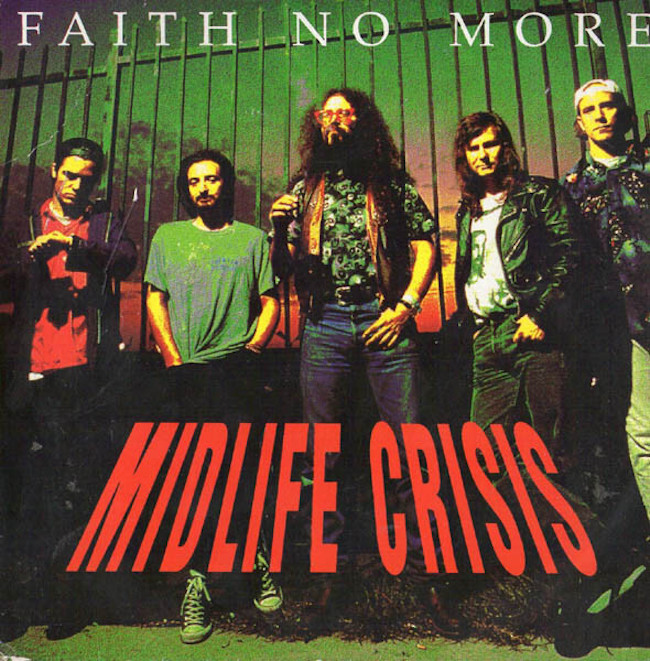
"Cuh mawn an wring mah nyeckk!" "YUH MEN! STREW-WAY! TIN HAWWWT!" "MED-LAWWWF CRAWWW SYESSS!" Sometimes, shit is so self-evidently awesome that I don't even know what to say. Like this: In 1992, a San Francisco funk-metal band finally got around to following up the freak mainstream hit that they made a few years earlier. There was suddenly a whole lot more attention on heavy alternative music, even though nobody quite knew what that meant, and this band got the opening slot on the summer's biggest rock tour. So what did they do? They made an oblique opaque prog-churn spine-snapper about invasive, oppressive mass culture, and they called in "Midlife Crisis." They did virtually everything in their power to prevent 12-year-olds from loving them, and 12-year-old me thought it was the coolest shit in the world. 12-year-old me was right, too. "Midlife Crisis" goes hard as fuck.
In 1992, I thought it was perfectly obvious that Faith No More were an alternative rock band. They made weird and sometimes intentionally off-putting music. They dressed like freaks. Like the Red Hot Chili Peppers, they did something that could almost slightly be described as rapping. My parents hated them because their name seemed nebulously anti-religious. My dad once told me, "I'd rather you listen to a band called Spit In Your Father's Face," as if that was going to make me like Faith No More any less. Moreover, they were awesome. Their music burst with life and ideas, and you could still bang your head to it. I was still figuring out what the term "alternative" meant to me, but it never occurred that Faith No More wouldn't qualify.
In the context of this column, though, I can see that America's modern rock stations were actually taking a bit of a leap by throwing FNM's "Midlife Crisis" into rotation. The from-out-of-nowhere platinum success of the 1989 album The Real Thing probably helped make it possible for bands like Nirvana and the Chili Peppers to become hugely popular a couple of years later, but FNM were never creatures of alternative radio. If they got airplay anywhere, it was on mainstream rock stations, or more importantly on MTV. In the summer that they released their Angel Dust album, Faith No More were on tour with Guns N' Roses and Metallica, two bands that the DJs at my local alt-rock station regularly mocked on-air. Faith No More might've been an alternative rock band, but they came from a social context pretty far removed from the stations that were still playing the Cure and XTC.
Faith No More were a knowingly arty band, and they were getting weirder all the time. That was a big part of the story of Angel Dust -- these carnival geeks using the blank check of their last record's success to make something weirder and headier. They made heavy use of keyboard, which separated them from their metal peers and brought them in line with plenty of the bands who were in modern rock radio rotation. But I also think that the modern rock stations of 1992 were having a bit of an identity crisis. Their old standbys were still doing well, but there was this new youth wave of heavier, riffier bands that seemed to be getting all the attention and youth enthusiasm.
Maybe Faith No More seemed more in line with those stations than, say, Pearl Jam would've been at the time. Pearl Jam will eventually appear in this column, and before too long the alternative charts would be mostly taken up by bands trying to sound like them, but that wasn't the case in summer 1992. At that point, Pearl Jam had only reached the Modern Rock charts twice -- with "Alive," which peaked at #18, and with "Even Flow," which only made it to #21. Faith No More had never been on the Modern Rock chart before "Midlife Crisis," but maybe they seemed like they were more aligned with what alt-rock radio programmers were trying to do. I don't know! It's weird!
Faith No More's run as an alternative-radio band was not long. "Midlife Crisis" had its one week at #1, and then the band only scored one more charting single. As with Pearl Jam, though, you could hear FNM's influence in plenty of the far-inferior bands who dominated the airwaves in later years. But whenever I heard "Midlife Crisis" on the radio, it was fucking over. I was moshing in the back of my parents' station wagon. I was kicking holes in drywall and throwing my souvenir Empire State Building coin bank out the window. I was vibrating at a different frequency. I was perfect, yes, it's true.
Some version of Faith No More existed as far back as 1979, the year that I was born. Drummer Mike Bordin and slap-bass monster Billy Gould were members of the satirically-but-awesomely-named Sharp Young Men. That band went through a bunch of different names and lineups over the years. By the time they released their debut single "All Quiet In Heaven" in 1983, they were called Faith. No Man., and their sound was twitchy, gothy post-punk, but with a full-on prog-metal churn on the low end. The band recorded that single in a garage with their friend Matt Wallace, who would become their go-to producer for the rest of their life as a band.
Faith. No Man.'s original singer and guitarist eventually left, but the band kept going. They became Faith No More. Keyboardist Roddy Bottum came on board. For a little while, Courtney Love became their lead singer, which opens up all sorts of alternate-universe possibilities. Footage of Love singing for FNM, and I think doing a local cable-access interview with them, still exists online. It is a trip. (Courtney Love's band Hole will eventually appear in this column.)
Courtney Love was only in Faith No More for about six months. When she left, they recruited another singer, Chuck Mosely, from the band Haircuts That Kill. Mosely had a lot of issues, but he basically gave Faith No More an identity. He was a limited singer, but he had tons of presence and energy, and he rhythmically bellowed his lyrics in ways that sounded a bit like rapping, at least in the Beastie Boys sense. He was a Black man operating in a genre that was almost entirely white, and that made a difference, too. Around the time that Mosely joined FNM, they also got Jim Martin, the frizzy-haired guitarist with the red-framed Sally Jesse Raphael-looking glasses.
The members of that new Faith No More lineup raised enough money to record a few songs, and those songs got the attention of Mordam Records, an independent punk distributor that was looking into signing some bands itself. Faith No More's 1985 debut We Care A Lot was the first LP ever to come out on Mordam. The record got the attention of Slash Records, a hugely important LA punk label that had just started being distributed through Warner Bros. Faith No More re-recorded their We Care A Lot title track for their next album, 1987's Introduce Yourself. They made a video for the track, and it got some love at MTV. It fucking rules. Classic song. As a kid, I didn't understand why "We Care A Lot" was on two different Faith No More albums, and I also didn't get the strain of self-important yuppie charity that it snottily satirized. I just knew that it rocked.
"We Care A Lot" wasn't a hit, but it made some noise. Faith No More toured with the Red Hot Chili Peppers, and they went off to Europe. Chuck Mosely got more and more unreliable on the road; he had the same addiction problems as so many of his generation of rockers. Eventually, Faith No More kicked Mosely out of the band, and he sued FNM and went on to sing for a latter-day Bad Brains lineup before starting his own group Cement, who should not be confused with Pavement. Faith No More found their new singer close to home. At the time, Mike Patton was the teenage frontman of Mr. Bungle, a berserker-weirdo thrash metal band out in the relatively remote California weed-country town of Eureka.
Mike Patton had been to see Faith No More when they played at a Humboldt County pizzeria in 1986. A different Bungle member gave Faith No More the band's demo tape, a wild piece of work called The Raging Wrath Of The Easter Bunny, and the band was impressed with Patton's range. Patton could bark like Chuck Mosely, but he could also wail out huge, operatic notes. Patton wasn't even a big Faith No More fan, but the band invited him to join up while they were working on their next album, and he dropped out of college to take the spot. At the time, Faith No More had already recorded all the music for their next album, 1989's The Real Thing. Patton had two weeks to write and record all of his vocal parts, and that's all he needed.
I bought The Real Thing on cassette when I was maybe 10, and it was one of the first rock records that I ever loved. It's still one of my favorite rock records. With Mike Patton on board, Faith No More found a new sense of energy and purpose. They already had tons of urgency and catchy riffs, and now they suddenly had these choruses that could swallow the world. The reason that I bought The Real Thing was the same reason everyone else bought it: "Epic," the cryptic stomp-wail anthem that sounded like hair metal crumbling in on itself. The "Epic" video, with its exploding piano and its fish flopping around, became an MTV staple, and the song went all the way to #9 on the Hot 100. Another single, the maybe-even-better "Falling To Pieces," also hit the Hot 100, though it only reached #92. While all this was happening, modern rock radio was perfectly content to ignore Faith No More. I don't think they were even getting significant college radio burn back then.
While Faith No More took off, Mike Patton made sure he had enough time to continue leading Mr. Bungle. Because of the success of The Real Thing, Mr. Bungle got a Warner Bros. deal. Their 1991 self-titled debut, produced by downtown avant-jazz guy John Zorn, is among the weirdest albums to get a major-label release in those years. Bungle kept going throughout Faith No More's entire tenure. Earlier this month, one of Bungle's founding members, multi-instrumentalist Theobald “Theo” Lengyel, was found guilty of murdering his girlfriend. I don't even know what to say about that. Most of the people who make weird music are just people who make weird music. Every once in a while, though, you'll find one who's an actual dangerous person, and this is one of those cases.
Partly because of that Mr. Bungle record, Faith No More took a break before getting to work on their follow-up to The Real Thing. Other than Bungle, the main Faith No More thing that I remember from those years was Jim Martin making a quick cameo in Bill & Ted's Bogus Journey in 1991. When work on the next LP started, Mike Patton was adamant about wanting to take a more active role in the band's music.
Most of Patton's bandmates were down to make something artier and headier than The Real Thing. Roddy Bottum, for instance, had the idea to call the album Angel Dust, explaining that "it's a really beautiful name for a really hideous drug, and that should make people think." They also got involved in the album's layout, picking the hanging-beef-heads picture for the CD's back cover. The one band member who wasn't really on board was Jim Martin, who was less enthused about the new direction. Years later, producer Matt Wallace told Diffuser that Martin kept complaining about the album being "gay disco."
Today, Angel Dust has earned a reputation as Faith No More's masterpiece. I'm still a Real Thing guy, but I understand that take completely. On Angel Dust, Faith No More sound fully locked-in. They're pushing themselves, trying new things, and sustaining a sense of deep dread throughout. The hooks aren't quite as immediate, but the album still rocks extremely hard, and it does so in strange, vivid, explosive ways. You can hear most of the facets of their new direction at work on "Midlife Crisis."
Mike Patton once said that "Midlife Crisis" is a song about Madonna. It's not a celebration of her, either. The song's working title, the one that they put on setlists before Angel Dust came out, was "Madonna." In a fan Q&A, Mike Patton later said that he felt "bombarded by her image" when he was writing the song, that he thought her "a bit desperate." Madonna would've only been in her early thirties when Patton wrote his "Midlife Crisis" lyrics, so she was nowhere near midlife. But Patton is a decade younger than Madonna, so maybe your early thirties look like midlife when you're in your early twenties.
I went decades without realizing that "Midlife Crisis" has anything to do with Madonna, and you would never know it from lyrics alone. There's one line that works as a pretty canny dig at the entire celebrity-industrial complex: "You're perfect, yes, it's true! But without me, you're only you!" Most of the time, though, Patton is just booming and scrawling out about bodies and lost vitality: "Go on and wring my neck like when a rag gets wet," "suck ingenuity down through the family tree," "your menstruating heart, it ain't bleeding enough for two." You don't need to analyze the "Midlife Crisis" lyrics line-by-line to get the general vibe. It's a cynical, almost celebratory depiction of things falling apart. That's all you really need.
"Midlife Crisis" opens with a cool echoing, syncopated drum beat that always reminded me of the intro to INXS' "Need You Tonight." It turns out that those drums are only partly done by Faith No More's Mike Bordin. The rest is a sample of Simon & Garfunkel's 1970 hit "Cecilia." I never would've guessed that, but when I learn where that spectral percussion comes from, it seems way too obvious. Maybe "Midlife Crisis" tapped into some subliminal nostalgia. Maybe it exploited that nostalgia, too. Maybe there's something pointed about flipping a beloved baby-boomer pop chestnut on a song called "Midlife Crisis" at the moment that plenty of boomers were hitting midlife.
There are other samples on "Midlife Crisis," too. Faith No More got really into samples, sometimes using the band members' own field recordings, when they were making Angel Dust. On "Midlife Crisis," the other samples all pop up on the bridge. There's a sort of descending whistle, and that's from the Beastie Boys' Paul's Boutique deep cut "Car Thief." There's also someone yelling "yeah," and that's taken from oft-sampled LA rap duo Rodney O & Joe Cooley's 1991 single "Get Ready To Roll." Also, the "arrrrah" bit, the one that sounds like someone stretching, is from "Cylinder's Re-Cycle (Bonus Beats)," a 1982 track from the avant-disco group Konk that's basically just sound effects.
That Madonna body-horror stuff and those patched-together samples make for unlikely ingredients on an early-'90s metal anthem, but that's probably the point. Faith No More weren't trying to make obvious moves when they recorded "Midlife Crisis." Instead, they went all-in on goony ambition, but that goony ambition didn't stop them from making metal anthems. On "Midlife Crisis," Mike Patton sounds like at least four different people. He starts the track out at a menacing whisper before letting his voice explode, and all of it sounds tremendous. The track has these glacial new-age synths and churning metal guitars running up against the samples and Patton's rasp-grunt-howling, and it all builds to a crescendo -- the end of the track, where we hear all of Patton's approaches in multi-tracked counterpoint. It's so heavy and so catchy, and it sounds like nothing else.
For the "Midlife Crisis" video, director Kevin Kerslake, who was right in between making Nirvana's "Come As You Are" and "Lithium" clips, didn't quite know how to visualize what Faith No More were talking about. So he came up with a disconnected image almost as powerful as the flopping fish from "Epic": Four horses pulling a man's limbs in opposite directions. We never actually see the guy get quartered, but the implication was enough. Most of the clip is Faith No More, on flickering film stock, looking cool, but the horses were always going to be the bit that people remembered.
The "Midlife Crisis" single dropped in May 1992, with the Angel Dust album coming a couple of weeks later. About a month after that, Faith No More joined Guns N' Roses and Metallica, opening up shows on their gigantic co-headlining stadium tour. The opening night from that tour was my first concert. My dad took me, which he did not want to do; that's why he was talking about "Spit In Your Father's Face" up above. But I got straight A's on my seventh-grade finals, so he relented. That means Faith No More are basically the first band that I ever saw live.
My dad and I were way up in the upper deck at RFK Stadium, and I don't remember too much about Faith No More's set. People were moshing at the back of the field, and I didn't know what that was; I thought it looked interesting. This was before moshing was fully widespread, so the people up front all just kind of jumped around and headbanged. Faith No More closed their set with "Epic," and the main thing I remember is the image of tens of thousands of people pumping their fists to the beat. We really lost something when people stopped fist-pumping en masse at rock concerts. That shit looked cool.
"Midlife Crisis" got a bit of play on mainstream rock stations, and it was a top-10 hit in the UK, but it didn't cross over to the Hot 100 over here. Angel Dust debuted at #10, one spot higher than The Real Thing when it was at its peak. It's still the only top-10 album of Faith No More's entire career. The LP got good reviews, and it landed at #26 on the 1992 Pazz & Jop poll -- right in between Television's self-titled reunion album and Leonard Cohen's The Future. (The Real Thing came in at #27 on the 1990 poll, so I guess there was a hard ceiling on how much critical respect Faith No More could expect.) Ultimately, Angel Dust went gold, which must've been a slight disappointment after The Real Thing. After "Midlife Crisis," Faith No More only made the Modern Rock charts once, when follow-up single "A Small Victory" peaked at #11. That song rules, too.
A year after Angel Dust came out, guitarist Jim Martin left Faith No More, and he went on to become a prizewinning farmer of gigantic pumpkins. This is not a joke. That's what Jim Martin is doing today. The band went through a few more guitarists, and Mr. Bungle's Trey Spruance is probably the best-known of them. The same year that Martin split with FNM, keyboardist Roddy Bottum came out as gay -- a rare thing in the world of heavy rock at the time.
In 1993, Faith No More released their Easy EP, and its title track was a surprisingly straightfaced cover of the Commodores' hit 1977 ballad. "Easy" didn't make the Modern Rock chart, but it became Faith No More's last Hot 100 hit, peaking at #58. That "Easy" cover, which was added to later pressings of Angel Dust, was a huge hit elsewhere in the world -- #3 in the UK, #2 in Norway, #1 in Australia. Earlier this year, one of my oldest and best friends used it as the first dance at his wedding. It was awesome.
Faith No More released two more albums, 1995's King For A Day... Fool For A Lifetime and 1997's Album Of The Year. Those records have their proponents, but they didn't do much in terms of sales, radio play, or critical acclaim. I remember thinking that they were both cool but that they didn't have the same magic as The Real Thing or Angel Dust. Faith No More broke up in 1998, canceling a planned tour with Aerosmith in the process.
Mike Patton went on to make one more Mr. Bungle record before that band broke up. He also sang for a bunch of noisy rock supergroups -- Fantômas, Tomahawk, Peeping Tom, the Nevermen, Dead Cross. He started Ipecac Recordings, a pretty important indie label. He made voice noises on Björk's vocals-only Medúlla. He voiced the zombie-vampire monsters in the Will Smith movie I Am Legend. He got back together with Mr. Bungle to re-record and tour their original thrash demo. He's an interesting guy with an interesting career. I can't tell you what all the other Faith No More guys have been doing, but Roddy Bottum still leads the sick-as-hell power-pop band Imperial Teen. They haven't had any Modern Rock hits, but 1999's "Yoo Hoo" should've been a contender.
In 2009, Faith No More got back together to play the big rock festivals in Europe, and they kept touring steadily for about another decade. They also released one more album, 2015's Sol Invictus, which I liked pretty well. Chuck Mosely got back together with Faith No More for a couple of 2016 shows to celebrate a reissue of We Care A Lot, and he died a year later at the age of 57. In 2021, Faith No More were supposed to resume their COVID-mangled touring plans, but Mike Patton backed out, citing mental health issues. A little while after that, he said that he hadn't spoken to anyone else in the band since canceling, so maybe Faith No More are now broken up again.
If Faith No More never walk the earth as a band again, that's OK with me. They still did what they did, and the recordings remain. In the alternative rock radio of its time, the success of a song like "Midlife Crisis" seemed a bit like a digression, a red herring. If you look at the grand scope of the chart's history, though, "Midlife Crisis" was a sign of things to come. It's just too bad that most of Faith No More's stylistic descendants couldn't kick ass like that.
GRADE: 10/10
BONUS BEATS: Speaking of Faith No More's inferior inheritors, here's the "Midlife Crisis" cover that Disturbed released as a 2008 B-side:
(Disturbed's highest-charting Modern Rock hit, 2002's "Prayer," peaked at #3. It's a 3.)