
September 14, 1996
- STAYED AT #1:4 Weeks
In The Alternative Number Ones, I’m reviewing every #1 single in the history of the Billboard Modern Rock Tracks/Alternative Songs, starting with the moment that the chart launched in 1988. This column is a companion piece to The Number Ones. The column is now biweekly, alternating with The Number Ones on Mondays.
Some people wanted me to delay this column for two days. See, Wednesday is March 11, which means it's 311 Day. That's not a real holiday, but the band treats it like one. For a while, they've been embarking on 311 Day Caribbean cruises and whatnot. 311 non-fans have made 311 Day a goofy thing online, too, especially in the comments section of this website.
Well, no. Sorry. I'm not doing that. This column is a serious, academic deep-dive investigation into the history of the alternative rock charts. This is my life. I'm not here to participate in your memes. If this edition of the column happened to line up with 311's made-up holiday, then it would run on that day. It doesn't, and I will not bend time and space to accommodate such foolishness. If you want to wait two days to read it, go ahead. You're a paying subscriber. You can read it whenever you want. But I am a serious person, and I will not be a party to these silly games.
Anyway, this is the song that goes, "Cheese a lotta bean! Zone, zone! Nutha bee hen always be! Down, down!"
Here's a discussion question: If you're a funk-rock slap-bass specialist, is it stupider to call yourself Flea or P-Nut? Neither one of those names is very dignified. They're goofball teenage nicknames that professional middle-aged men have to carry forward for the rest of their lives. Flea is even "Flea" when he shows up in movie credits. But we've had decades to see Flea as a three-dimensional person, a sensitive soul whose artistic ambitions extend far beyond slapping the bass with the Red Hot Chili Peppers, whereas I still just think of P-Nut as just P-Nut. Also, Flea spells his name correctly, and P-Nut has a name that always makes me imagine him getting urine on his testicles somehow. For these reasons, I have to give P-Nut the slight edge in the stupidity department, and I can only hope that Flea will forgive me. It's nothing against Flea. He's just up against a world-historic talent in the "stupid bassist name" department.
P-Nut is known to the government as Aaron Wills, but he'll always be P-Nut to everyone else. Like all five 311 members, P-Nut grew up in Omaha, Nebraska. 311 might be the most spiritually Californian band on the face of the planet, so it's always a little funny to realize that they took shape 2,500 miles to the east, but that's what happened. Disconcertingly handsome 311 frontman Nick Hexum started playing in a cover band called the Eds when he was at Omaha's Westside High School in the mid-'80s, and most of the members of 311 were either in that band or in Hexum's extended social circle. After high school, Hexum and some of those buds started a new band called Unity and moved to Los Angeles to try to make it. They didn't make it. Instead, they broke up and returned to Omaha.
After the end of Unity, Nick Hexum briefly moved to Germany, while some of their friends started a new band called Fish Hippos. (That's where P-Nut enters the picture.) In 1990, Fish Hippos got a gig opening for Fugazi in Omaha, which must've been a huge deal for a local band. From what I can tell, Hexum moved all the way back from Germany just so that he could join Fish Hippos at this Fugazi show, but he hated the band name. At the Fugazi show that night, Fish Hippos announced that they were changing their name and that they would be known as 311 from that day forward. "311" was the local Omaha police code for indecent exposure, and the band knew that because one of P-Nut's friends had been arrested for skinny-dipping in a public pool.
Once 311 became 311, Nick Hexum took out a student loan and used the money to turn his parents' basement into a recording studio. 311 practiced down there, and they recorded three albums that they released on their own in quick succession in the early '90s. That's where they figured out their sonic identity. These guys grew up on punk, but they were also into funk and rap and reggae, and they did their very best to fuse all those genres into one thing. Lots of bands had similar ideas around the same time, and there's definitely a lot of Chili Peppers-esque funk-metal in 311's early music. But 311's clumsy sincerity moved them into a slightly different realm, and they eventually found a niche as pretty much a jam band for skaters.
In their early days, 311 put together a remarkably durable lineup that hasn't changed since 1992. Some of the guys in the band knew each other since high school, and others met at the University Of Nebraska. The band's guitarist ever since the pre-311 Eds/Unity days is a guy named Tim Mahoney, which is extremely funny to me because it's also my father-in-law's name. If you knew my father-in-law, you'd think it was funny, too. The band had a friend named Doug "S.A." Martinez, a funky child with some words on his tongue, who would sometimes join in as a rapper. They invited him to become a full-on band member in 1992. I think it's important for you to know that the "S.A." stands for "Spooky Apparition."
Around the time that Martinez joined the band, 311 decided to trust their instincts, let go of regret, and move all the way out to Los Angeles. Unity had tried it a few years earlier, and that didn't work out, but things did work out for 311. They caught the attention of famed '70s prog producer Eddy Offord, scored a deal with Warner's newly relaunched Capricorn imprint, and re-recorded a bunch of their Hexum's-basement material, releasing it as their 1993 major-label debut Music. They didn't get any press attention, but their single "Do You Right" became the first 311 song to reach the Modern Rock chart, where it peaked at #27.
311 recorded quickly, releasing their sophomore album Grassroots just over a year after Music came out, and they toured tirelessly. More importantly, they appealed directly to a very specific type of guy. If you were someone who used the term "fatty boom batty blunt" in regular conversation, then you were probably a 311 fan. Google tells me that the character Jay says that exact phrase in Mallrats, and it's very easy to imagine Jay being super into 311. But "fatty boom batty blunt" isn't etched into my brain because of that movie. It's etched into my brain because I knew a few guys who really talked like that, and those guys loved 311.
You could not invent a band that could better appeal to '90s stoner bros. They had everything: clumsily exaggerated rapping, bottom-heavy Camaro riffs, meaningless all-catchphrase lyrical chants, utopian psych-rock harmonies, excessive levels of slap-bass, goofy nicknames. Other bands were messing around with the same ingredients, but none of them were as happy as 311. They could've called themselves Weed-Placated Acceptance Of The Machine.
Music and Grassroots didn't get much support from press, radio, or MTV, but those records were word-of-mouth sensations for that particular type of guy. Those guys had numbers, and both of those albums sold pretty well. Both eventually went gold, though neither got that certification until 1999. Anyway, momentum was building. The members of 311 saw their crowds getting bigger and bigger. In 1995, they released their self-titled album, the one with the blue cover that was just their graffiti-looking bubble-letter logo. That was the one that broke things wide open for 311.
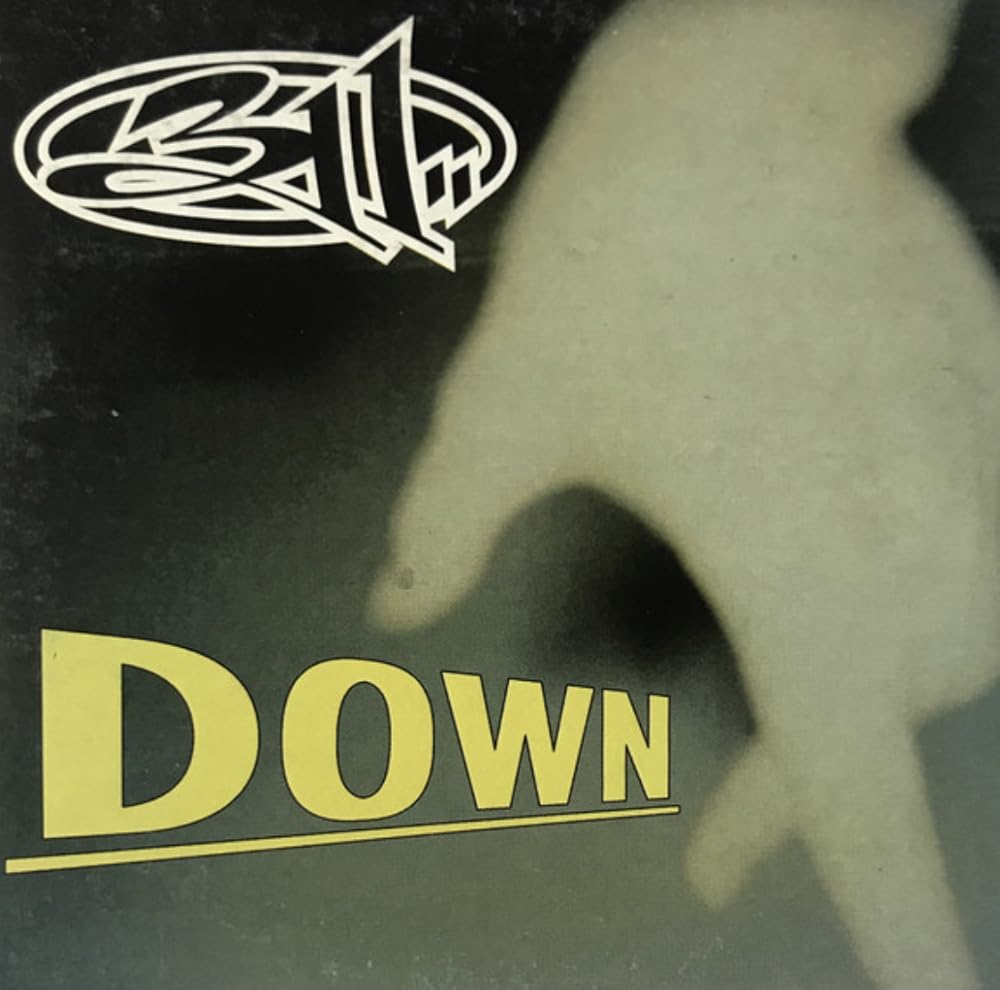
Later, Nick Hexum said that he knew 311 were about to take off and that he addressed that momentum directly on "Down," the first song on the self-titled record. Those lyrics that I quoted up above, the ones about "cheese a lotta bean," are not the real "Down" lyrics. Instead, the hook is Hexum singing, "We changed a lot and then some, some/ Know that we have always been down, down/ If I ever didn't thank you, you/ Then just let me do it now." In a 2015 Songfacts interview, Hexum said that he wanted to thank both 311's day-one fans and the bandmates who'd been on that journey with him from Omaha. He knew that he was about to be famous, so he wanted to get that message out to them first. As it happened, the song where he expressed that gratitude was the one that made him and his bandmates famous.
311 recorded their self-titled album with producer Ron St. Germain, a music business veteran who'd started working as a sound engineer in the mid-'70s. In the '80s, St. Germain produced the great mid-period Bad Brains albums I Against I and Quickness, and I have to imagine that's why 311 wanted to work with him. They recorded their self-titled LP live in the room together, hoping to capture the energy of their shows. The record didn't get much hype when it first came out in July 1995. Lead single "Don't Stay Home" got some alt-rock airplay, but it peaked at #29. I heard it enough times to decide that it was annoying.
Instead, "Down," the second single from 311, was the one that suddenly took off. I have theories. The summer of 1996 was alt-rock radio's great reckoning with rap music. In the moment, the Beck approach was the one that worked most often: dusty breakbeats, mumbled non-sequiturs, ironic distance. But the other thing that surged into the post-grunge vacuum was the snotty, energized pop-punk that broke onto the radio two years earlier with Green Day and the Offspring. There was a whole audience that was just waiting for someone to fuse those two approaches, for white guys to rap awkwardly over bright, adrenalized riffage. 311 were the right band at the right moment.
We'd get a whole lot more bands like 311 in the years after "Down." There were precedents, of course. The Red Hot Chili Peppers had been around for a decade-plus. There were all the other '90s funk-metal bands, the Faith No More and Fishbone types. There was Rage Against The Machine, who were already huge by the time that 311 took off but who were never as big a radio band as you might expect. (Rage's highest-charting Modern Rock hit was "Guerilla Radio," which peaked at #6 in 2000. It's a 9.) But none of those bands had the same mellow hacky-sack vibes as 311, and that's what the world wanted. "Down" even had the extraneous DJ scratching that would become inescapable over the next few years.
We should talk about the rapping. S.A. Martinez, the guy who does the actual rapping on "Down," is not a white guy, but he's still an exemplar of a particular type of white-guy rapping that really caught on for a few years. Guys in rock bands would do this self-impressed staccato singsong thing, an exaggeration of the already-exaggerated Beastie Boys style, and they'd do it over pretty much any kind of music. G. Love, for instance, did it over acoustic gutbucket quasi-blues. That nasal "jyeah" rap approach quickly became the preferred style of Fred Durst types, too. Eminem was such a revelation when he finally came along because nobody knew that white people could rap like that. Eminem was a Scribble Jam guy, and there was a whole multiracial underground of guys like that, but none of them got famous. The guys who got famous in the pre-Slim Shady LP days were the 311 types.
You can't really tell what S.A. Martinez is saying through most of his "Down" verses, and that's probably a good thing. The stuff he's saying is stupid. "While I scatter my spit, I dream of juice": Stupid. "You know we dazzle like ghetto box boomin' battles/ Rattle inside your head, feel redeemed like cola bottles": Stupid. "We're dope, kid, change like the chameleon and the channel whenever the wack show Real World is on": Stupid, and also The Real World was still pretty good back then. But when you can't really hear the words, you just get the cadence instead. You get that this guy is rapping and that he's really feeling himself.
Nick Hexum did plenty of his own clumsy-ass rapping on other 311 songs, but he doesn't do any on "Down." Instead, Hexum sings the obnoxiously memorable hook, and there's a nice little contrast between his deep croon and Martinez's nasal yammer. Some of that 311 energy, which may or may not have a certain color, comes from the way those two voices bounce back and forth. Both guys sound like they're on the same page, but they express it different ways.
We should talk about the riffs, too. The riffs are good! That's where the mid-period Bad Brains influence really comes in. The riffs on "Down" are hard-strutting mosh riffs. They're propulsive and physical and bottom-heavy. They move. But I just can't get past the contrast of the unbelievably silly vocals and those riffs. It's too big of a stumbling block. Plenty of other people didn't have that problem. The first time that I heard Turnstile, a band that will at least theoretically appear in this column one day, I was like, "Wait, that's what hardcore is today? Kids are trying to sound like 311?" I got over it quickly enough, and I love Turnstile now. (So does Nick Hexum.) But 311's sheer goofiness levels were powerful enough to keep me away. I couldn't take them seriously. Still can't.
"Down" took off largely through MTV. In the clip, the guys in the band all meditate in front of a big Latino guy who I guess is supposed to be Buddha. Eventually, Nick Hexum floats into the air and disappears. I don't really know what's going on there. Maybe he finds enlightenment. In any case, 311 look cool in extremely 1996 ways. Even after the Real World disrespect, MTV put the Buzz Bin tag on the "Down" clip, and it went into heavy rotation.
Quickly after "Down" took off on the radio, 311 scored another big hit with "All Mixed Up," a track from the same album. That's the one where my resistance crumbles. "All Mixed Up" has a beautifully lilting quasi-funk groove. The band's version of dancehall toasting is just as clumsy as their version of rapping, but I find it way more charming for some reason. The hook really sticks with me. I had already decided that 311 were stupid, but "All Mixed Up" was the kind of stupid that I like. ("All Mixed Up" peaked at #4 in the early days of 1997. It's an 8.)
After the one-two punch of "Down" and "All Mixed Up," 311 were huge. Their self-titled album went platinum, and alt-rock radio quickly decided that genre-blurring stoner-bro types were the future. It's a short leap from 311 to bands like Sugar Ray and Incubus. Plenty of 311 types will be in this column in the virtual years ahead. As for the real 311, they got way looser and jammier on their next album, 1997's Transistor. That record went platinum, but it didn't get busy at radio the same way that 311 did. The biggest Modern Rock hit from Transistor was the title track, which peaked at #14.
Still, 311 basically ensured their continued relevance by going deeper and deeper into the jam-band universe, and they were part of the alt-rock radio landscape for many more years. The band's 1999 album Soundsystem had another truly goofy radio hit in "Come Original," which peaked at #6. (It's a 4.) 2001's From Chaos also had the #7 hit "You Wouldn't Believe," where has a pretty fun video where Shaq wrecks the band at basketball. (The song is a a 5.) That album also had "Amber," the song that Hexum wrote about his then-girlfriend, the future lead Pussycat Doll and Tony winner Nicole Scherzinger, and about the color of her energy. That song only made it to #13 on the alt-rock charts, but it's probably the band's signature song today. It's got way more streams than any of their other tracks.
Soundsystem and From Chaos both went gold, a slightly more impressive feat in the early Napster era. The band's 2003 album Evolver did not, but it had "Creatures (For A While)," which reached #3, giving 311 their biggest chart hit since "Down." (It's a 6.) They weren't done after that, either. We'll see 311 in this space again. I haven't done the math or the planning, but maybe that future column will run on 311 Day. You jokers have a one in 365 chance. I hope you feel lucky.
GRADE: 4/10
BONUS BEATS: The gleefully offensive grindcore band Anal Cunt released a withering, sarcastic "Down" cover in 1997, except they changed the title to "311 Sucks." Here's their act of musical music criticism:
BONUS BONUS BEATS: Here's the joyously chaotic spectacle of 311 attempting to perform "Down" on The Eric Andre Show in 2015:
BONUS BONUS BONUS BEATS: In 2018, 311 went out on a co-headlining tour with the Offspring, a band that's been in this column once and that'll eventually be back. As part of the tour promo, the two bands covered each other's songs. Here's the Offspring's take on "Down," which is less sarcastic than the Anal Cunt cover but not that much less sarcastic: