
January 23, 1993
- STAYED AT #1:6 Weeks
In The Alternative Number Ones, I'm reviewing every #1 single in the history of the Billboard Modern Rock Tracks/Alternative Songs, starting with the moment that the chart launched in 1988. This column is a companion piece to The Number Ones, and it's for members only. Thank you to everyone who's helping to keep Stereogum afloat.
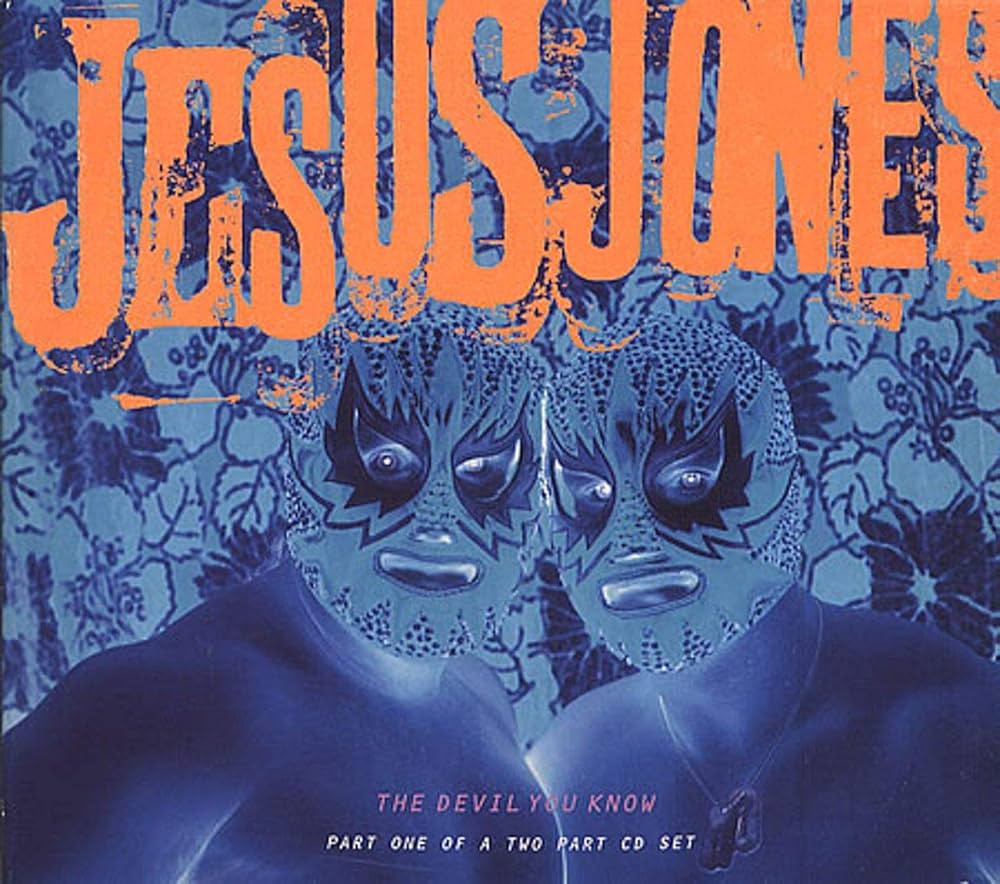
Look, I don't know what to tell you. I'm as baffled as you are. Jesus Jones? In 1993? For a song that's not "Right Here, Right Now"? For a song that came out years after "Right Here, Right Now"? And it was #1 on the Modern Rock chart for six weeks? Surely, somebody is playing a joke on us. This must be some kind of Wikipedia prank. It's simply not possible. But it happened. I've looked at the scans of the old Billboard issues, and it's all right there in the historical record. For six weeks at the beginning of 1993, a Jesus Jones single called "The Devil You Know" was the #1 Modern Rock song in America. It doesn't make any sense, but there it is.
I was listening to Modern Rock radio in 1993, and I do not remember ever hearing "The Devil You Know." Maybe I heard the song all the time and it simply wasn't memorable enough to leave a deep impression on my 13-year-old brain. Maybe I never heard the song, and it simply owes its chart success to alternative rock stations in the other parts of the country. Maybe money changed hands under the table and someone used underhanded means to get Jesus Jones those chart numbers. Maybe everyone assumed that Jesus Jones' next single would be massive after the gigantic crossover chart success of "Right Here, Right Now." Maybe "The Devil You Know" always just happened to be on the radio when I was asleep or watching Renegade or whatever. I don't know! It's a mystery!
Even more mysterious: It seems that I am not the only person with no memory of "The Devil You Know." The song has no Wikipedia page. If you add up the YouTube and Spotify numbers, it just barely inches past the million-stream mark. (I might've pushed it there while researching this column.) To the extent that anyone remembers Jesus Jones' 1993 album Perverse, it's to call that record an over-ambitious, career-ending calamity. 1993 was the year that fuzzed-out alt-rock really took over American pop culture, and it's hard to wrap my head around such a big chunk of that year, at least as far as this column is concerned, belonging to a record that has vanished from the cultural memory. As the bottom of this column will attest, "The Devil You Know" blocked a bunch of better-remembered songs from the #1 spot, too.
But "The Devil You Know" definitely represented someone's idea of the future, or maybe of the 1993 present. The members of Jesus Jones were quite dismissive of their rock 'n' roll contemporaries, and they were trying to push things forward. They didn't succeed, but they did manage to foreshadow a few things. Today, we can look at "The Devil You Know" as a path not taken. On its own merits, it's also a decent-enough song.
There's at least some possibility that Jesus Jones' Perverse is the first rock album to be recorded almost entirely on computers. That's the way that the record was presented to the world, anyway. Bandleader Mike Edwards was increasingly unimpressed with his various guitar-rock contemporaries, who he saw as being hopelessly retrograde. In one interview, Edwards dismissed the stuff at the top of the British charts as "pseudo-young music made by pseudo-young people." Without specifically identifying hyped-up UK newcomers Suede, Edwards also called out "these cabaret-impression '70s bands on the covers of the British music press... it’s just people reliving their childhoods."
In that same interview, Edwards talked about the music that actually did inspire him: "I can't think of anyone releasing an album this year, however, that I am looking forward to hearing. Depeche Mode, maybe. But if I'm asked what I’m listening to or who I’m influenced by, it would be a whole lot of currently obscure techno musicians, like the Aphex Twin." He loved Aphex Twin, and it seemed obvious to him that computers were the way forward. The surprising success of Jesus Jones' Doubt album, and of the big hit "Right Here, Right Now" in particular, gave Edwards the latitude to make whatever weird shit he wanted. He thought he'd gone out of his way to make something accessible with that record, and he didn't want to do that again.
As one Melody Maker feature put it, Mike Edwards once claimed that Jesus Jones' Perverse would be "the second rock album of the '90s." To him, Swiss industrial band the Young Gods' 1992 LP TV Sky was the first, and everything else was a hopeless attempt to recreate something from the past. In that Melody Maker story, Edwards kept going:
People say there's something to be said for gritty authenticity, like MTV Unplugged, but there's no longer anything to be said for it. Where the electrification of the guitar used to be the best thing to ever happen to music, now it's the sampler. It's the excitement generated by music that's important, not whether the musician is a sincere and authentic craftsman.
The British music press falls all over itself for that egotistical Icarus talk; it's the kind of thing that can follow an artist around forever. I think Edwards was doing his best to rationalize and publicize the methods that Jesus Jones used when they made Perverse. Edwards wrote the album's songs at his keyboard, often while touring. He moved into a new house in London, and he built a home studio full of newfangled electronic gadgets, as well as a backyard skatepark. Other than his voice, pretty much every sound on the album was fully electronic, and he put all of it onto floppy discs, the best storage method that existed in the moment, before bringing them to an actual studio.
Edwards insisted that his recording style wasn't all that radically new, since all the techno producers who he loved were doing something similar. But Edwards wasn't really trying to make techno, though there was certainly plenty of rave influence on the record. Instead, he wanted to use those techniques to make a rock record. He'd just do it with midi guitars and drum pads, rather than guitars and drums. As a result, Perverse was a much more expensive album to record than Doubt. It must've been a huge pain in the ass, too. Rather than producing Perverse himself, Edwards enlisted Warne Livesay, a veteran alt-rock producer who's already been in this column for his work on Midnight Oil's "Forgotten Years" and "Blue Sky Mine." Edwards wanted Livesay because of what he'd done on The The's 1986 LP Infected.
With all these resources at his disposal, Mike Edwards mostly succeeded in making a record that was maybe two years ahead of schedule. I like the blippy momentum of Perverse, but it's a deeply dated record, and it's not really all that different from what UK indie-dance groups like the Shamen were doing at the time. Edwards evidently didn't see indie-dance types like Primal Scream as his contemporaries, but he didn't do that much to separate himself from them. Most of the tracks on Perverse would've fit just fine on the Hackers soundtrack in 1995. The record is just crammed with that naive ultra-'90s "whoa, technology" vibe. It's all right there in album opener "Zeroes And Ones." Edwards sings that binary code "will take us there": "This time, the revolution will be computerized/ You'll know it as you do it, in real time before your eyes."
What an optimistic guy! Jesus Jones made their big mark with "Right Here, Right Now," a song that really preserves a brief moment of post-Cold War utopian sentiment, an idea that humanity had finally reached some elusive promised land. That feeling did not last. Neither did the attitude that seemingly animated Perverse. At the time, there was a lot of press about Perverse being the classic "darker follow-up album" move, but it's more about that early-internet techno-hippie feeling that computers would be the great equalizer that brought everyone together. They did bring everyone together, and now we're all free to share corrosive rage-bait in our own isolated bubbles. Zeroes and ones took us there, but I'd rather be someplace else.
Zeroes and ones didn't take Jesus Jones to the place that they might've wanted to be, either. One of the real strengths of Doubt was the way that Mike Edwards' starry-eyed pop songs interacted with the band's of-the-moment dance-rock grooves. I'd never heard Perverse before working on this column -- I was only dimly aware of its existence -- but I don't think the songs are really there. They're fine, and the rave-adjacent production is fun. After a few listens, though, I couldn't hum you any of these songs. When you're making big statements about the future of rock 'n' roll, you need to really come with something, and the music on Perverse is too slight to register in that way.
It's almost heartbreaking to think that Mike Edwards really thought he had a new-world anthem on his hands with "Zeroes And Ones." The song got a bunch of remixes that have probably aged better than the original version. Aphex Twin did two different remixes of "Zeroes And Ones," and the Prodigy did another one. All the remixes are pretty sick, and all of them only have the barest resemblance to the Jesus Jones original. Aphex Twin ended up putting his second "Zeroes And Ones" remix on his 2003 compilation 26 Mixes For Cash, which is pretty funny. (Aphex Twin doesn't have any Modern Rock chart hits, but the Prodigy have a couple. 1997's "Breathe," their biggest hit on that chart, peaked at #18.)
In any case, "Zeroes And Ones" wasn't the lead single from Perverse. Instead, that honor went to "The Devil You Know," another song that seems to be all about seizing the moment and living in the now. On that one, Mike Edwards sings in a purposeful sigh: "Time that I took what's mine, took it now." At least for me, Edwards' "The Devil You Know" lyrics don't cohere into a meaningful picture, but he sings about escaping from "the ghost of the past" and maybe about the promise of the future: "Look at you now, look at you then, see how you will be/ All of your life belongs to me." Maybe he's singing from the perspective of the devil that you know? I couldn't tell you. Maybe it's confirmation bias, but I hear "The Devil You Know" as another piece of futurism about leaving old things behind. Honestly, though, that's already probably more scrutiny than Jesus Jones lyrics were built to bear.
The point of "The Devil You Know" isn't the lyrics; it's the way the sounds stack up on top of each other. It opens up with a tingly cascade of sampled notes. In one of the above-mentioned interviews, Edwards says that the track was really built on that riff: "'The Devil You Know' is an example of where a sample starts the songs: at the beginning is a very high-pitched Iranian instrument. I really liked that, so then I started collaging sounds on top to get more of a mood. Once that starts, then you work with the structure of it as a song."
That sample runs all through the track, and it lends it a dazed, otherworldly feeling. I really like all the different sampled and sequenced sounds that the band stacks on top of that sample: guitar-crunches, echoing drum-breaks, swooshes of keyboard. Edwards' voice has reverb all over it, and it's almost like we're hearing him howling from across a canyon. Especially given the not-that-advanced technology that Jesus Jones had at the time, the waves of sound are pretty impressive, and it reminds me a bit of the techno-influenced, retail-friendly dance-pop that came along later in the '90s. But the song underneath all that sound isn't sticky enough to cut through. It's a pleasant shrug that's been elevated by its production, and it doesn't have enough of a tune to linger in my memory. Maybe that's why I have no recollection of the song getting alt-rock radio play. Maybe I heard it and it just slipped away.
The video for "The Devil You Know" is a great little time capsule that could've only existed in the early '90s. The choppy film stock, the exaggerated camera angles, and the blinding lights all anchor it to its moment. But the fashion is what really does it: the tight and shiny black vinyl, the goatees, the whiteboy dreads. British dance-rock bands loved those whiteboy dreads. There's not much to it beyond the way those guys look, though we do get multi-colored paint dripping off of hands and models staring at the camera while holding up cardboard signs with adbusting slogans: "racism sees no color," "I [heart] future," "use condom," etc. It's all dumber than fuck, but it's dumb in a way that now triggers instant nostalgia in old people like me.
This burst of imagery did not keep Jesus Jones on top. Perverse got skeptical reviews, and while it charted in a bunch of countries, it didn't sell anywhere near as well as Doubt. On their own website, Jesus Jones write, "The fallout from Perverse would take years to settle, and would change all of us. We were never quite the same band again -- Mike would be particularly stung by its reception, and it took him a while to recover his songwriting mojo." Their follow-up single "The Right Decision" peaked at #12 on the Modern Rock charts, and then Jesus Jones never charted in America again.
Jesus Jones didn't release another album until 1997's Already, and that one vanished without a trace. After that, Jesus Jones lost their label deal, and their next two albums came out independently, many years apart. But credit where it's due: Jesus Jones stayed together, and they're still a band today. Earlier this year, they toured with their unlikely crossover contemporaries EMF. These days, a whole lot of rock bands record in ways not that dissimilar from how Jesus Jones put Perverse together, but it didn't stop that album from fading from memory. Today, Jesus Jones are mostly remembered for one hit, and that one hit is not "The Devil You Know." Maybe one day, the world will wake up to this particular piece of history. Probably not, though.
GRADE: 6/10
BONUS BEATS: "The Devil You Know" peaked at #10 on the UK pop charts, so Jesus Jones got a chance to lip-sync the song on Top Of The Pops. In fact, they gave the first TOTP performance of 1993, and they did it in front of a big "1993" sign, with fireworks. With everything about the performance -- the clothes, the whiteboy dreads, the instruments that clearly don't correspond with anything happening on the song -- you could've easily pegged it to 1993 even without that sign. Here's it is:
https://youtube.com/watch?v=6hgnP38MBro
THE NUMBER TWOS: This is another one of those situations where there are too many songs that peaked underneath the main one, so I'll have to just link out to the Bonus Beats videos. First up: R.E.M.'s twinkling jangle-jam "Man On The Moon," the song that gave the Jim Carrey Andy Kaufman biopic its title, peaked at #2 behind "The Devil You Know." It's a 9.
(Bonus Beat: !!!'s funky, hard-strutting 2021 cover.)
Duran Duran's starry-eyed and restrained adult-contempo comeback ballad "Ordinary World" also peaked at #2 behind "The Devil You Know." It's an 8.
(Bonus Beat: Matthew Vaughn using that song to soundtrack some violent violence in the 2004 crime flick Layer Cake.)
One more: The The's sweaty harmonica-honking rocker "Dogs Of Lust" peaked at #2 behind "The Devil You Know." It's another 8.
(Bonus Beat: Foetus main man JG Thirlwell's superior Germicide mix.)
THE 10S: Soul Asylum's fuzzed-out, heart-on-sleeve shit-town lament "Black Gold" peaked at #6 behind "The Devil You Know." If you don't think it's a 10, then brother you ain't my kind.
(Bonus Beat: "Weird Al" Yankovic's parodic pastiche "The Night Santa Went Crazy.")