May 1, 1993
- STAYED AT #1:6 Weeks
In The Alternative Number Ones, I'm reviewing every #1 single in the history of the Billboard Modern Rock Tracks/Alternative Songs, starting with the moment that the chart launched in 1988. This column is a companion piece to The Number Ones, and it's for members only. Thank you to everyone who's helping to keep Stereogum afloat.
It's a miracle that New Order ever existed. This was a band formed out of grief and tragedy. The three surviving members of Joy Division were suddenly without their generational frontman, who took his own life just as the band was gathering steam. Instead of that guy, they had to make do with guitarist Bernard Sumner, whose lyrics felt like place-holders and who always seemed faintly embarrassed to be singing. This band should not have worked, but they went on to exceed Joy Division at pretty much every level and to change the sound of left-of-center music for generations. That's miracles on top of miracles. That's pretty good.
In their first decade as a band, New Order figured out how to take stark and meditative post-punk to the club -- to fuse the joyous mechanics of synth-based dance music with the dour expressiveness of the stuff that they grew up making. They released anthem after anthem. They became pop stars in the UK, and they basically defined alternative music in the US when "alternative" first became a Billboard-recognized radio format. (1989's Monsters Of Alternative Rock tour, an important Lollapalooza precursor with an on-the-nose name, had New Order headlining over Public Image Ltd., Throwing Muses, and the Sugarcubes.) They accomplished a lot, and then they effectively broke up.
New Order have broken up many times over their long lifespan, and their first breakup didn't become public knowledge until years later. These people were all good and sick of each other, and they only got back together in a failed last-ditch effort to save Factory Records, the iconic indie label that they'd been bankrolling for most of its history. In the process, they made a glittering, humming pop masterpiece that became their biggest-ever American hit. That song was also the Billboard Modern Rock chart's #1 track of 1993 -- the year that synthy and arty British music finally lost its hold over American alternative radio. Once again: Pretty good.
This isn't a column about Joy Division, but every conversation about New Order has to begin with Joy Division. That was a miracle of a band, too. Joy Division came together in the earliest days of Manchester's punk scene, quite literally. Bernard Sumner famously met bassist Peter Hook at the Sex Pistols' first-ever Manchester show in 1976. The deeply depressed heavy-baritone singer Ian Curtis became their frontman, and they found drummer Stephen Morris by putting an ad in a music-shop window. Manchester TV presenter Tony Wilson caught on to what they were doing, and he signed them to his brand-new label Factory Records. They recorded two perfect albums of spaced-out dark reveries with producer Martin Hannett, and people are still ripping them off today. Then Ian Curtis hung himself on the night before Joy Division were supposed to head out for their first US tour. He was 23.
How do you recover from something like that? Maybe you never do. I was an infant when Ian Curtis died in 1980, so I can't tell you anything firsthand about where Joy Division's career was at the time of his passing. But Joy Division weren't exactly stars at that point, and I have to assume that lots of people heard of the band for the first time when the news of Curtis' suicide came out. A month after his death, Joy Division released their single "Love Will Tear Us Apart," and it became a top-20 hit in the UK. That's probably mostly because it's an all-time classic song, but I bet the strange glamor of the young dead artist added to the appeal.
I don't know how Curtis' bandmates decided to keep going after his death, but that's what they did. Just a few months after Curtis died, all three surviving members were already recording demos. They knew better than to keep using the Joy Division name, so they initially called themselves the New Order Of Kampuchean Rebels, after a headline that manager Rob Gretton saw in The Guardian. They also apparently thought about calling themselves the Witch Doctors Of Zimbabwe, and it's a good thing that they didn't. Before long, they shortened their name to just New Order, and that's a good thing, too.
By the end of 1980, the newly constituted New Order were touring the US, the thing that Joy Division never got to do, as a trio. Initially, all three of them traded off lead vocals, but Bernard Sumner eventually emerged as the frontman, even though he wasn't comfortable singing and playing guitar at the same time. Joy Division were already messing around with keyboards when they were still a band -- Sumner played them on "Love Will Tear Us Apart" -- and Stephen Morris' girlfriend Gillian Gilbert quickly joined the band on keyboard and occasional guitar. New Order's debut single "Ceremony," released early in 1981, was just a leftover Joy Division song, re-recorded with Sumner on vocals. It was a top-40 hit in the UK, and it fucking rules.
New Order recorded their 1981 debut album Movement with Martin Hannett producing, and it basically sounds like a Joy Division album without Ian Curtis. Even early on, though, New Order didn't tap into the heavy-hearted darkness that so many of Joy Division's disciples adapted. You can hear a strange sense of optimism even in "Dreams Never End," the opening track from Movement. Peter Hook, in a relatively rare lead-vocal turn, sings the whole thing in a frog-throated Curtis impersonation, but the track has a melodic lift that feels new. In the years that followed, that lift would become more and more pronounced.
When they were working on that first album, the members of New Order got Martin Hannett to show them how to work a mixing board, and then they mostly produced themselves in the years ahead. Visiting New York while promoting Movement, New Order learned about all the synthy post-disco dance music that was bubbling on the city's underground club scene, and they fell in love. Stephen Morris taught himself to program drum machines, and the band locked into a starry-eyed synth-rock groove on 1982's "Temptation," the first New Order single that really sounds like a New Order single. And then came "Blue Monday," the club-rocking 1983 freakout that became, by some estimates, the highest-selling 12" single in UK history.
"Blue Monday" was a top-10 hit in the UK, and then it went even higher on that chart when the band got fucking Quincy Jones to remix it in 1988. Synthpop existed as both a creative and commercial force years before "Blue Monday," but I don't think I'd be overstating things if I claimed that "Blue Monday" is the all-time definitive synthpop hit. It's as spartan and unforgiving as Joy Division, except it renders its minimalism in future-shocked electronics. Every element of the track works as a hook -- the synth-string riff, the stomping bass, the whump of the drum machines, the freakout drum-break, even Bernard Sumner's sad-robot vocals. "Blue Monday" single sales essentially kept Factory Records afloat, and New Order helped in that effort by continuing to crank out banger after banger.
There are so many classic New Order songs. I know this, and yet I'm overwhelmed whenever I look at everything that the band released in a relatively small window of time. "Age Of Consent”? "Vigilantes Of Love”? "The Perfect Kiss”? "True Faith”? Forget it. It's not even fair. These songs were culture-smashing anthems in the UK. On this side of the Atlantic, they were more like culty critical-fave curios. New Order's singles were showing up on the Pazz & Jop poll from the very beginning. By critical consensus, "Ceremony" was the #12 single of 1981 -- right behind Rosanne Cash's "Seven Year Ache," right ahead of Bob Dylan's "The Groom's Still Waiting At The Altar." -- Tracks like "Blue Monday" got heavy club play over here, too. But New Order didn't show up on the Hot 100 until 1987, when "True Faith" peaked at #32.
So the numbers don't tell the story. Instead, New Order wrote their place in history through the messy force of cultural change. The band's experiments with synth-driven club music were fully-formed and inviting, and they directly helped set the stage for the euphoric acid-house wave of the late '80s. One of the UK's chief incubators of rave culture was the Haçienda, the Manchester nightclub that Tony Wilson opened in 1982. When the Haçienda struggled, the members of New Order signed on as Wilson's loan guarantors. That means they weren't just musically influential; the place literally couldn't have continued to exist if not for their efforts. On top of that, New Order's music helped the British public learn how to appreciate blips and thumps, which softened the ground for acid house. When acid house caught on, New Order updated their sound accordingly. You can hear its influence on their 1989 album Technique, which happened to be the band's first to come out after Billboard started its Modern Rock chart.
The Technique singles did well on the Modern Rock chart. "Fine Time" made it to #3, while "Round & Round" peaked at #6. ("Fine Time" is a 9, and "Round & Round" is a 10.) In 1990, the band released "World In Motion," the official World Cup anthem for that year's English national soccer team. The band wanted to call it "E For England," but the various authorities put a stop to that. Still, the spirit came through. "World In Motion" became New Order's only #1 hit in the UK. That song, with its clumsy-ass rap from British player John Barnes, is total gobbledygook to American ears, but our alt-rock radio programmers still had enough brand loyalty that it reached #5. (It's a 5.) That was the last New Order single for a while, since the band members wanted to go off and do other things.
During New Order's long stretch between albums, Bernard Sumner made Electronic records with the former Smiths guitarist Johnny Marr, and their song "Get The Message" has already been in this column. Peter Hook made solo dance music under the name Revenge, and he made it to #8 with his 1990 single "Pineapple Face." The other two members, Stephen Morris and Gillian Gilbert, started a group that was literally called the Other Two, and they just barely ooched onto the Modern Rock chart when their 1994 track "Selfish" peaked at #30. These people were all severely annoyed with one another, and they were also into various different drugs. They had no interest in continuing to function as a band. Eventually, though, they got back together for a specific purpose: Factory Records needed them.
In a 2017 video interview, Peter Hook described New Order's internal vibe at the time like this: "Literally, you're at the point in the relationship where you hate each other's stinking guts. And somebody is to say to you, 'Would you get back together, you and him?' At that moment, you would say, 'I would rather die.’" But the band had a financial interest in keeping both Factory Records and the Haçienda going. They'd already given the label a #1 hit, but Factory continued to hemorrhage money. Hook says that the band was "browbeaten" into making another album, convinced that people would come for their money if the club and label went bankrupt. Hook, Morris, and Gilbert all went off to make instrumental tracks, and then Sumner came in and reworked everything. After that, they all got into nasty fights over publishing splits, and the band was once again doomed for a while.
Probably because the band members weren't getting along, New Order didn't produce their 1993 album Republic on their own. Instead, they brought in Stephen Hague, an American best-known for producing British bands. (Hague has already been in this column for his work on Siouxsie And The Banshees' "Kiss Them For Me" and Public Image Ltd.'s "Disappointed." Don't send that guy to the Hague.) New Order had a miserable time making the album, and they did not accomplish the goal of saving Factory Records, which went out of business in 1992. As it turned out, New Order never had an official contract with Factory, so instead they released Republic on London, the label that considered buying Factory mostly so that they could get that nonexistent New Order contract. As far as I can tell, nobody ever came for the band members' money, and the Haçienda held on until 1997.
For the most part, Republic is a good-not-great New Order album. It doesn't carry many echoes of the acid house and Manchester baggy scenes that the band inspired. Instead, it's New Order sounding like themselves, at a time when alternative rock music was moving on to different things. In his SPIN review, Eric Weisbard wondered if New Order even had a place on the circa-'93 sonic landscape and scolded the band for not fully embracing rave sonics, as Big Audio Dynamite and Jesus Jones were doing. But if you jumble the band's Republic tracks in with the rest of their songs on a playlist, they don't exactly stand out as being all that different. Once they settled on their sound, New Order never made any significant changes, only slight tweaks here and there. Since New Order's base-level sound was fucking awesome, their entire catalog has aged beautifully. Even when they were at their lowest as a band, New Order were capable of making something perfectly solid. At times, they were even capable of making something great. That's "Regret."
"Regret" started as an instrumental demo that Peter Hook, Stephen Morris, and Gillian Gilbert recorded together at the home studio that Morris and Gilbert built at their farm. Then Bernard Sumner wrote some bittersweet lyrics about a permanently out-of-reach state of happiness, and he played some beautiful parts on a guitar that he borrowed from Johnny Marr. (I don't mean that Sumner ripped off Marr's guitar tone. I mean he literally borrowed the instrument from Marr.) There's no real science to the way "Regret" works. It's just a moment that all the old New Order parts came together and complemented one another perfectly. Peter Hook has acknowledged "Regret" as "the last great New Order song." I think they had some really good ones after "Regret," but I'm not going to sit here and argue with the man.
On "Regret," Bernard Sumner sings about life goals that almost seem boring in their attainability: "I would like a place I could call my own/ Have a conversation on the telephone/ Wake up every day, that would be a start/ I would not complain of my wounded heart." But he doesn't structure those lyrics as inward diary musings. Instead, he's talking to someone else about his failure to achieve those things with this person: "You may think that I'm out of hand, that I'm naive, I'll understand/ On this occasion, it's not true/ Look at me, I'm not you." For years, I heard that last part as "I love you," and the whole tone of the song changes when you realize what it actually is.
Bernard Sumner sings that he has no regrets, even if he's forgotten the name and the address of everyone he's ever known. (I feel you, buddy. I am terrible with names, and I live in constant fear of running into someone at the supermarket and being like, "Oh, what's up, um, dude?" I watch people's faces fall when I can't remember their names, and I feel like shit.) It could be that Sumner is singing about the struggle of still being in this band as he gets older. Or it might not be that deep; it's always hard to tell with him. Sumner tends to write ultra-simple lyrics that hint at deeper truths that he can't quite express. It's one of the most endearing things about him -- the way his voice always sounds slightly shell-shocked, as if he can't hide his dismay at his own limited lyrical vocabulary. Somehow, that quality always makes New Order's songs more affecting, not less.
"Regret" is a sad song on paper, but that's not how it sounds. The music sparkles. From the very first moment, where the jangle-drunk guitar line and the hum-sigh keyboard answer each other, the instruments sound like they're talking to one another. Through the whole song, they're pieces of a machine. New Order's magic interplay isn't something that other bands can replicate. There's no rhythm section in New Order. Instead, every instrument keeps the beat, just as every instrument brings layers of feeling. On "Regret," Peter Hook's bass does as much to carry the melody as Bernard Sumner's vocal. How many songs in this column will feature prominent bass solos? Not many, probably. But the bass solo on "Regret" is perfect, and it's just as important to the track's feeling as Sumner's lyrics.
New Order did not speak to the 1993 moment when they made "Regret." They simply did their New Order thing, and they did it about as well as they've ever done it. The song glides along and gives the distinct impression that it's almost abashed by its own beauty. I have never attempted to rank my favorite New Order songs because why would anyone ever do such a thing? Why pit all these wonderful tracks against each other? It's simply enough that they exist -- a decade-plus run that works in perfect harmony with itself. But if someone were to tell me that "Regret" is the best song that New Order ever made, I'd shrug and say, "Sure, why not?" It's one of the best New Order songs, and that alone is amazing.
New Order knew that they had something special with "Regret," and they made it side-one track-one of Republic. They did a lot of that. The following songs are opening tracks on New Order studio albums: "Dreams Never End," "Age Of Consent," "Love Vigilantes," "Paradise," "Fine Time," "Crystal." Pretty good! In most of those cases, the albums are rock-solid enough that they don't even peak with those openers. This was not the case with Republic. There's a lot to like about Republic, but it's all downhill after "Regret," and that probably affected the album's reception. When you start a pretty-good album with a great song, you're in dangerous territory.
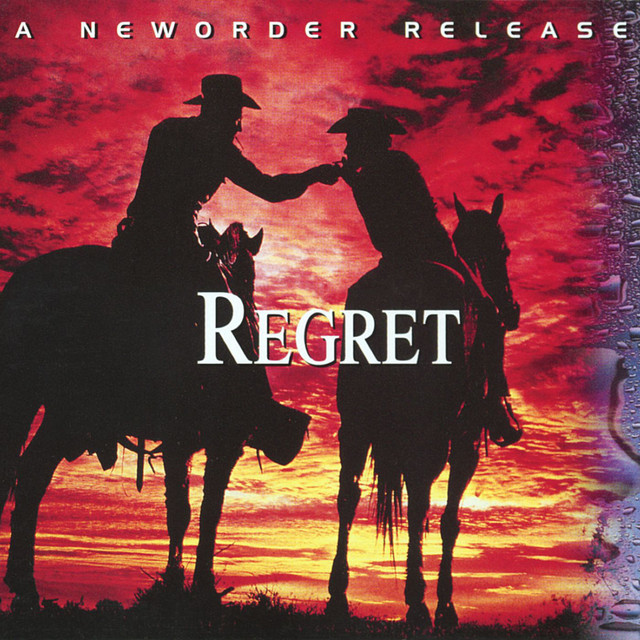
"Regret" was a big hit around the world. In places like Canada, the Netherlands, and Ireland. "Regret" went top-10 on the pop charts. On the Hot 100, "Regret" made it to #28, which makes it the biggest US hit of the band's career. In the UK, "Regret" went all the way to #4. When the band promoted the song on Top Of The Pops, they didn't lip-sync in the studio. Instead, they went to Los Angeles and filmed themselves lip-syncing on the literal set of Baywatch, complete with a cameo from David Hasselhoff. From what I can tell, this was largely regarded as a cheesy stunt at the time, but the absurdity feels absolutely joyous now. It was probably the point, too. In putting together the art for Republic and "Regret," the late Factory designer Peter Saville was trying to capture the strangeness of American culture, and god knows we gave him plenty of material. The Top Of The Pops "Regret" performance taps right into that, way more than the actual postcard-style music video that the band shot in Rome.
New Order followed "Regret" with "Ruined In A Day," which stalled out at #30, but they scored another Modern Rock hit when their track "World (The Price Of Love)" made it to #5 later in 1993. (It's an 8.) By the time that song reached its chart peak, New Order were already done. In August of '93, New Order headlined the last night of the Reading Festival, and it was their last show for years. New Order had once again effectively broken up without announcing it, but they remained relevant on alt-rock radio anyway. In 1994, the Australian group Frente! made it to #10 with a twee acoustic cover of "Bizarre Love Triangle," and it didn't even seem ironic. (It's a 6. Frente!'s highest-charting Modern Rock hit, 1994's "Labour Of Love," peaked at #9. That one is a 7.)
Five years after Republic, manager Rob Gretton convinced New Order that they should get back together. That reunion led to the release of 2001's Get Ready, a pretty-great late-career record that did well in the UK but didn't really impact the American alt-rock landscape. But the Killers, a band that will eventually appear in this column, took their name from the fake band in New Order's 2001 "Crystal" video. New Order still found ways to influence the kids, even if it was by accident.
Ever since Get Ready, New Order have been in well-earned legacy-act mode. They've released two more albums since then, and they've also parted ways with Peter Hook, who's basically been making fun of Bernard Sumner on a full-time basis since 2007. Hook and Sumner have been at war in the courtroom, too. New Order broke up again, and they reunited again. Two years ago, New Order and Joy Division were nominated for the Rock And Roll Hall Of Fame as one single act, though they didn't make it in. These days, New Order tour arenas around the world, and they'll headline the big California retro-goth festival Cruel World in a few months. That's fine. Nothing is ever going to hurt New Order's legacy. It's written in stone. It was probably written in stone before "Regret," which stands now as one more miracle in a career full of them.
GRADE: 10/10
BONUS BEATS: Here's the excellent Greg Dulli solo-piano "Regret" cover that the Afghan Whigs released in 2016:
(The Afghan Whigs' highest-charting Modern Rock hit is "Debonair," which peaked at #18 in 1993.)
THE NUMBER TWOS: Radiohead's "Creep," the overplayed but undeniable grunge-adjacent mope anthem that threatened to turn them into one-hit wonders from jump, peaked at #2 behind "Regret." It floats like a feather in a beautiful world, I wish I was special, it's so fuckin' special, it's a 10.