
June 16, 2018
- STAYED AT #1:1 Week
In The Number Ones, I'm reviewing every single #1 single in the history of the Billboard Hot 100, starting with the chart's beginning, in 1958, and working my way up into the present. Book Bonus Beat: The Number Ones: Twenty Chart-Topping Hits That Reveal the History of Pop Music.
Well, shit, it happened again. I write a column ahead of time, and then there's some weekend cultural event that needs to be addressed. It's been, what, four columns in a row now? That means that I have to rewrite the whole thing at the last minute, or at least seed references to the event throughout what I've already written. This time, though, the weekend event is relevant to the performer but not to the song, so I'm just going to mention it up top and then go back to our regularly scheduled programming.
Over the weekend, the surviving members of Nirvana played together at the Saturday Night Live 50th-anniversary concert. They've done that a few times in recent years, and they've always had a series of women -- St. Vincent, Joan Jett, Kim Gordon, Lorde, Dave Grohl's daughter Violet -- standing in for the late Kurt Cobain. There was also that one time where it was Paul McCartney. This time, it was Post Malone. Posty got up there in a long-sleeve thermal, smoking a cigarette the whole time, and he led Nirvana through "Smells Like Teen Spirit," which happens to be that band's highest-charting single. ("Smells Like Teen Spirit" peaked at #6 in February 1992, three years before Post Malone was born. It's a 10.)
Post Malone and Nirvana’s full performance at the #SNL50 Anniversary Concert. #PostNirvana pic.twitter.com/FUJT1Rikvx
— Pop Truther (@poptruther) February 15, 2025
This odd hybrid beast had its roots in a COVID-era livestream set of Nirvana covers that Post Malone played. People liked that. People seem decidedly more mixed on what Adam Sandler introduced as "Post-Nirvana." But to the extent that something like this can be said to be pretty good, Post Malone did a pretty good job. I don't know, man. Other than Post Malone's involvement, "Smells Like Teen Spirit" has nothing to do with the Post Malone single "Psycho," so let's just get into the column that I already wrote. It starts like this:
If you were watched Post Malone and Ty Dolla $ign's "Psycho" video with the sound off, without any other context, you might think it was the hardest rap song of all time. First off, it's called "Psycho." Psychos are scary, right?The clip opens with a tight close-up on Post Malone's squinty, tatted-up face. As the camera pulls back, we see that he's perched atop something that looks like tank but without a turret. Wikipedia tells me that it's a FV103 Spartan armored personnel carrier, and it looks cool, especially with its cryptic flags fluttering in the wind and its sides covered in what appears to be graffiti art.
Post Malone rides his not-a-tank through a barren desert, briefly encountering a little feral kid like the one that Mad Max finds in The Road Warrior. He skulks through aircraft hangers and apocalyptic junkyards. Eventually, he encounters a Spirit Halloween decoration-level werewolf, and he kills it with a flamethrower. Flamethrowers aren't supposed to kill werewolves; we must be working with some unconventional version of that mythology. Then it's a flash-forward to a nighttime scene, and Post Malone and Ty Dolla $ign are smoking weed in what looks like the wreckage of a crashed airplane as snow drifts softly down all around them. They wear beautiful, luxuriant full-length furs. If some mysterious cataclysmic event has devastated the rest of society, it has not touched these two at all. They are chilling.
Given all the things that we know about music-video grammar, a song with that video should sound like DMX in 1999. It should be all barks and screams and Casio clonks and skull-shatter drum sounds. But look closer at this hypothetical muted video and you might notice that Post Malone and Ty Dolla $ign never snarl directly into the screen. The camera doesn't shake or cut quickly; its movements are fluid and graceful. Even when the two vocalists scowl, it's a peaceful kind of scowl. If you picked up on those clues, then maybe you wouldn't be shocked when the sound came on.
"Psycho" is not the hardest rap song of all time. It's not quite clear that the song even qualifies as rap, though the lyrical flexes are at least rap-adjacent. "Psycho" does not go for rupture. It doesn't even try to grab your attention. The first sound that we hear on "Psycho" is an acoustic guitar, or maybe a synthetic harpsichord. It's slathered in the digital reverb that was so popular in late-'10s pop records. The beat never really drops or even kicks in. Instead, the drums and bass-tones arrive calmly and without fanfare. Mostly, what we hear is empty space, ornamented with soft and minimal keyboard notes and the type of sub-bass that can turn a car ride into a seismic event but that might not even register if you play the song on laptop speakers.
Over that amniotic, barely-there backdrop, Post Malone and Ty Dolla $ign talk about how fly they are, but they do it gently and sleepily. The two artists' singsong cadences come from rap, but they sing sweetly through grainy, soulful accents and a few layers of tastefully applied Auto-Tune. It's a weirdly pretty drift of a song, one that seems engineered specifically to fade into the background. Maybe it comes up on a playlist, and maybe you barely register the song's presence before it's over. It's pleasantly breezy in the way that only a completely empty thing can be. When it's over, you might struggle to remember anything beyond a few sounds or images, as of it's an indolent daydream that fades from your mind the second that you need to focus on something.
In 2018, this kind of sleekly vague, precisely imprecise quasi-rap didn't just occupy the most lucrative echelons of rap. It basically subsumed pop music entirely. In the peak Drake era, even the non-Drake #1 hits had that Drake feeling to them -- that rapping-but-singing digital mist that could soundtrack efficient data-entry work just as easily as it could serve as party music. "Psycho" isn't an exceptional example of the form, but it's not bad. It'll do.
"Psycho" was Post Malone's follow-up to "Rockstar," the moody-hazy party song that dominated the Hot 100 for the last few months of 2017. (If I was writing the "Rockstar" Number Ones after Post-Nirvana, I'd at least have something to work with.) Somewhere in there, Post also had "Candy Paint," a song that he made for the blockbuster sequel The Fate Of The Furious. That track later appeared on Posty's Beerbongs & Bentleys album, and it reached #34 despite never getting much of a promotional push. But "Psycho" was Posty's real next single, and it basically repeated the successful "Rockstar" formula, with a few minor tweaks. The tweaks were important, but so was the sense that Post Malone was just blowing along on the slipstream, as if he tumbled into tremendous success by accident.
From the moment that he arrived on the national scene, Post Malone had a team in place. The collaborators that he used on "Psycho" are mostly the same ones that he used on "Rockstar." There was Louis Bell, the producer who worked on both songs and who would quietly achieve near Max Martin-level chart ubiquity over the next few years. "Rockstar" and "Psycho" also have songwriting credits for Carl Rosen, a frequent Post Malone collaborator who has worked on some truly huge songs despite having absolutely no public profile. Rosen doesn't even have a Wikipedia page, and I can find precious little information about him online. (Bell has already been in this column for his work on "Rockstar" and Camila Cabello's "Havana," and he'll be back many times. Rosen's work will appear in the column again, too.)
Much like "Rockstar," "Psycho" is a languorously melodic song about living a glamorous and fantastical lifestyle. But "Rockstar" at least hints at the danger and self-destruction that can power the all-obliterating party drive. "Psycho" isn't interested in any of that. Instead, "Psycho" is simply a shrugging acknowledgment that Post Malone really does live like that and that it can be pretty fun sometimes. Even when he croons that he can't trust nobody with all his jewelry on, it comes out as a soft-spoken flex, not as a lament. As in: You must really be doing big things if your jewelry renders you incapable of trust. As on "Rockstar," Post Malone shares the spotlight with a Black peer who has more direct ties to the rap mainstream. But "Rockstar" had 21 Savage, a street-rap specter who could add grit and menace. "Psycho" has Ty Dolla $ign. Much like Post Malone himself, Ty carried himself like a rapper without ever quite being a rapper. So let's talk about Ty Dolla $ign.
Tyrone William Griffin Jr. comes from Los Angeles, and he was a 36-year-old veteran by the time that he reached #1. (When Ty Dolla $ign was born, Joan Jett And The Blackhearts' "I Love Rock 'N' Roll" was the #1 song in America. If you can find some clever way to link that back to Nirvana, go ahead.) Ty's father Tyrone Griffin, Sr. played in one of the later lineups of the Akron funk band Lakeside. If you know Lakeside at all, you probably know them for their only Hot 100 hit, the synth-rumbling 1981 jam "Fantastic Voyage," which peaked at #55. Former Number Ones artist Coolio scored his first real hit with a song also called "Fantastic Voyage," which was built on a sample of the Lakeside track and which peaked at #3 in 1994. (It's a 7.) But Tyrone Griffin wasn't in Lakeside when they made "Fantastic Voyage," so he didn't get any of those Coolio royalties. Instead, Griffin joined the band in 1983, and he played with them for a few years in the '80s, when his son was just a tiny kid.
Ty Dolla $ign didn't grow up rich. As a kid, he was immersed in funk music and in South Central LA gang culture, two overlapping worlds. He linked up with the Bloods, and he also learned to play guitar, bass, drums, and keyboards and to program drum machines. As a young man, Ty moved to New York and became one half of Ty & Kory, a sort of alt-soul duo who had some vague Will.I.Am connection and who made records with left-of-center types like Sa-Ra Creative Partners and Black Milk. Ty & Kory's music wasn't too different from the rap-fluent synth-soul that would later become Ty's calling card, but it never found an audience. Ty & Kory broke up before long, and Ty moved back to Los Angeles. There, he linked up with the hungry young Compton rapper YG, and he co-produced and sang the hook on "Toot It And Boot It," the light and bouncy single that became the breakout hit for both artists. ("Toot It And Book It" peaked at #67. YG's highest-charting lead-artist single is the 2018 2 Chainz/Big Sean/Nicki Minaj posse cut "Big Bank," which peaked at #16. YG also reached #6 as a guest on Jeremih's 2014 track "Don't Tell 'Em," and that's a 10.)
YG and Ty Dolla $ign's stars both rose as they linked up with DJ Mustard, the producer whose precise, propulsive, minimal style was becoming the dominant sound of West Coast street-rap. (A Mustard-produced track will eventually appear in this column, and you already know which one I'm talking about.) In the early '10s, I fell in love with that Mustardwave sound, and I was really into the way that Ty sang over those Mustard beats. He has a slippery, grainy voice and a way with lighter-than-air melodies, but he'd always sing about having way too much sex and then trying to avoid the girls who he'd already fucked -- a sweetness/nastiness combination always carried a certain charge. On the strength of those mixtapes, Ty signed with Atlantic and then moved over to Wiz Khalifa's Taylor Gang imprint. You can hear Ty's sweetness/nastiness combination at work on his first lead-artist hit, the 2013 Mustard production "Paranoid." In its mixtape incarnation, that song was a collaboration with LA street-rapper Joe Moses, but Atlantic swapped Moses out for former Number Ones artist B.o.B., and the song peaked at #29. I prefer the Joe Moses version, but both of them are bangers.
Ty Dolla $ign's first two major-label albums, 2015's Free TC and 2017's Beach House 3, both went gold, and both of them had a few minor hits. But Ty Dolla $ign was way more present as a collaborator and a featured guest. He'd write and produce songs for other artists, and he'd pop up to sing hooks all over the place. For the longest time, it seemed like every major-label rap record had to have at least one Ty Dolla $ign feature. He made sense alongside just about anyone. Sometimes, he made sense on an actual pop song, as when he guested on Fifth Harmony's 2016 smash "Work From Home." ("Work From Home" peaked at #4. It's a 10.)
In 2016, Kanye West got both Ty Dolla $ign and Post Malone to sing on his Life Of Pablo track "Fade." Kanye himself barely does any vocals on that song. Instead, it's an old-school Chicago-style house track, and it's got both of those guests wailing passionate Auto-Tuned ad-libs over its hypnotic bassline. Both of them blur right into the texture of the track, and both of them sound amazing. Ty Dolla $ign and Post Malone are born collaborators, instinctive melodic craftsmen who have a seemingly effortless way of locking in with whatever kind of track they're recording. They made sense together. ("Fade" peaked at #47.)
There don't seem to be any fun stories about Post Malone and Ty Dolla $ign getting together to record "Psycho," which makes me think that there is no fun story. These guys are both professionals who don't generally bring much drama to the studio, so the creative process was probably as smooth and frictionless as "Psycho" itself. Maybe the two singers were in the same room and maybe not; it doesn't really matter. Either way, they operate on the same wavelength, both lyrically and melodically. There's no visceral thrill to be found on "Psycho"; it's not that kind of song. Instead, the song's pleasures are quieter and subtler -- the effortless changes in cadence and delivery, the slight variations on the sticky central melody, the way both singers savor the sound of all the luxury goods that they namecheck. The song is like a cloud; its beauty rests in its vaporous impermanence.
"Psycho" isn't a song about being crazy. Post Malone doesn't say that he's crazy. He's not crazy, face-tattoo situation notwithstanding. He's a canny operator who also seems like a great hang. I get the sense that Post Malone is the kind of guy who might quit drinking but then still hang out with you at the bar -- the best kind of guy. Presumably, that's one big reason that so many people, from Taylor Swift to Beyoncé to Nirvana, hit him up for collaborations. Instead, the line is "my AP goin' psycho" -- as in, his Audemars Piguet watch. Post has fun with wordplay and allusion, and he trusts people to keep up with him. When he says he's got the Tony Romo for clowns and all the bozos, he's making a bouncy internal rhyme and shouting out the Dallas Cowboys, the team that employed his father. He's also saying that he's got a nine-millimeter, since 9 was Romo's number. But if you don't pick that up, it doesn't matter, since the line just floats by lazily.
Really, Post Malone seems to be sing-rapping just for himself; there's no way the general public could've made much out of his shoutout to his high-school joke-synthpop alter-ego Leon DeChino. But you get the song's basic idea. Post Malone is living a crazy life, getting $30,000 to walk through a club and buying so many bottles that he "gave ugly girl a sip." (Rude, honestly.) Ty Dolla $ign mostly does something similar, promising that he'll get a girl high and take her to Rodeo and then to the South Central slums where he grew up. With both of them, the writing is more for technique than for meaning. It's in the playful way that Ty sings, "50 on the pinky, chain so stanky," pronouncing those words so that they rhyme. But neither one talks tough, and there's a fundamental softness that comes through in the odd line -- Posty admitting that he can't say no when a girl asks if she can hold some money, Ty breaking cadence to croon, "Girl, you look so beautiful tonight" as if the thought just suddenly occurred to him. These guys sound like they're having a good time, and if you hear it in the right frame of mind, then you might have a good time, too.
Of course, plenty of people didn't have a good time with "Psycho." Post Malone was an easy rap-critic target -- a white carpetbagger who played around with trap-music aesthetics while stupidly badmouthing the artistic capabilities of rap music. To plenty of people, he was just hanging around to get a check, and he would split for another genre when it became more lucrative. That turned out to be the case, though I honestly think Post Malone loves rap just as much as he loves every other genre in his arsenal. The thing about Post Malone is that he makes every genre sound like a single genre. These days, Posty is touring with a country backing band, and "Psycho" is still a part of his setlist. The song doesn't sound all that different with fiddles and pedal steel -- partly because the melodies adapt to the surface-level presentation and partly because circa-2025 commercial country isn't even that far removed from circa-2018 commercial trap. If we ever get Nirvana backing up Post Malone on a pseudo-grunge version of "Psycho," maybe that'll sound natural, too. That's on the table now.
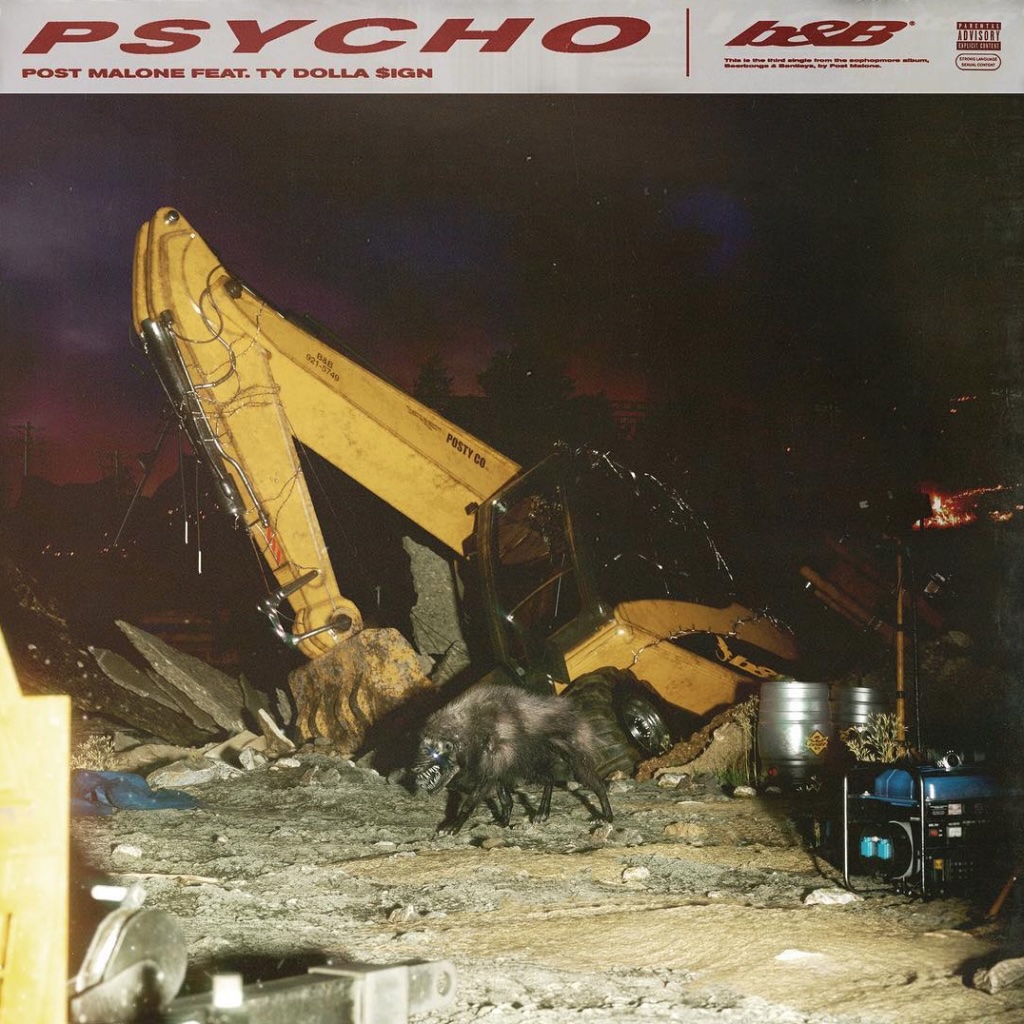
"Psycho" came out in February 2018, and it debuted at #2 behind Drake's "God's Plan." Like "Rockstar" before it, "Psycho" hung around the top five for a long time. It didn't get its one week at the top until June, four months after its release, when it followed Childish Gambino's "This Is America" as the second track to interrupt the reign of Drake's "Nice For What." "Psycho" didn't reach #1 because of some remix or gimmick or marketing push. The song just stuck around, doing big streaming numbers and eventually entering pop-radio rotation.
In April 2018, Post Malone released his long-awaited sophomore album Beerbongs & Bentleys, and it did the same kind of huge streaming numbers as his debut Stoney. Just like Stoney, Beerbongs & Bentleys is now quintuple platinum. "Psycho" went diamond in 2022, and that doesn't even feel like much of a flex. Post Malone has a zillion diamond singles. He has random album tracks that went diamond. Today, "Psycho" has more than a billion streams on both YouTube and Spotify, but it doesn't have as many plays as Posty's next single. He followed "Psycho" with "Better Now," a bittersweet and self-pitying relationship song that makes the trap-to-country transition even more easily than "Psycho." ("Better Now," which has also gone diamond, peaked at #3. It's a 6.)
The success of "Psycho" didn't seem to have a huge impact on the career trajectories of either Post Malone or Ty Dolla $ign. Post went right on making hits, and we'll see him in this column again soon. Ty Dolla $ign stayed on the featured-guest circuit, where he was so omnipresent that he released a 2020 album literally called Featuring Ty Dolla $ign. For years after "Psycho" Ty didn't appear on another top-10 hit, though he never seemed to go away, either. But when you hang around for long enough and prove to be a sufficiently malleable collaborator, you sometimes get another chance to break through. For Ty Dolla $ign, it happened again. We'll see him in this column again, too.
GRADE: 6/10
We rely on reader subscriptions to deliver articles like the one you're reading. Become a member and help support independent media!
BONUS BEATS: Here's future Number Ones artist Shawn Mendes singing a sweet little "Psycho" cover in a 2018 visit to the BBC Live Lounge:
The Number Ones: Twenty Chart-Topping Hits That Reveal The History Of Pop Music is out now via Hachette Books. And I'm like, "Whooooaaa! Damn, my book so goddamn cooooold! you should really buy it heeeeere."