Skip to Content
Columns

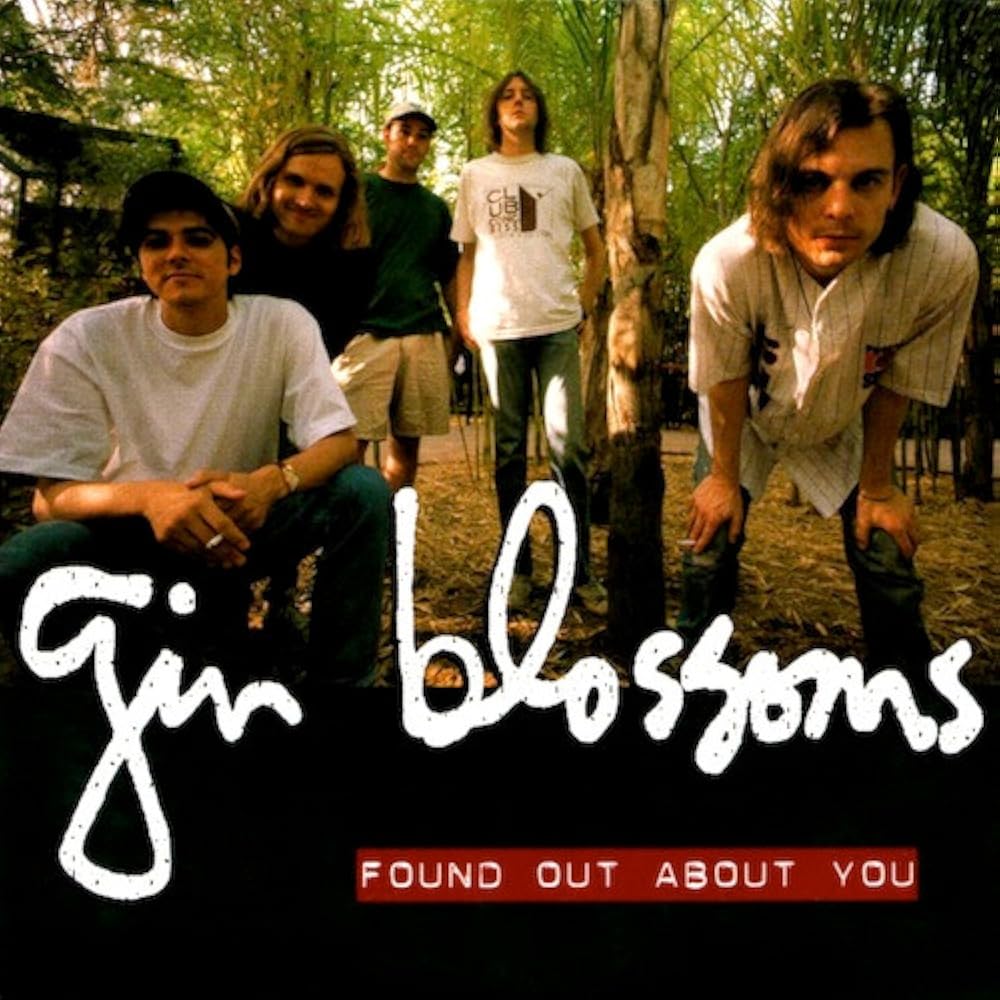
The Alternative Number Ones: Gin Blossoms’ “Found Out About You”

January 15, 1994

  • STAYED AT #1:1 Week

In The Alternative Number Ones, I'm reviewing every #1 single in the history of the Billboard Modern Rock Tracks/Alternative Songs, starting with the moment that the chart launched in 1988. This column is a companion piece to The Number Ones, and it's for members only. Thank you to everyone who's helping to keep Stereogum afloat.

At some point in the late '80s, Doug Hopkins was at an R.E.M. show, and his ex-girlfriend kicked him in the face. Or maybe she punched him in the eye. Accounts differ. At that point, Hopkins was the guitarist in the Gin Blossoms, a regional band from the college town of Tempe. The Gin Blossoms did pretty well in bars around the Southwest, but they weren't exactly a cultural sensation. Hopkins poured a his pent-up frustration about his ex into writing "Found Out About You," which sounds a lot like the song you might write after your ex-girlfriend kicked you in the face at an R.E.M. show.

Years later, "Found Out About You" was the #1 Modern Rock song in America. By the time that happened, Doug Hopkins was dead.

This is going to be a dark one. Really, they're all dark ones these days. The combination of hard drugs and newfound mainstream attention had a crushing effect on the alt-rock stars of the early '90s. Very few of them came out of that experience healthy and whole. But even among his peers, Doug Hopkins' story is almost mythic in its darkness. Hopkins wasn't even famous when he started on his downward spiral. The Gin Blossoms weren't quite finished with their major-label debut when they kicked Hopkins out of the band, and then he had to watch from the sidelines while his former friends got famous on the strength of the songs that he wrote. When those songs took off, he couldn't handle it.

I don't think the Gin Blossoms' success is why Hopkins took his own life, since it's always too easy to peg suicide on any one factor. From what I can tell, Hopkins was plenty self-destructive long before his songs were on the radio. Whether he knew it or not, his self-destructiveness was the subject of many of his best songs. But let's just say that the Gin Blossoms' success wasn't helping anything, as far as Doug Hopkins was concerned.

There are self-destructive people all over the world, and most of them don't write alterna-rock touchstones that still work as karaoke staples decades later. Part of the Gin Blossoms' secret spice is that Doug Hopkins wasn't the one singing. He wasn't always the ones writing the songs, either. Different Gin Blossoms wrote different songs, and you can't always tell who wrote what on first listen. But Hopkins' songs are the ones that made the band famous, and they're the Gin Blossoms songs that remain the most popular today. Hopkins' peers also wrote about drinking and making messes, but Hopkins' songs really get into what it's like to revel in the absolute wreckage that you've made of your own life.

Could Doug Hopkins sing? I have no idea. I know that he didn't sing. Instead, that job went to his bandmate Robin Wilson, and Wilson sang Hopkins' songs with a sort of blithe remove. Maybe that's why they work so well. Maybe that's why these squalid broken-man anthems could work as cuddly jangle-fuzz power-pop. In any case, the Gin Blossoms kept going after Hopkins' death, and they remained functional without his songs, even if the other guys' songs never fully recaptured the fucked-up majesty of the ones that Hopkins wrote.

Doug Hopkins was born in Seattle, but he mostly grew up in Tempe, and he studied sociology at Arizona State. While he was in college in the '80s, Hopkins and his friend Bill Leen had a band called the Psalms. A couple of years after they finished college, Hopkins and Leen started another band with a few other guys from around Tempe. They called themselves the Gin Blossoms after a caption in Kenneth Anger's book Hollywood Babylon. Anger's book had an image of WC Fields, his face all red and splotchy from drinking too much, and Anger referred to those splotches as gin blossoms. Originally, guitarist Jesse Valenzuela was the Gin Blossoms' lead singer, but that role eventually went to Robin Wilson. Wilson and Hopkins went to the same high school in Tempe, but Wilson was four years younger. He and Hopkins knew each other from skateboarding.

The Gin Blossoms played a lot around Tempe and Phoenix. Phoenix New Times readers voted them the city's best rock band, and that got them invited to play SXSW. They released their debut album Dusted on the tiny San Jacinto label in 1989. Dusted isn't in print or on any proper streaming services, but you can find the whole thing on YouTube. In fact, check it out: I found it for you. Among other things, Dusted has faster, messier versions of "Hey Jealousy" and "Found Out About You," the two Doug Hopkins songs that later made the Gin Blossoms famous. Those songs are really good, even in their scrappier early form. Still, it's impressive that a major-label talent-scout type could hear those songs and imagine that they could become hits.

When sparkly re-recorded versions of "Hey Jealousy" and "Found Out About You" eventually took off on the radio, they sounded like the work of one of the many R.E.M.-disciple bands out on the college-rock landscape -- or maybe like a bridge between R.E.M. and the softer adult-comptempo alt-rock that did so well in the mid-'90s post-grunge era, the Hootie micro-generation. But even in cleaned-up form, there's nearly as much Replacements as R.E.M. in those songs. When you listen to Dusted, the Replacements' influence comes through even more clearly. The Gin Blossoms clearly loved the twinkly-jangly guitar sound that they heard in records from R.E.M. and the Church, but they were just as drawn to the Replacements' bleary barfly rock 'n' roll. If you were feeling uncharitable toward the Replacements, you could look at Doug Hopkins' entire life story as a cautionary tale about what can happen when the Replacements become somebody's personal heroes.

Dusted earned word-of-mouth buzz for the Gin Blossoms, and CMJ called them America's best unsigned band. Soon enough, they secured a deal with A&M Records and relinquished that title. But when the Gin Blossoms went off to record their major-label debut, everything went wrong. As far as A&M was concerned, only four songs from those sessions were good enough to release, so the band's first A&M release was 1991's Up And Crumbling EP. One of the songs from Up And Crumbling stuck around. The other guys in the band didn't want to record the songs that Robin Wilson wrote, but then Wilson came up with the starry-eyed gem "Allison Road," and they couldn't deny him. Later on, "Allison Road" reached #39 on the Modern Rock chart. That's a really good song.

The Up And Crumbling EP didn't make much noise, and the Gin Blossoms knew that they weren't exactly a priority at A&M, but they got another crack at recording an album. They shipped off to Memphis and went to work at Ardent Studios, the place where power-pop heroes Big Star crafted their masterpieces. The Gin Blossoms co-produced their LP New Miserable Experience with John Hampton, a studio veteran who'd worked with Big Star leader Alex Chilton and who'd also engineered and mixed the Replacements' 1987 album Pleased To Meet Me. While the Gin Blossoms were working on their LP, Doug Hopkins was deeply depressed and extremely drunk. When he wasn't drinking, his DT shakes were so bad that he couldn't play guitar. He kept trying to record his solos and fucking them up, to the point where he started to accept the idea that someone else would have to come in and play his solos.

Eventually, the Gin Blossoms kicked Doug Hopkins out of the band. There are lots of stories about that, and some of them conflict with each other. It's possible that A&M gave the band an ultimatum: Either lose Hopkins or get dropped. But there are also stories about the band withholding money that they owed Hopkins unless he signed over half of his royalties to Scott Johnson, the guy brought in to replace him. (Johnson didn't actually play on New Miserable Experience, but he's credited in the liner notes instead of Hopkins.) Hopkins, quite understandably, felt betrayed. He was coming off of a terrible bender when he flew back to Arizona, and he spent the rest of his life broke, fuming about the way his old friends did him.

New Miserable Experience came out on A&M in August 1992. At first, it didn't sell or get critical attention. But the label had faith in lead single "Hey Jealousy." Hopkins wrote that song about the same ex-girlfriend who might've kicked him at that R.E.M. show. It's a knowingly pathetic lament about trying to accept that you've fucked everything up and wishing that you could rewind time. The "Hey Jealousy" narrator is too drunk to drive, so he asks if he can crash on his ex's couch and wonders how things could've been different if he hadn't blown the whole thing years ago. Even in his despondent state, he can't come up with a better idea than to drive around this town and let the cops chase him around. Even with all that lyrical heaviness, "Hey Jealousy" absolutely goes. It's a hangdog jangle-jam of the highest order, a song that sounded warm and familiar the first time you heard it. I don't write songs, so I'll never fully understand how someone can write a song as functional as "Hey Jealousy" without being the least bit functional himself. But then again, I write these long-ass columns in a permanently dirty hovel of a home, so maybe I really do understand it.

A&M commissioned three different videos for "Hey Jealousy," raising the budget a little bit whenever the band filmed a new one. Eventually, the third "Hey Jealousy" video went into MTV rotation, and the song took off. The label also released New Miserable Experience a couple of different times; the album cover that most people know, with the band members' faces reflected in the windshield of their beat-up tour van, is the second one. Oddly enough, "Hey Jealousy" never made it onto the Billboard Modern Rock chart, even though I remember hearing it on my local alt-rock station all the damn time. But "Hey Jealousy" was huge on Mainstream Rock radio, and it even crossed over to the Hot 100, peaking #25 in October 1993.

The Gin Blossoms, suddenly blowing up, made a brief appearance in Wayne's World 2. After the Charlton Heston cameo and the Graduate parody, they pull up during the closing credits to play played at Wayne's Waynestock festival. This honestly raises questions about what Wayne Campbell's musical tastes were supposed to be, or maybe it's an accurate reflection of the way '80s metal guys latched onto the most approachable versions of '90s alt-rock. America's critics voted "Hey Jealousy" the #21 single of 1993 on the Pazz & Jop poll; it tied with RuPaul's "Supermodel" and the Pet Shop Boys' "Go West." New Miserable Experience went gold in September 1993, and the band had a plaque sent to Doug Hopkins. He hung the gold record on his wall, and then he took it down and smashed it. At one point, Robin Wilson was back home from tour, drinking in a Tempe bar. When he came out of the bathroom, Hopkins punched him in the face. Hopkins' friends dragged him away. That was one of the last times that Wilson saw him.

I have no idea why alt-rock radio would get behind "Found Out About You" and not "Hey Jealousy," but that's apparently what happened. The two songs have a lot in common. They were written by the same man, about the same woman. They're both pretty and fuzzy and catchy. They both open with warm twinkle-riffs, and Robin Wilson sings both of them with a weary sense of resignation. "Found Out About You" is a little softer and prettier. The guitars sometimes sound like mandolins, or maybe it's a mandolin that sounds like a guitar. The song stays at a low boil, with Jesse Valenzuela hitting some muscular-but-pretty Smithereens-style backup harmonies. Even when "Found Out About You" builds up to a fuzzed-out solo, it doesn't quite achieve full catharsis. But the big difference between "Found Out About You" and "Hey Jealousy" is in the lyrics, not the music.

Where "Hey Jealousy" is all about the narrator trying to grapple with his own failures, "Found Out About You" is about actual jealousy and the bitterness that comes with it. On "Found Out About You," that narrator turns his rage outward, fuming about how this lady has the audacity to go on living her life without him. On the first verse, the narrator wonders whether the entire relationship was a lie, whether the girl never felt the things about him that he felt about her. By the chorus, he's accusing her of hooking up with people in schoolyards, and he goes into slut-shame overdrive on the second verse: "Well, you're famous now and there's no doubt/ In all the places you hang out/ They know your name, they know what you're about." The third verse moves into full-on stalker territory: "I write your name, drive past your house/ Your boyfriend's over, I watch your lights go out."

That's creepy! It's unsettling! This guy should just let this girl go. If he was the last one to know when she dumped him, he needs to get over his shit and find someone else -- preferably someone who won't beat him up at an R.E.M. show. When you know the Gin Blossoms' story, it gets worse. There's no deniability. We're not just hearing someone writing from a theoretical character's perspective. Instead, these are the words of someone who was utterly unable to figure his shit out -- someone who apparently reacted to getting fired from his band the same way that his "Found Out About You" narrator reacts to getting dumped.

The thing that saves "Found Out About You" and makes it work as pop music is Robin Wilson's delivery. If he sang "Found Out About You" as an angry song, the bile would overwhelm everything. Instead, it's sad and regretful. The way Wilson sings it, the narrator knows he fucked up, even if that's not obvious in the lyrics. It's the sort of thing that sometimes happens when the person singing isn't the one who wrote the words. That distance can derail a song, but it can also elevate a song and add new emotional dimensions. That's what happens on "Found Out About You." I never bought a copy of New Miserable Experience, but I'm always happy to encounter "Found Out About You" in a car-radio context. If it registered as a creepy-angry stalker song, I don't think that would be the case.

Plenty of people did buy New Miserable Experience. "Found Out About You" didn't just reach #1 on the alt-rock chart. It was also a #5 Mainstream Rock hit, and it got airplay on mainstream pop and adult contemporary stations. Just like "Hey Jealousy" before it, "Found Out About You" made it to #25 on the Hot 100. On the album chart, New Miserable Experience peaked at #30 in February 1994, nearly two years after its release. Eventually, it went quadruple platinum. By the time all that happened, though, Doug Hopkins was dead. In December 1993, Hopkins bought a gun at a pawn shop, and he took his own life. He was 32. Most of the people in his life apparently weren't surprised to learn of his death. Six weeks after he passed away, "Found Out About You" was the #1 song on alt-rock radio. "Found Out About You" didn't take off because people were mourning Doug Hopkins' death. Most of the people who enjoyed the track had no idea about his fate. Instead, Hopkins' story slowly made its way into the world, becoming grist for magazine features and VH1 video packages.

At Doug Hopkins' funeral, a woman approached his former Gin Blossoms bandmates with a message. Years earlier, someone had poured sugar in the gas tank of their tour van -- the one on the New Miserable Experience cover. They never knew who did it. Hopkins wanted those guys to know that it was him, that he was the one destroying his own band's transportation. Hopkins self-sabotaged long before fame was even a possibility, and he went to his grave without making peace with the other Gin Blossoms. His death hit them hard. The Gin Blossoms kept touring, but they didn't make another album for a few years. "Until I Fall Away," another New Miserable Experience track, eventually reached #13 on the Modern Rock chart. Hopkins didn't write that one; it came from Robin Wilson and Jesse Valenzuela. Those guys readily admitted that the big Gin Blossoms songs, the ones that sold all those records, were the Doug Hopkins ones.

The Gin Blossoms finally came back in 1995 with "Till I Hear It From You," their song for the Empire Records soundtrack. Wilson and Valenzuela co-wrote "Till I Hear It From You" with power-pop OG Marshall Crenshaw, and it was a legitimate across-the-board hit. (Crenshaw's only Modern Rock chart entry, 1991's "Better Back Off," peaked at #17.) "Till I Hear It From You" made it to #5 on the Modern Rock chart, and it was also big on mainstream rock and adult contemporary radio. On the Hot 100, "Till I Hear It From You" went all the way to #9, making it the Gin Blossoms' biggest-ever crossover pop song. (It's a 7.)

In 1996, the Gin Blossoms released their New Miserable Experience follow up, which has the extremely 1996 title Congratulations I'm Sorry. It's a pretty good album, but it sounds like a sanded-down version of New Miserable Experience, which is to say that it sounds like a whole lot of the radio-ready alt-rock that was coming out around that time. Lead single "Follow You Down" reached #8 on the Modern Rock chart. (It's a 7.) The relatively intense follow-up single "Day Job" peaked at #21, and that was the last time that the Gin Blossoms had a new song in alt-rock radio rotation. Congratulations I'm Sorry took a year to go platinum, which is good but which still marks a big step down from New Miserable Experience.

The Gin Blossoms broke up in 1997, and all the guys in the band went on to different projects that didn't get a ton of traction. In 2002, the Gin Blossoms got back together, and they've been back together ever since. They've put out three more albums. Drummer Phil Rhodes eventually had to leave the band because of his own alcoholism, but all the other Gin Blossoms seem to be doing fine. They tour constantly, often on '90s-nostalgia packages. Anytime now, someone could get kicked in the face at a Gin Blossoms show, and it could inspire them to write their own devastating post-breakup song. Probably not, though. If you're old enough to go to a Gin Blossoms show in 2025, you're probably too old to get into face-kicking situations. You should feel good about that. The face-kicking situation helped Doug Hopkins write a great song, but it wasn't good for him in the long run.

The other Gin Blossoms could all win the lottery and save babies from burning houses, and the band's story would still be dark. Eventually, this column will probably hit a story that's not quite so crushingly bleak, but it won't be next week.

GRADE: 8/10

BONUS BEATS: Here's Kelly Clarkson really belting out a "Found Out About You" cover on a 2022 episode of her talk show:

(Kelly Clarkson has never been on the Modern Rock chart, even though something like "Since U Been Gone" is a more convincing alt-rock banger than a great many of the songs that will appear in this column.)

GET THE STEREOGUM DIGEST

The week's most important music stories and least important music memes.