
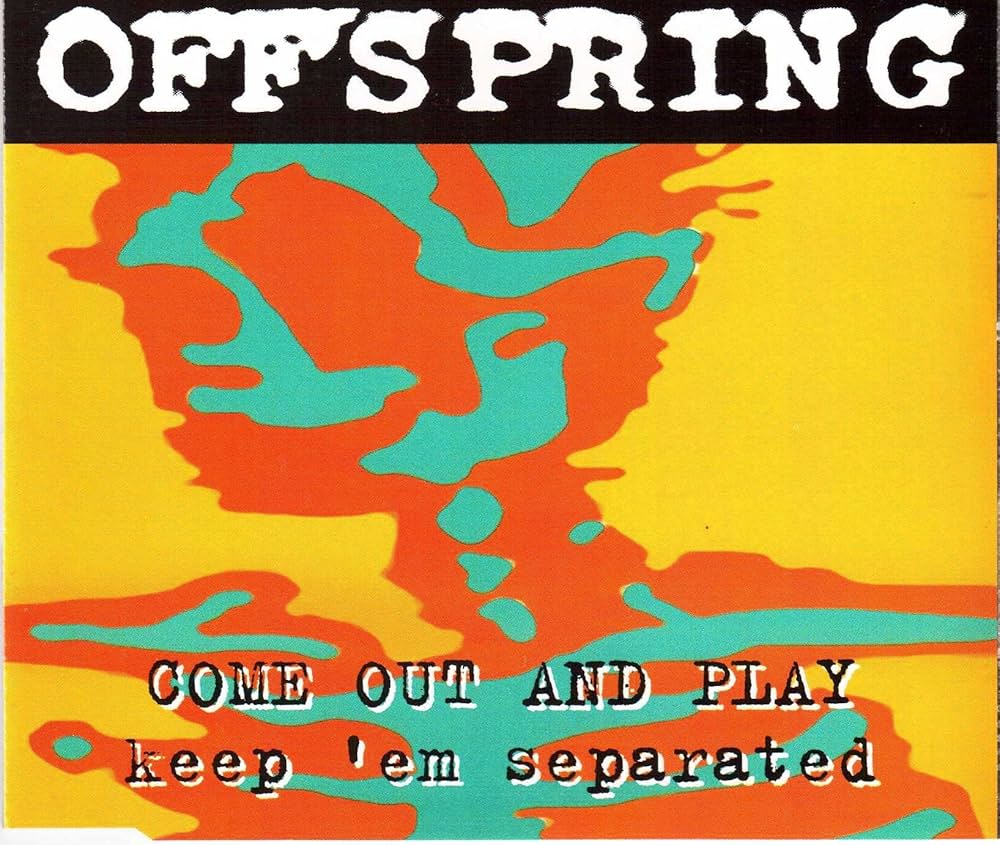
July 30, 1994
- STAYED AT #1:2 Weeks
In The Alternative Number Ones, I'm reviewing every #1 single in the history of the Billboard Modern Rock Tracks/Alternative Songs, starting with the moment that the chart launched in 1988. This column is a companion piece to The Number Ones, and it's for members only. Thank you to everyone who's helping to keep Stereogum afloat.
For about six months in 1994, the Offspring looked like the Rolling Stones to Green Day's Beatles. Those two bands' near-simultaneous arrivals in the popular imagination made for a genuinely game-changing subcultural moment, and it changed things at least as much as the original grunge explosion -- probably not coincidentally, almost exactly at the moment that the grunge explosion died down. Green Day and the Offspring's first radio hits heralded a sudden boom in fast, down-the-middle pop-punk -- a genre that probably could've always held more radio appeal than grunge, if not for the surrounding subculture's ambient disdain for gen-pop success. Green Day, cute and catchy and bouncy, were the ideal envoys for this thing, which had flourished in the shadows for years before its main-stage moment. Compared to them, the Offspring seemed dangerous.
Green Day and the Offspring came from different California punk scenes, but those scenes intersected plenty. The two bands released two cult-sensation albums apiece before blowing up on the radio, and both of them showed real popcraft instincts long before alt-rock radio programmers noticed. Green Day sang about self-hatred and indolence. The Offspring sang about self-hatred and violence. When the Offspring blew up, their sound was raw and muscular, even compared to what Green Day were doing. And the Offspring didn't have to sign to a major label to become huge. Instead, they did the unthinkable -- selling millions of CDs to suburban teenagers without ever leaving their own punk ecosystem. In the moment, that was revolutionary.
To kids like me, Green Day were a fun band, but they didn't bring a whole cosmology with them like the Offspring. The Offspring were on Epitaph Records, a California indie with a fully developed aesthetic and a roster of bands -- Rancid, NOFX, Pennywise -- with their own individual senses of swagger and personality. Naturally, the major labels descended like vultures, but those big three Epitaph bands never left. The Offspring, on the other hand, did. They went corporate in a big way, and they transformed themselves into makers of vaguely reactionary novelty hits. They lost their mystique really quick. But that initial breakout moment was hugely exciting, and the songs that came out of it remain top-shelf car-radio scream-alongs. The greatest of those scream-alongs is still "Come Out And Play (Keep 'Em Separated)," the song that made the Offspring famous.
Looking back today, you can hear the seeds of the Offspring's vaguely reactionary novelty hit future in "Come Out And Play." The song looks at gang violence from an extreme outsider standpoint, never quite empathizing with the kids who really went through it. Instead, "Come Out And Play" plays fast and loose with Latin cultural signifiers even as it depicts gang members as a terrifying plague. But plenty of great art has taken that viewpoint to a way more extreme degree. I maintain that Dirty Harry is a great movie, objectionable as it is, and "Come Out And Play" isn't exactly Dirty Harry. Even if I don't get the same rush of excitement that I once did when I hear "Come Out And Play," and even if I now think of the Offspring as absolutely non-dangerous cheeseballs, the song remains an absolute banger.
Nobody expected "Come Out And Play" to do what it did, which is part of the song's magic. The Offspring were never the chosen ones. Instead, they were a vaguely nerdy California punk band who didn't have the same aesthetic charge as plenty of their Epitaph labelmates. Looking back now, I don't know why I ever thought they were dangerous. In the "Come Out And Play" video, Dexter Holland looks like a gym teacher with ill-advised white-guy braids. In real life, he was a science-class overachiever who had to put his molecular biology dissertation on hold to become a rock star.
If the first Green Day column needed to begin with a discussion of 924 Gilman St., then maybe the first Offspring column needs to kick off with a look at the history of Epitaph Records. Bad Religion guitarist Brett Gurewitz was about 16 when he founded Epitaph, and the label mostly existed at first so that Bad Religion, whose members were all in high school, would be able to release their 1981 debut EP How Could Hell Be Any Worse? Gurewitz had to borrow a thousand dollars from his dad to get that record pressed up. Bad Religion had a rocky road, temporarily breaking up after the release of their keyboard-heavy, prog-flavored 1983 sophomore album Into The Unknown -- still out of print and disowned even though it rules -- before blasting back at full strength with the 1988 classic Suffer. (Bad Religion’s highest-charting Modern Rock hit, 1994’s “21st Century (Digital Boy),” peaked at #11.)For most of the '80s, Epitaph was just the Bad Religion label. But as Bad Religion grew into an underground mainstay, the label also put out records like L7's self-titled debut and NOFX's S&M Airlines.
Bad Religion were part of a booming early-'80s Orange County punk scene. The classic Orange County bands -- the Adolescents, TSOL, D.I., Agent Orange -- played a fast, snotty, extremely suburban version of LA hardcore, adding in big, straightforward whoa-oh-oh melodies. The sound mixed nicely with the area's surfing and skating subcultures and with general teenage suburban discontent, and it was powerful enough to reach Brian "Dexter" Holland, a self-described geek from the Orange County city of Garden Grove. Holland wasn't a punk in the most obvious ways. Unlike Green Day leader Billie Joe Armstrong, he didn't drop out of high school or live on the edge of society. Instead, Holland ran cross country and served as math club president and as valedictorian of his graduating class. "Dexter" is a punk name, and it's short for "Poindexter." That's how he saw himself.
Holland discovered punk rock with his cross country teammate Greg Kriesel, later to be known professionally as Greg K. In 1984, the two of them started a band called Manic Subsidal, with Holland on drums and Kriesel on bass. Eventually, drummer James Lilja joined up, and Holland moved over to vocals. Guitarist Kevin "Noodles" Wasserman was a couple of years older than those guys, and they recruited him from a band called Clowns Of Death. In 1986, Manic Subsidal changed their name to the Offspring, and they pooled together enough money to record and release a 7" single called "I'll Be Waiting."
In their early years, the Offspring were a spare-time activity -- something to do while the band members all went off to college. Dexter Holland studied biology at USC. Greg Kriesel got a degree in finance. James Lilja left the band to go pre-med -- he's a gynecologist now -- and the band replaced him with 16-year-old drummer Ron Welty. Noodles, the only one who wasn't at school, found a union job as a high-school janitor. The young Offspring didn't really fit in with the Southern California punk scene, but they did find a receptive audience at Gilman St., the same community-focused Bay Area DIY venue that nurtured Green Day. Without ever fully becoming a Gilman band, the Offspring used to head up there a couple of times a year. Most of the band would drive, but Noodles would fly because he could afford it and he didn't want to miss any work.
After that first 7", the Offspring made a demo tape, and then they got Nemesis Records, an indie label that put out punk bands like Uniform Choice and Final Conflict, to release their self-titled 1989 debut album. The footage of the Offspring lip-syncing their album track "Jennifer Lost The War" on a public-access TV show is pretty adorable. To record that album, the Offspring linked up with Thom Wilson, a music-business veteran who'd worked as an engineer on '70s soft rock records by people like Seals & Crofts. In 1981, the Adolescents randomly hired Wilson to record, mix, and master their classic self-titled debut, and Wilson found himself a place within the Orange County punk scene. He produced early records from TSOL, the Vandals, Youth Brigade, and Social Distortion, who were initially part of that Orange County scene. (Social D's highest-charting Modern Rock hit, 1992's "Bad Luck," peaked at #2. It's an 8.) For the Offspring, Wilson must've been the ideal collaborator. They stuck with him for their next two albums, including the one that blew the fuck up.
After that first album, I can't imagine that anyone had huge expectations for the Offspring. They were among the many bands doing variations on the Bad Religion sound -- fast and muscular riffs, simple and melodic belt-along lyrics, occasional flourishes like surf-guitar solos. (The Offspring's Orange County forebears Agent Orange were the ones who covered Dick Dale and truly drew the connecting lines between early-'60s surf guitar and early-'80s hardcore; more on them below.) The Offspring pressed up about 5,000 copies of their self-titled debut. That's not bad for a baby punk band, but some of their slightly older peers had way bigger audiences. Bad Religion's Brett Gurewitz first met the Offspring when he engineered a track that they recorded for The Big One, a 1991 compilation released by the punk zine Flipside. Gurewitz didn't take the band too seriously at first, but he liked their 1991 7" Baghdad. That record convinced him to sign the Offspring to Epitaph, and they released their sophomore album Ignition on the label in 1992.
With Ignition, the Offspring went for it. The band went back to work with Thom Wilson, and they'd become tighter and more purposeful. Epitaph had the capability to sell records in ways that other punk labels just couldn't do, and Bad Religion regularly sold hundreds of thousands of records on an independent level. Epitaph pushed the Offspring's music to the people who made skate videos, and that opened up new audiences to them. The Offspring toured continually for a few years, making it over to Europe and playing shows with other Epitaph bands. By the time the Offspring made another record, Ignition sold 60,000 copies. The band got no press attention, but that's a higher number than what plenty of indie rock critics' favorites were moving at the time. That's how the punk scene existed -- a populist movement that with plenty of adherents but very little media attention. That history goes a long way to explaining why the sudden influx of media attention was so destabilizing.
The Offspring wrote a bunch of songs in 1993, and they went back into the studio with Thom Wilson to record their Smash album early in 1994, making the LP with a budget of $20,000. You can't really tell. The sound of Smash isn't as sleek and detailed as what Green Day did on Dookie, but it's big and brash and confident. As he grew his hair out and got it braided, Dexter Holland evolved into a sharp songwriter and a great rock screamer, and some of the songs on Smash don't sound all that far-removed from some of the gnarlier grunge that was getting airplay around that time. In some ways, the massive sales of Smash and Dookie were among the ripples of the Nevermind splash, though they had plenty of ripples of their own. But there's not really any grunge on "Come Out And Play," the first single from Smash and the last song that the band wrote for the LP. Instead, "Come Out And Play" is a weirdly funky punk attack, and not in the Chili Peppers sense.
"Come Out And Play" is a song about gang violence, but Dexter Holland, its sole songwriter, got the original idea when he was doing his graduate work -- in Dexter's laboratory, if you will. He already had a surf-guitar riff and a bottom-heavy groove. One day, he was growing bacteria in petri dishes, and he had to heat up and cool down the elements of the broth so that they'd separate. Last year, Holland told Stereogum, "When I said it to myself in my head, all of a sudden it had a rhythm to it, 'Gotta keep ’em separated.' That was just sticking in my head all day in the lab as I’m walking around in a lab coat and gloves, oven mitts. And then it was like, 'Wait a minute, I gotta put this in a song.'" Since Holland knew that he didn't want this to be a song about Erlenmeyer flasks, "Come Out And Play" had to be about something else.
At the time, Holland was driving a shitty car and commuting to school at USC. He had to drive through a gang-heavy area in East LA, and he witnessed the 1992 riots firsthand. That gang culture became the subject of the song, the thing that had to be kept separated. On "Come Out And Play," Holland sings about all the kids strappin' on their way to the classroom, gettin' weapons with the greatest of ease. When different gangs get together, violence pops off. There's a bit of tragic weight in Holland's writing: "One goes to the morgue and the other to jail! One guy's wasted, and the other's a waste!" But I don't hear a ton of empathy on "Come Out And Play." Instead, Holland writes from the place of an appalled suburban white guy. He's worried that the gangs will take over his own campus locale, and if they catch him slippin', then it's all over, pal. He wails that you gang kids are going to "tie your own rope." There's never any feeling that he'll get involved in that.
Plenty of LA punks in the '80s and '90s were involved in gangs; there's always been talk about how gang violence made shows way scarier after the initial burst of punk excitement. Gang violence was not an alien phenomenon for many of the Offspring's peers; witness "Bro Hymn," the classic 1991 singalong dead-friends dedication from the Offspring's Epitaph labelmates Pennywise. (Pennywise's highest-charting Modern Rock hit, 2008's "The Western World," peaked at #22.) The Offspring recorded "Come Out And Play" at a studio where Snoop Dogg happened to be working, and they asked him if he's do the "keep 'em separated" bit. He declined. Much later, the band got Redman to pretty much play that role -- coming in, saying the title of their song, and doing absolutely nothing else -- on their 2000 single "Original Prankster." ("Original Prankster" peaked at #2. It's a 5.)
When Snoop said no, the Offspring got a friend of theirs, a guy named Jason "Blackball" McLean, to come in and say the big line on the hook: "You gotta keep 'em separated." McLean got his nickname because he kept going to Offspring shows and requesting "Blackball," the B-side from their first 7". He's a white guy, but Holland says that he grew up in a Mexican neighborhood and understood the slang; I'm not sure whether he's doing an accent on the song or just talking in his regular voice. Later on, Holland said, "I wanted it to be like a Latino, gangster-style sounding voice. I figured I’d have to call a casting company or something. Then I thought, you know, I bet this guy Blackball, he might be able to do it." Blackball got to meet Snoop Dogg, so he was happy. He lip-synced the line in the "Come Out And Play" video, too. Later, he moved to Seattle and became a mailman. He's still friends with the Offspring. This 30-second conversational clip of Blackball and remaining Offspring guys Holland and Noodles is a wild ride.
I just typed out thousands of words of "Come Out And Play" context, and part of the song's magic is that nobody knew any of that when they first heard the song. I'll get into the way "Come Out And Play" was able to achieve radio-hit status in the first place, but most of us didn't know jack fucking shit about the song the first time that we heard it on the radio. We just got the song itself, and the song itself fucking rocked. "Come Out And Play" opens with a tricky, funky little drum pattern, a crunchy and accidental-sounding guitar chord, and Blackball muttering that you gotta keep 'em separated. Then the riff kicks the door down and storms into the house, and it's fucking on.
"Come Out And Play" is a simple and direct rocker. It's not fast enough that it necessarily reads as punk, though the backing vocals get into gang-chant territory. The riff has a tremendous bounce to it, and Holland's snaky surf-guitar bit adds another layer of catchiness. The whole thing moves. The drum fills and power chords all arrive at the right moments. Nobody overthinks anything. It's just a pure engine of fuck-yeah momentum, the kind of song that makes you want to bang on your car's roof when it comes on the radio.
On paper, "Come Out And Play" is an anti-violence song. In practice, Dexter Holland and his buds sing about gang rivalries with so much fired-up energy that they make that lifestyle sound fun. There are probably deeper psychological layers to that kind of thing -- suburban '90s white guys making sure to tut-tut about gang violence even when they're clearly fascinated with the culture behind it. The funky counter-rhythms of "Come Out And Play" owe at least something to the long tradition of LA gangster funk, which is probably why the Offspring were hoping to get Snoop Dogg on the hook. Latin funk loomed especially large for the band. In 1995, Holland told SPIN, "There’s kind of a rhythmic thing about the vocals; I talk instead of sing in a lot of parts. The whole beat of the song is kind of like the old War song ‘Low Rider.'" Holland would end up comparing a lot of Offspring songs to "Low Rider" and throwing questionable Spanglish phrases into many of them, but he's not really wrong.
In any case, the sheer exhilaration of "Come Out And Play" doesn't really mesh with the lyrical content. But I don't give a fuck about the lyrical content. I just want to be like, "Hey! Man, ya disrespectin' me! Take 'em out!" This song lets me do that. Every part is catchy and memorable, to the point where it's permanently lodged in my brain. The Offspring probably didn't have any idea what they had on their hands when they made "Come Out And Play," but their label boss Brett Gurewitz did. He later said that he got back the Smash mixes and stayed in his car, circling his block, so that he could keep listening. Then he went inside and told his wife, "Honey, we're gonna be rich." He was right, too.
"Come Out And Play" blew up in the way that songs used to blow up: One radio DJ got behind it, and then it spread slowly but definitively across the country. In this case, the radio DJ was Jed The Fish, from the LA giant KROQ. "Come Out And Play" took off in Los Angeles and then spread to Las Vegas and Phoenix and points further east. The Offspring spent a few thousand bucks making a "Come Out And Play" music video, their first, and MTV went crazy with it. When "Come Out And Play" started getting radio burn in Baltimore and DC, I didn't immediately link the Offspring with Green Day, though I really liked the breakout hits from both bands. The rock press made that connection for me, and it quickly became clear that those two bands' moments would be forever linked.
Like Green Day, the Offspring had more potential hits where that first one came from. They followed "Come Out And Play" with "Self Esteem," a berserker singalong about what must now, unfortunately, be known as cuck mentality. Holland insisted that he wrote the song about a friend, not about his own experience, and this bulldozing rocker about being too meek to leave a cheating girlfriend became a radio juggernaut. Until I wrote this column, I didn't realize that "Self Esteem" didn't reach #1 on the Modern Rock chart; I just assumed that I'd write another column about it. But no, "Self Esteem" apparently peaked at #4. (It's an 8.) Both "Come Out And Play" and "Self Esteem" stayed on the Modern Rock chart for months, but the Offspring didn't score another Modern Rock chart-topper until much later, so this column will have to get into a huge chunk of the band's history.
Smash sold like crazy. Those two singles both rocked hard, and word gradually got around that the rest of the album rocked just as hard -- that you would not be wasting your $15 if you bought a copy at Sam Goody. By the end of the year, it was triple platinum -- a truly baffling feat for an independently released punk album. Bad Religion happened to sign to Atlantic shortly before the Offspring blew up, and Brett Gurewitz eventually left the band because running Epitaph took too much work to do part-time. (By amazing coincidence, Bad Religion leader Greg Graffin, much like Dexter Holland, was a doctoral-level scientist, and he eventually got his PhD in zoology from Cornell. Gurewitz told SPIN, "We don’t look at GPA so much, but I do prefer my bands to have good work and study habits." Now, Gurewitz is back in Bad Religion, and Bad Religion are back on Epitaph.) Epitaph already had a powerful infrastructure in place, but it had to figure out how to expand its international distribution in a hurry. For a while, the label's office was so crammed with copies of Smash that nobody could move.
Very quickly, Smash became the biggest-selling independent rock album in history. It's now platinum six times over. Major labels went after the Offspring and every other band on the Epitaph roster. The Offspring initially said no to all those labels, and they said no to lots of other opportunities, as well. They turned down big tours with Metallica and Stone Temple Pilots. They turned down the Saturday Night Live musical-guest slot. They toured bigger and bigger venues on their own, with other punk bands opening for them. They made an amazing video for the Smash track "Gotta Get Away," and the song reached #6. (It's a 9.)
Other Smash songs didn't get radio play but went platinum in the middle school cafeteria. The road-rage freakout "Bad Habit" was the people's champ, largely for the part where the music drops out and Dexter Holland lets loose with a long string of cusswords. The Offspring sold shirts with "stupid dumbshit goddamn motherfucker" across the back, and those things were fiercely coveted even though we would've all gotten in so much trouble if we actually owned them.
In 1995, Dexter Holland and Greg K started Nitro Records, their own label. At first, it was a way for the Offspring to reissue their first two albums. Ignition went gold in 1996, and the album cut "Kick Him When He's Down" got enough airplay to reach #22. But Holland signed other California punk bands to Nitro, too. One of those bands was AFI, who were a pretty normal skate-punk band before they found arena-goth stardom. (AFI will eventually appear in this column.)
The success of the Offspring did huge things for the visibility of the California punk scene from whence they sprung. I remember having a huge eureka moment when reading a SPIN article about Green Day and the Offspring and seeing a blurry live photo of Rancid's Tim Armstrong. I was like: "Holy shit, people look like that?" I bought Let's Go and went straight down the rabbit hole. Not everyone involved in that scene was thrilled, though. Robbie Fields, owner of the LA indie Posh Boy, tried to tell Epitaph that they owed him a certain percentage of Smash sales because "Come Out And Play" directly ripped off Agent Orange's 1980 single "Bloodstains." Agent Orange's entire surf-punk approach was definitely a huge influence on the Offspring, and I think "Bloodstains" is one of the most perfect songs ever written, but that was some bullshit. The Offspring refused to humor the claim, and it never went to court. Later on, the Offspring covered "Bloodstains," but Agent Orange leader Mike Palm was still sore about it. I wonder whether that episode contributed to the Offspring's detachment from the Orange County punk world.
Somewhere along the line, things fell apart between the Offspring and Epitaph, and the Offspring signed to Columbia. The split was bitter. Its causes are pretty obscure now. The Offspring claimed that Brett Gurewitz was meeting with majors on his own, and I'm sure he was, though he never sold any part of the company. All that money wasn't necessarily good for Gurewitz, who developed a serious crack habit. Still, none of the other big Epitaph bands signed, and plenty of them had bitter feelings toward the Offspring. Gurewitz eventually went to rehab, and Epitaph remains extremely successful to this day. (Gurewitz was one of the people who contributed $1,000 to Stereogum during its fundraising drive a few years ago, and I wrote a Bonus Number Ones on "Louie Louie" for him. It was an honor, even though I don't think he cared.)
Around the same time that they signed to Columbia, the Offspring covered the Damned's "Smash It Up" for the Batman Forever soundtrack, and it reached #16. (Another Batman Forever song will eventually appear in this column.) Dexter Holland also showed the good sense to cut off his braids, going with a spiky blonde cut instead. In 1996, the Offspring followed Smash with their major-label debut Ixnay On The Hombre. I believe that title is pig-Spanglish for "Nix On The Man." For that one, the Offspring ditched Thom Wilson and worked instead with Jane's Addiction producer Dave Jerden. Ixnay went platinum, but it was a huge commercial step down from Smash. Only one of its singles, the quasi-grunge anthem "Gone Away," reached the top 10 on the Modern Rock chart. ("Gone Away" peaked at #4. It's an 8.)
The Offspring turned their commercial fortunes around when they steered right into silliness on 1998's Americana. That album had a bunch of hits, but the biggest and most obvious of them was "Pretty Fly (For A White Guy)," the unbelievably obnoxious novelty song about how all these damn white kids need to pull their pants up and stop listening to rap. MTV went bugnuts for its hyper-exaggerated video, and that led to director McG's career as a feature film auteur, which means the Offspring are indirectly to blame for the way the Terminator franchise got dog-fucked. "Pretty Fly (For A White Guy)" peaked at #3, and I am amazed and vaguely relieved that I won't have to write a column about it. (It's a 2.)
If only "Pretty Fly" was the only obnoxiously reactionary novelty song on Americana. It's not. The Offspring followed that one with the even worse "Why Don't You Get A Job?," an absolutely objectionable song on every musical and societal level. ("Why Don't You Get A Job?" peaked at #4. It's a 1.) "The Kids Aren't Alright," a nominally more serious song about how everyone is too self-destructive and lazy, reached #6. (It's a 4.) Americana went quintuple platinum, selling nearly as much as Smash. The Offspring played at Woodstock '99, where Dexter Holland was one of the few performers to tell that audience to stop sexually assaulting women. He also used a baseball bat to beat up cardboard cutouts of the Backstreet Boys onstage. I'm nostalgic for a lot of the cultural moments of my youth, but not that one.
The Offspring never stopped making a cleaned-up version of beefy, melodic California punk, but there was nothing culturally punk about Americana. Instead, that's the album where the Offspring effectively remade themselves as pandering goofs. It became their new identity, and it kept them relevant. Their next album, 2000's not-great Conspiracy Of One, only went platinum once, but the Offspring were still in the alt-rock radio mix. (That's the one with the aforementioned "Original Prankster.") As Clear Channel took over the radio and the scope of alt-rock programming contracted, the Offspring remained a fixture. We'll see them in this column again, though it'll be a while. I don't really like what the Offspring became, and I now hear the beginnings of that thing in "Come Out And Play." But it doesn't really matter, since "Come Out And Play" still goes like a motherfucker.
GRADE: 9/10
BONUS BEATS: "Weird Al" Yankovic eventually released the Offspring parody "Pretty Fly For A Rabbi," but for some reason he never released the "Come Out And Play" parody that he wrote and sometimes performed. Depending on who you ask, the Offspring may or may not have declined permission for that one. Naturally, the "Weird Al" parody is called "Laundry Day," and it recreates the surf-guitar riff on accordion. Here's a live recording:
THE NUMBER TWOS: Stone Temple Pilots' joyously percussive swamp-stomper "Vasoline" peaked at #2 behind "Come Out And Play"; this was an amazing time for big, dumb riffs on alt-rock radio. "Vasoline" is an 8.