
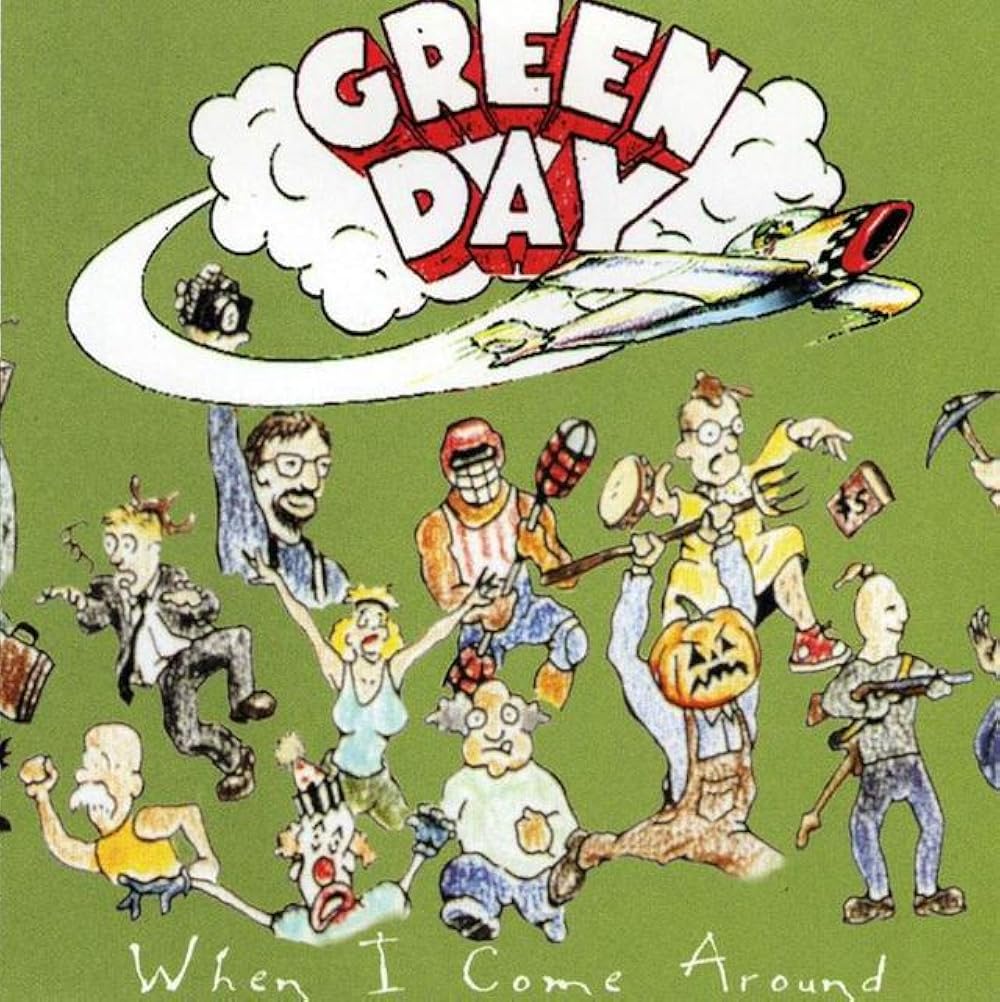
January 7, 1995
- STAYED AT #1:7 Weeks
In The Alternative Number Ones, I’m reviewing every #1 single in the history of the Billboard Modern Rock Tracks/Alternative Songs, starting with the moment that the chart launched in 1988. This column is a companion piece to The Number Ones, and it’s for members only. Thank you to everyone who’s helping to keep Stereogum afloat.
"The softest songs will get the hardest reactions," says Mike Dirnt. It's 1995, and he's on a couch between his two Green Day bandmates, talking to MTV News about all the ways that their lives have changed since their album Dookie unexpectedly blew the fuck up. He's visibly bored, and so are his bandmates. But probably just to entertain himself and his friends, Dirnt suddenly snaps into character, imitating some rando at a Green Day show: "Dude! 'When I Come Around'!" He then grabs Billie Joe Armstrong and flails every limb in every direction. He kicks and punches the air and fish-flops across his bandmates' laps while they crack up. For whatever reason, this little bit of physical comedy has been stuck in my head for the past 30 years.
This is life for Green Day in the year that Dookie takes over the world. Their lives are different now, and they'll be different forever. They've been exiled from the punk scene that offered them salvation not long ago. They're rich now, and they're famous enough that they can't walk down the street without getting mobbed. They're past the moment where their live shows regularly turned into riots, and they miss that unpredictable energy. Two of the three of them have just become parents, so that's weird, too. They're at a crucial fulcrum point, one that could easily destroy a band like theirs, but they're determined to stay together and build a life out of this moment. The boredom and bewilderment of their newfound rock stardom are interlinked with one another, and they know they have to beat it. So they do goofy shit to keep themselves going -- goofy shit up to and including turning an MTV interview into a one-man Three Stooges routine. It works out. Three decades later, Green Day are still a band.
The "When I Come Around" thing seemed especially strange. With Dookie, Green Day made a generational punk rock album, the single biggest-selling LP of the entire '90s alternative era. It's a record full of sharp, polished pogo bangers, songs that are precision-engineered to make crowds of kids lose their shit. But "When I Come Around" isn't one of the album's ragingest ragers. Green Day didn't really do ballads -- not at that point, anyway -- but "When I Come Around" is the closest thing they had to one. It's a sleek, vulnerable midtempo power-pop jam about romantic indecision, not a pent-up anthem. But thanks to the vagaries of popular taste, "When I Come Around" became the biggest song on a ridiculously big album. Green Day had already been strapped to a rocket and fired into strange new realms of rock stardom, and "When I Come Around" took them even further out there. It went crazy on pop radio, not just mainstream and alternative rock stations, and arena crowds apparently turned into wild-eyed berserker mobs whenever Green Day played it live. When some insane shit like that happens, you're never going to make sense of it, so you might as well turn it into an MTV News joke.
In the "When I Come Around" video, the members of Green Day wander through San Francisco's Mission District, looking cool as fuck. I have coveted Billie Joe Armstrong's olive green sweater ever since I first saw the clip, even though (or maybe because) he probably just found it in a thrift shop somewhere. Mike Dirnt's T-shirt might be the biggest look that the British band China Drum ever got. Tre Cool has a gas station attendant's jacket. All three of them wear Chuck Taylors. In a moment that's always stayed with me, they walk past a payphone and Armstrong just casually takes the receiver off the hook and leaves it dangling. Why? What does that accomplish? Nothing, obviously. It's just another random piece of disorder, a not-right thing that some other person will inevitably feel compelled to fix. I loved that. I probably took a lot of payphones off their hooks after I saw that video.
When "When I Come Around" reached #1 on the Billboard Modern Rock Songs chart, Green Day were getting used to leaving random disorder in their wake. The same week that "When I Come Around" reached the summit, Dookie officially went quadruple platinum. In the next few months, the album would sell another four million copies, and then it would just keep selling. Last year, Dookie became one of only 13 albums ever to go double diamond -- 20 million copies, or their streaming-era equivalents, sold in the US alone. Some of the other albums on that list are greatest-hits collections or multi-disc sets or multi-disc greatest-hits collections, so they don't even really count. That means Dookie is breathing incredibly rarefied air. It's bigger than any album by Nirvana or Pearl Jam or the Red Hot Chili Peppers or any of the other huge '90s alt-rock bands, unless you count Hootie And The Blowfish as a '90s alt-rock band, which I do not. Dookie is in the album-sales pantheon with Thriller, Back In Black, Hotel California, Led Zeppelin IV, Cracked Rear View, Come On Over, and absolutely nothing else.
"When I Come Around" has a lot to do with those insane sales. In some ways, "When I Come Around" is the most directly mainstream hit on Dookie. On the Hot 100 airplay chart, "When I Come Around" went all the way to #6, which means it's one of those songs that might've reached #1 on the Hot 100, the big chart, if Warner Bros. saw fit to release a commercial single in the US. But if Warner Bros. saw fit to release a commercial "When I Come Around" single in the US, then Dookie probably wouldn't have put up Shania Twain numbers. Even without a proper single, "When I Come Around" still went gold in the streaming era.
As huge as Green Day were just on the basis of "Longview" and "Basket Case" and "Welcome To Paradise," "When I Come Around" worked on a completely different level. How? Why was this song the one? The members of Green Day seemed pretty mystified at the time. I was pretty mystified, too. Today, it makes a lot more sense. "When I Come Around" was Green Day's new wave song, their pop song, and the conditions were just right for that song, from that band, to go nuclear.
Like a lot of tracks on Dookie, "When I Come Around" was part of Green Day's live show before they ever became a major-label prospect. Also like a lot of songs on Dookie, "When I Come Around" is about a girl. In 1990, Green Day played a show in Minneapolis, and Billie Joe Armstrong met a college student named Adrienne Nesser. They started a long-distance relationship. "2000 Light Years Away," maybe the catchiest song on Green Day's 1991 album Kerplunk, is also about her. But the couple got into a fight and broke up, and that's how we got "When I Come Around." I'd never really thought hard about the "When I Come Around" lyrics, and it's kind of a nasty song -- nasty to Adrienne and also nasty to Billie Joe himself. Billie Joe's narrator is hard on his ex, the one who's been crying so loud that he can hear her across town as she sits around feeling sorry for herself. But he sings that he's a loser and a user and he don't need no accuser to try and slag him down because he knows she's right. It's the kind of thing that you write when you don't have your shit together quite yet, when you don't believe in your own worth or your viability as a romantic partner.
As ever, Green Day are crazily tight and locked-in on "When I Come Around." The opening guitar crunch is simple but bouncy, and it gets bouncier when Mike Dirnt comes in with his busy, melodic bass action. They play slower than usual, so Tre Cool holds back on the drums, and then he lets it all out when he plays wild-ass fills during the pre-chorus. With all the Dookie songs in this column, I've had more opportunity to think about how much Green Day's rhythm section brought to that record. Those guys were beasts. Green Day did all of us a favor when they signed to Reprise, since the sharp and cleaned-up production, from the band and Rob Cavallo, really shows how much they had going on instrumentally. "When I Come Around" is just a simple three-minute guitar-pop song, but those two guys' firepower elevates it.
Billie Joe Armstrong sings "When I Come Around" with a little extra sneer -- maybe to properly convey the song's viciousness and maybe to make up for the slightly relaxed pace of the tempo. He's got that slight hint of a fake British accent, and he uses it for maximum-brattiness effect, putting real mustard on the line about "dry your whinin' eyes." Maybe you need to be nasty when you're telling someone to move on with her life -- to go do what she likes and make sure she does it wise. He's trying to sound wise himself when he tells her that they were never meant to last: "You may find out that your self-doubt means nothing was ever there/ You can't go forcing something if it's just not right." But the chorus sends a mixed message. He tells her that she'll be able to find him when he comes around. It's not "if" he comes around. He knows that he's in a weird place, and he knows that he'll get over it. Maybe that's why there's such sweetness in the harmonies on the chorus, such a hopeful tinge to Armstrong's guitar solo.
Billie Joe Armstrong and Adrienne Nesser eventually got back together, so maybe he really did come around. Around the same time that Green Day released Dookie, Armstrong invited Nesser out to move in with him in the Bay Area, and he proposed pretty soon thereafter. They got married in July 1994, and she found out she was pregnant with their first kid on the day after the wedding. They're still together today, and she's Adrienne Armstrong now. Tre Cool also got married as Green Day were blowing up, though that one didn't last. His daughter Ramona was born in 1995, and I just bet she's named after the Ramones. Mike Dirnt got married in 1996, but that one didn't last, either. All three Green Day members were working-class kids with chaotic home lives who got famous when they were very young. I think it's pretty telling that they all got hitched right away. They must have been looking for stability any place they could get it.
For me, "When I Come Around" is a strictly B-tier Dookie song, which means it's still really good. An album like Dookie needs songs like that, slower and more contemplative moments that give you a chance to catch your breath, but this one always sounded relatively slight to me. I made a tape from my brother's copy of Dookie, and I edited "When I Come Around" off of it -- partly because I heard it all the damn time on the radio anyway and partly because I only wanted to hear the bangers. Now, with the benefit of hindsight, I can concede that "When I Come Around" is a banger, too. It captures the restless moment right before someone figures their shit out, when they're still battling with themselves over whether they want to figure their shit out. But I still don't think it has anywhere near as much juice as "She," the Dookie song that reached #5 later in 1995 even though Green Day never pushed it as a single. ("She" is a 10.)
While "When I Come Around" ran wild on the radio, Green Day's accolades piled up. On the 1994 poll, Dookie came in at #12, below Soundgarden's Superunknown and above Freedy Johnston's This Perfect World. (Mid-'90s critics just loved stuff like Freedy Johnston.) At the 1995 Grammys, Green Day lost Best New Artist to Sheryl Crow, but they won Best Alternative Album, beating out Nine Inch Nails, Tori Amos, Sarah McLachlan, and Crash Test Dummies. Dookie wasn't necessarily received as an instant classic in its moment, but it got respect.
Green Day didn't give Dookie room to breathe. In 1995, when the album was taking over the universe, they quickly cranked out another record, and the short and jagged Insomniac hit stores in October. But before the world even got to hear the next Green Day LP, a stray track from the band, which may or may not have been intentionally leaked by their managers ahead of time, became yet another alt-rock radio hit. We'll see Green Day in this column again soon.
GRADE: 8/10
BONUS BEATS: Here's Weezer frontman and future Green Day tourmate Rivers Cuomo playing a solo-acoustic "When I Come Around" cover and leading a wholesome singalong in a 2018 gig at Chicago's Beat Kitchen:
(Weezer's "Buddy Holly," the other song in that video, peaked at #2 in 1994. It's a 9. Weezer will eventually appear in this column, and Cuomo will also be in here as a guest on someone else's song.)
BONUS BONUS BEATS: Here's the Halifax indie band Nap Eyes' video for their mellow, countrified, generally lovely 2021 cover of "When I Come Around":
THE NUMBER TWOS: Pearl Jam's bruised, soulful, empathetic "Better Man," a song that Eddie Vedder originally wrote for his previous band Bad Radio, peaked at #2 behind "When I Come Around." It's an 8.
The Stone Roses' spaced-out blues-rock mantra "Love Spreads" also peaked at #2 behind "When I Come Around," and it's another 8.
Ben Stiller te perdono por Zoolander 2, más ahora que vi y me emocioné con el inicio del episodio 3 de Severance en donde suena Love Spreads de los Stone Roses y calza perfecto ?pic.twitter.com/2NgHpnsKb9
— Arturo Manrique (@manriquearturo) February 13, 2025
THE 10S: Portishead's desperate, wounded, Lalo Schifrin-sampling "Sour Times," a trip-hop spy-guitar torch song that wallows in beautiful self-pity, peaked at #5 behind "When I Come Around." I'm covered by the blind belief that it's a 10.