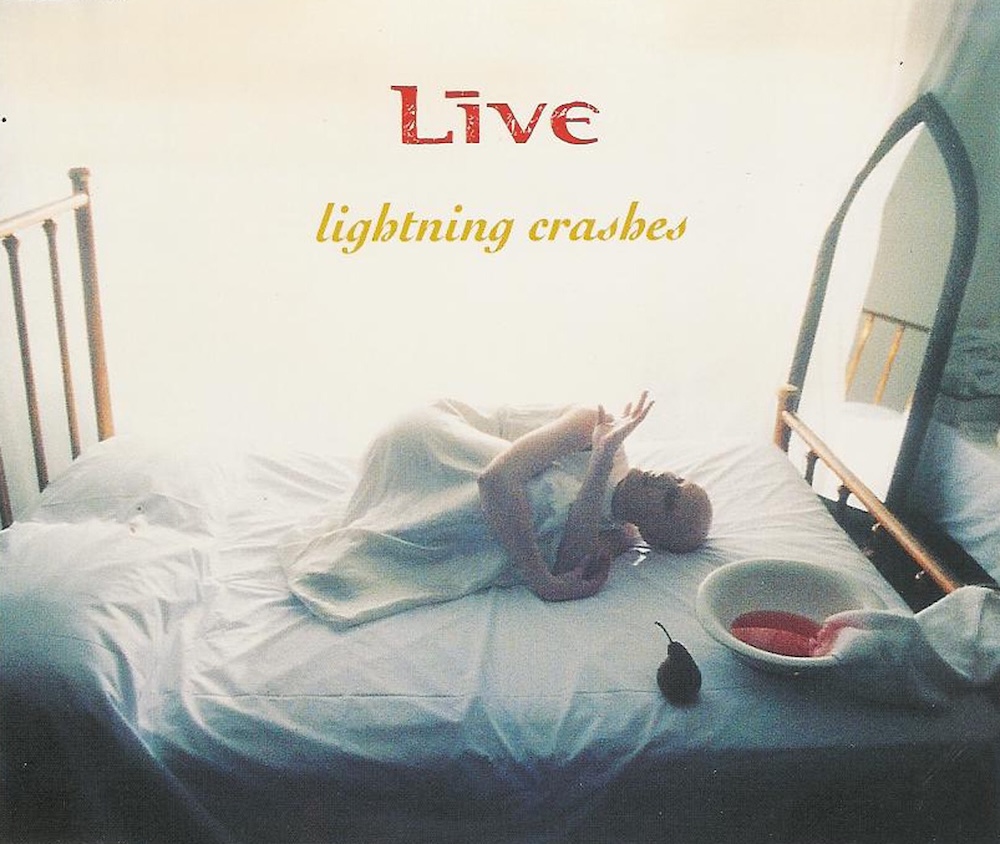
February 25, 1995
- STAYED AT #1:9 Weeks
In The Alternative Number Ones, I'm reviewing every #1 single in the history of the Billboard Modern Rock Tracks/Alternative Songs, starting with the moment that the chart launched in 1988. This column is a companion piece to The Number Ones, and it's for members only. Thank you to everyone who's helping to keep Stereogum afloat.
Try to imagine that you cannot get away from the "placenta falls to the floor" song. If you're old enough, you won't have to imagine it. It was lived experience. You would turn on the radio, and there it would be, the "placenta falls to the floor" song. Maybe you'd be like, Hell yeah, the "placenta falls to the floor" song! Or maybe you'd want to hear something, anything, other than the "placenta falls to the floor" song. But you would flip around the radio, and it would still be there -- on the alt-rock station, the mainstream rock station, the top-40 station, the adult-contempo station. All across the radio dial, it's just the placenta falling to the floor again and again. You turn on MTV, and you're once again confronted with that imagery, that implied plop.
It's so remote now, so far away. Younger people cannot imagine living life like that. Terrestrial radio might as well not exist to my kids. It's just something that we have to deal with when we're way out in the mountains and our phones lose their signals. Even then, there's no placenta falling to the floor; it's just my kids giving me vaguely horrified side-eyes while I sing along to Foreigner. (One thing that has not changed since the '90s: You can still find Foreigner playing on a terrestrial radio station at any moment of the day or night.) If there's a TikTok equivalent to the "placenta falls to the floor" song, I have not yet experienced it. The advent of the internet means that nothing is truly inescapable -- not in the same way, anyway. In 1995, we were served up a placenta on the floor again and again, and we had to simply accept it. If you were going to interact with popular music in any way, you were going to have to deal with some placentas on some floors.
Perhaps Live were victims of their own success. When you conquer popular culture with your "placenta falls to the floor" song, it's hard to be anything other than the "placenta falls to the floor" band. Live were a successful group before "Lightning Crashes," their big-gesture dirge-crunch with the line about the placenta falling to the floor, became the "Stairway To Heaven" of the Beanie Baby era, but that song took them into a completely different realm. By the time "Lightning Crashes" rose to #1 on the Modern Rock chart in the early days of 1995, grunge was basically over. Nirvana were gone. Pearl Jam were taking purposeful steps away from the spotlight. Soundgarden were making a real-deal bid for arena-rock stardom, but none of their songs, even "Black Hole Sun," had the radio reach of "Lightning Crashes." Almost by default, Live briefly became America's leading purveyors of self-serious baritone growls, and "Lightning Crashes" became the song that simply would not go away.
Maybe it was a cultural thing. In a lot of ways, grunge was a historical anomaly -- a time when underground critics' favorites took over the airwaves and the arenas, leading to a whole generation of kids who grew up thinking that it was perfectly normal to hear love songs to heroin playing on your parents' car stereos every day. When that wave ebbed away, there wasn't really anything dominant enough to replace it, though a few possibilities emerged. One possibility was Green Day, whose snot-rocket self-deprecation was urgent and exciting and tuneful enough to move 20 million copies of Dookie. But the year's biggest rock album was Hootie And The Blowfish's Cracked Rear View, an almost studiously uncool blockbuster from a Southern college-town touring institution who grew up worshiping R.E.M. but made no room for that band's more arty, obscuritan tendencies. As a result, Hootie And The Blowfish took off like a rocket while only glancingly touching Modern Rock radio. (Hootie's biggest hit on the Modern Rock chart, 1995's "Only Wanna Be With You," peaked at #22.)
Live grew up worshiping R.E.M., too. They had a lot in common with Hootie, actually. Like Hootie, Live came out of a small city on the Eastern seaboard, toured like hell, and cultivated the sort of image that was built around not having an image. Live and Hootie both had famous lyrics about dolphins and crying. But the Hootie lyric was about the Miami Dolphins, whereas Live were out here singing about actual small-D dolphins, or maybe metaphorical small-D dolphins. (They went to school, and they got the small D.) You never got the feeling that Ed Kowalczyk watched SportsCenter, even if Dennis Rodman did once join Live onstage to help sing "Lightning Crashes." If Kowalczyk and the Worm had a backstage conversation at that show, I'm guessing it did not revolve around rebounding numbers. It's more likely that Kowalczyk tried to convince Rodman to read a Jiddu Krishnamurti philosophy book. Darius Rucker could've never sung that line about the placenta falling to the floor. To Ed Kowalczyk, that line made perfect sense.
All four members of Live are credited as "Lightning Crashes" songwriters, but there is no way that anyone other than Ed Kowalczyk wrote the "placenta falls to the floor" line. When Live appeared on the cover of SPIN in 1995, Kowalczyk said that he wrote "Lighting Crashes" by himself on an acoustic guitar in his brother's bedroom. At the time, he was still living at home with his parents. It was the early '90s, and Kowalczyk was maybe 21 or 22. Live were already MTV Buzz Bin favorites with a successful major-label debut, but they weren't a commercial colossus yet.
"Lightning Crashes" is dedicated to Barbara Lewis, a friend of the band who was killed by a drunk driver when she was tragically young. That's the sort of thing that can stick with you forever. I had a good friend who died in similar circumstances when both of us were just out of college, and I couldn't make any sense out of that. It didn't compute. It still doesn't. And idle thought will occur -- I should see what Ian is up to -- before I remember that he's not up to anything. You could read "Lightning Crashes" as Kowalczyk's attempt to find some poetic significance in such a senseless death, a terrible thing that can never contain poetic significance. In that SPIN piece, though, he says, "The dedication to Barbara Lewis came after the song was written. But it was something that we hoped would honor the memory of a girl we grew up with and help her family cope with sorrow -- which it seems to have accomplished -- in a fashion in keeping with the theme of the song."
The theme of the song is an infinite cycle of death and rebirth. In a hospital, a young mother gives birth. Down the hallway, an old mother dies. The dying woman's confusion and the baby's confusion are the same. Kowalczyk mirrors his line about the placenta falling to the floor with an even clumsier one about the lady who's dying: "Her intentions fall to the floor." That's bad. That's really fucking bad. Kowalczyk has big ideas about the cyclical nature of life, about the energy that passes from the dead to the newly born. He's not necessarily talking about reincarnation. It's more the idea that no one ever really dies, that we're all part of the same endless loop that carries us through space and time. He's just not a graceful enough writer to render that in anything but the most gratingly pretentious language that you can possibly imagine.
If you spend any time thinking about the "Lightning Crashes" lyrics, you will get stuck, again and again. Instead, you have to feel it -- these cycles coming back again, like the rolling thunder chasing the wind, the forces pulling from the center of the earth again. Live's lyrics were always bad. It was part of the package. The last time Live were in this column, it was for "Selling The Drama," the one where Kowalczyk wails about "we won't be raped" on the chorus. There's a real divide between Live and the cool bands of the mid-'90s -- your Pavements and your Elasticas and your various Beastie Boys affiliates. Live didn't play around with irony or innuendo or allusion. Instead, they tried to wrap their arms around gigantic feelings, feelings too big for them, and they succeeded because they failed.
The strength of "Lightning Crashes" isn't the words. It's the feeling. It's the way the song wells up over its nearly endless five and a half minutes. "Lightning Crashes" begins with Ed Kowalczyk mutter-singing over a few bare guitar strums. His line about the placenta shows up right away, and he's at least bashful enough that you can hear the intro and convince yourself that he wasn't really singing that. But the song picks up steam, and Kowalczyk's soulfully clenched howl gets louder and louder. The "Lightning Crashes" chorus is a potent, intense bit of melody, and it gets more potent as the song builds, as Kowalczyk's bandmates get louder and more conviction creeps into his voice. He's still belting out nonsense about the angel opening her eyes -- her pale blue-colored eyes -- but his nonsense gains steam.
If it's your millionth time hearing "Lightning Crashes," his vocal inflections might get more and more grating with each new repetition. But if you're looking to be swept away, to get lost in your own big feelings, the song's rising crescendo does the trick. "Lightning Crashes" earns its crescendo -- the drums banging, the guitars chugging, the other guys in the band apparently doing gospel-style backing-vocal runs. (I can't believe those backing vocals really come from the rest of Live, but nobody else is credited, so you have to hand it to them.) It's like Live, as a band, harness the sheer force of will to push "Lightning Crashes" out of the realm of abjectly embarrassing bullshit and into the zone of decent-enough mediocrity. That itself is a triumph. Live were kids from nowhere -- York, Pennsylvania is effectively nowhere -- but they were truly convinced that they had the ability and the need to make a vast statement about life and death, and that impulse is beautiful even when the resulting song is awfully clumsy.
You really have to be in the right mood for the determined solemnity of "Lightning Crashes" to work on you. If you're not in that mental place, the song is almost cartoonishly grating. But when you're in the zone for it to work on you, the song's classic-rock craft really can overwhelm its silliness. Really, maybe the craft and the silliness are the same. Maybe you have to be willing to risk absolute ridiculousness to open yourself up enough to make something like that. Maybe people loved "Lightning Crashes" because of its rigid hamminess, because of the way it translated the sonic language of grunge into pure goofy grandeur. In any case, a whole lot of people were clearly in the right mood in 1995.
Live's 1994 album Throwing Copper was already a runaway success before the band released "Lightning Crashes" as a single in September 1994. Both "Selling The Drama" and "I Alone" remained in heavy rotation for months. ("I Alone" never got past #6, but I still heard it all the time. It's a 7.) The band hit the college touring circuit hard, playing to bigger and bigger crowds. Their videos got higher budgets right around the time that Ed Kowalczyk decided to go with the shaved-head/braided-rattail look, which was incredibly off-putting but at least gave this anonymous band a visual signature. It gave MTV another reason to pay attention.
My family didn't have cable in the mid-'90s, but I still saw the "Lightning Crashes" video so many times. Its portentous imagery -- monastic band members, grieving families, baldheaded angels, all shot through the same dusty yellow filter -- was a total drag, a "Losing My Religion" bite with none of that video's sensuality. But it was just always on. The song remained on the Modern Rock chart for half a year, and its nine-week stay at #1 was the longest since the Lemonheads' "Into Your Arms." On the Mainstream Rock chart, "Lightning Crashes" was even bigger -- ten weeks at #1. Pop stations were playing that song -- just transitioning from Coolio or Soul For Real into the "placenta falls to the floor" song like it was nothing. You could not stop that song's momentum.
When "Lightning Crashes" blew up, so did Live's Throwing Copper. The album hadn't even gone platinum when the song reached #1 on the Modern Rock chart, but it went quadruple platinum that summer. (Today, it's platinum eight times over.) Throwing Copper was a true sleeper smash, picking up steam for week to week until it finally reached #1 on the album chart more than a year after its release -- sliding in there right in between the Lion King soundtrack's and the Friday soundtrack's runs at the top. For a while, it seemed like every song on Throwing Copper was in radio rotation. On the Modern Rock chart, the LP yielded two more hits. "All Over You" didn't even have a video, but it peaked at #4 in July and stayed on the chart for even longer than "Lightning Crashes." (It's a 5.) "White, Discussion" eventually reached #15. I think that song is pretty good.
A band like Live couldn't hope to follow a slow-building smash like "Lightning Crashes." It wasn't possible. The band rode that momentum for a long time. They kept touring, and Throwing Copper kept selling. In 1996, Throwing Copper producer Jerry Harrison got together with his former Talking Heads bandmates Tina Weymouth and Chris Frantz. They were estranged from their former frontman David Byrne, so they started a new band called the Heads, which Byrne ended via lawsuit. The Heads were around just long enough to release one album, No Talking, Just Head, with a succession of guest vocalists. One of those guest vocalists was Ed Kowalczyk, which means we have one historical document of how the Talking Heads might have sounded if they had Ed Kowalczyk instead of David Byrne. The song in question is called "Indie Hair," and it is very funny. On the first verse, Kowalczyk addresses his personal-grooming philosophy: "I could cut my hair, but it costs too much/ So I'll buy my own clippers, darlin', and DIY this bush!" By the end, he's singing about going to India to sit with angels. I'm so glad I looked this up. You're welcome.
"DIY this bush" did not enter the alternative rock radio lexicon alongside "the placenta hits the floor," and Live never made another song with anything like the impact of "Lightning Crashes." Today, "Lightning Crashes" has more than twice as many Spotify streams as "I Alone," Live's second-biggest song on that app. But Live still continued to reverberate. You can pretty much draw a straight line between "Lightning Crashes" and the post-grunge yarlers who took over the alternative stations in the late '90s, and Live themselves continued to rack up Modern Rock chart numbers for the next few years. We'll see them in this column again.
GRADE: 6/10
BONUS BEATS: The TV show Yellowjackets persistently goes hard on nostalgic '90s alternative rock needledrops, so it's not exactly a surprise that "Lightning Crashes" soundtracked a scene in a 2023 episode. I don't know what scene it was, and I can't find video online. Whatever. Doesn't matter. What does matter is that Yellowjackets star Christina Ricci went on the fucking warpath about being made to act like she, or her character, could ever have anything nice to say about "Lightning Crashes." Please enjoy:
(Christina Ricci and I are basically the exact same age -- I'm five months older -- and she is entirely correct that Live were never cool. Whether they were any good is an entirely different question, but they damn sure were not cool to people in our tiny little sliver of a generation. It's honestly comforting to learn that a glamorous teenage movie star had to deal the the same radio-overplay aggravation as the rest of us did, even when she was off filming Casper or whatever.)
THE NUMBER TWOS: PJ Harvey's seductively sinister goth-blues slither-twist "Down By The Water" peaked at #2 behind "Lightning Crashes." That song really is cool. I'm guessing that Christina Ricci would agree with me, and I know that Wednesday Addams would. And now I moan, and now I holler, that it's a 10.
Oasis' majestically sweeping, proudly derivative power ballad "Live Forever," a song currently inciting massive stadium singalongs all across the UK, also peaked at #2 behind "Lightning Crashes." It's an 8.