
June 3, 1995
- STAYED AT #1:3 Weeks
In The Alternative Number Ones, I’m reviewing every #1 single in the history of the Billboard Modern Rock Tracks/Alternative Songs, starting with the moment that the chart launched in 1988. This column is a companion piece to The Number Ones, and it’s for members only. Thank you to everyone who’s helping to keep Stereogum afloat.
A long-suffering B-list alt-rock band gets swept up in the maelstrom of grunge, a phenomenon that they predated by a lot of years. They have already been dropped from one major label, but they're suddenly cranking out wounded-bittersweet fuzz-rock hits at an alarming rate. Their album sells a bajillion copies. Bill Clinton invites them to play at the White House. The band's lead singer starts dating Winona Ryder, a movie star who virtually personifies disaffected gen-X longing, and he makes a cameo in Reality Bites, a movie that serves as a virtual shorthand for disaffected gen-X longing. Our boys are rock stars now, and they're not sure what to think of their new rock-star gig. So when they make their next album, the lead single is an extended metaphor about a company that makes and sells misery. That's not on the nose. That is the nose.
By the time Soul Asylum got around to following up their bajillion-selling 1992 album Grave Dancers Union, things were different. Alternative rock no longer felt like an exciting new wave crashing into the mainstream. Instead, it was a whole new mainstream of its own, with its own attendant rat-race fatigue. The boom was still happening commercially, but the people taking part in that boom knew that they were simply feeding the content mill, not changing the world. This realization led to its own version of grown-up angst.
On the Minneapolis underground scene of the '80s, Soul Asylum were widely considered to be the little brother band to twin standouts the Replacements and Hüsker Dü, two groups who arguably helped catalyze the alt-rock boom but didn't last long enough to capitalize on it. (Paul Westerberg, Chris Mars, Bob Mould, and Mould's band Sugar all made alt-rock radio hits, but none of them really became stars in that early-'90s moment.) Soul Asylum stuck around and won the lottery. They did what their mentors couldn't do. Judging by "Misery," this was an alienating experience.
In 1995, Dave Pirner was famous-famous. Pirner met Winona Ryder backstage at Soul Asylum's MTV Unplugged taping in 1993, and they were a couple for a few years, with Ryder even leaving Hollywood to live in Minneapolis at the peak of her fame. Pirner's relationship put him in the tabloids. Soul Asylum toured endlessly and cranked out Grave Dancers Union singles, establishing themselves as part of the new alt-rock star system. The "Runaway Train" video, with its images of actual runaway kids, turned the band into responsible-rocker poster-boys, which led to them playing on the White House lawn. "Runaway Train" got so big that people got really, really sick of it.
Soul Asylum were in their blank-check moment. In retrospect, they were perfectly set up to make one of your classic difficult follow-up albums. But that's not really what they did. Instead, Soul Asylum's next record generally sounded just as commercial as Grave Dancers Union; it simply wasn't as good. They kicked their post-breakthrough album off with their song about a company that manufactures misery, a stupidly obvious fable about commercialized desperation that was too neat for its own good. In the end, that song became Soul Asylum's last real hit -- almost as if the public saw them grousing about being commercialized and decided that they'd heard enough. Maybe that's what happened. The song is pretty good, though.
"Maybe this has never been done before, but I’d like to beat the system. I would like to have the coup of just having been in a great rock band that nobody cares about anymore. Don’t you think I could do that?" That was Dave Pirner, talking to Rolling Stone in 1995. He was over it. Of course, being over it was a cool thing to be in 1995 -- the kind of attitude that multinational conglomerates were paying advertising firms to try and evoke. For those of us who didn't know about all of Soul Asylum's years as struggling underground rockers, Pirner's weariness often came off as a fashionable pose. But then, it wouldn't have been cool if Soul Asylum whole-heartedly embraced commercial success, either. They were in a no-win situation.
Or perhaps Soul Asylum just didn't know how to win in that situation. The aforementioned Rolling Stone profile is full of amazing Dave Pirner quotes, all of which reveal a guy who is utterly unprepared for his level of fame. Here's another quote: "My aspiration is to stand alone -- to put myself on a pedestal and to hate myself for standing on a pedestal." Here's another: "What’s Rolling Stone‘s angle here? Do they think we’re rock stars and suck or what? What do they want to know about us, just between me and you?" One more: "I met Bill Clinton, and I do think my aspirations are fucking higher than his, man." Magazine profiles were so much better before everyone was all media-trained.
When it came time to make their big follow-up album Let Your Dim Light Shine, Soul Asylum hired producer Butch Vig, who was coming off of Nirvana's Nevermind and Smashing Pumpkins' Siamese Dream. Not every album that Butch Vig produced in the early '90s turned out to be a generation-defining classic, but I have to imagine that Vig got the call because someone thought the next Soul Asylum album could be a generation-defining classic. (At the time, the debut album from Vig's band Garbage was just about to come out. We'll see them in this column eventually.) Soul Asylum also jettisoned longtime drummer Grant Young. During the Grave Dancers Union sessions, Young didn't impress producer Michael Beinhorn, so Beinhorn brought in Sterling Campbell, a session drummer who'd previously been in David Bowie's touring band. Starting in 1995, Campbell became Soul Asylum's full-time drummer. In the Rolling Stone profile, Dave Pirner keeps talking about how happy he is to have the right drummer, finally.
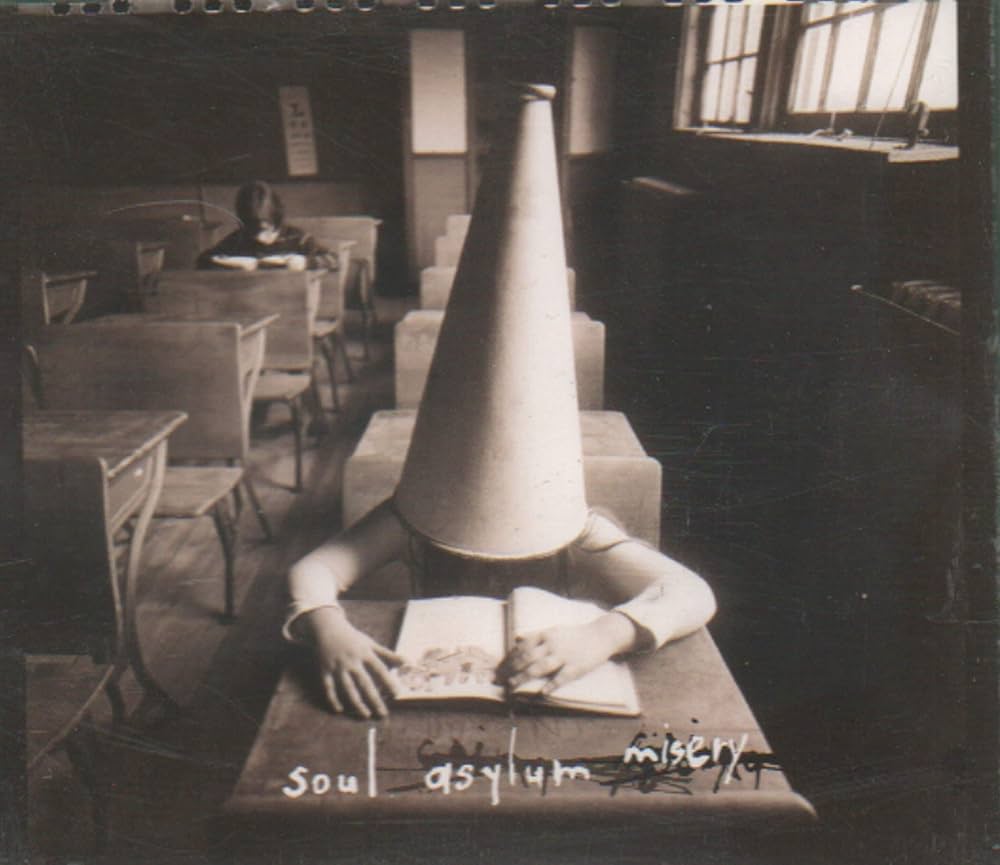
Maybe you have to think of yourself as an important band to write a song like "Misery." Maybe you have to believe that your aspirations are fucking higher than those of Bill Clinton, man. Or maybe you just have to be in what you perceive as a no-win situation. "Misery" is both the opening track and the first single from Let Your Dim Light Shine. It's the thing that they really wanted to put out there into the world. Soul Asylum had something to say, and that something was: "They say misery loves company/ We could start a company and make misery." Naturally, that company would be called "Frustrated Incorporated." Look, I like wordplay as much as the next guy (probably more than the next guy), but you should not hang the follow-up to your gigantic major-label album on that bit of wordplay. If that's your best idea, maybe it's time to go back to the woodshed.
I get it. You get it, too. It's impossible not to get. In the '90s, depression and dysfunction and disaffected gen-X longing were big business. The mainstream media depicted people from Dave Pirner's generation as arrogant dropouts who didn't want to participate in capitalist enterprises, and at least some of them bought into that image. Others sold the image, which is how Pirner ended up making his screen debut in a Universal picture called Reality Bites. When you realize that's what's happening, you might spin out about it: Companies selling you products that masquerade as art, designed to comment on the crushing realities of commerce while still keeping that commerce flowing. "We'll create the cure, we made the disease." "Did you satisfy your greed? Get what you need?" When you're one of the people operating in that art-commerce slipstream, it must be even more of a headfuck.
There was no answer to the art-commerce divide in 1995, and there's still no answer today. If anything, there's even less of an answer today. There's a moment in that Rolling Stone profile where Dave Pirner goes to see Fugazi and nobody recognizes him. A band like Fugazi could function in 1995 by dropping out of mainstream existence entirely. Well, Fugazi could function that way; there are and were no other bands like Fugazi. But now, Fugazi records are streaming on Spotify, which somehow seems even stranger than the fact that you could find them at Best Buy in 1995. Soul Asylum were not Fugazi, and Dave Pirner did not have the answer. The best thing he could think to do was to make a chunky, fuzzy, undeniably hooky alt-rock jam about the marketing of misery.
On a sheer musical level, "Misery" does the trick. Soul Asylum always had as much in common with Tom Petty as they did with any grunge band, and there's a truly satisfying folk-rock twinkle-crunch to "Misery." It hits all of its crowd-pleasing marks -- the soft and whispery opening, the cathartic build-up, the shake-your-hair chorus. Dave Pirner belts his hook out with doe-eyed sincerity, his bandmates singing with him in harmony. But that sincerity clashes badly with those lyrics, and that just makes the whole experience more incoherent. The delivery encourages you to sing along with the line about "Frustrated Incorporated," but if you do, you feel like a sap. You feel like part of the problem. If you don't think hard about "Misery," if you just want to sing along with something on the radio, it absolutely works. But under the slightest scrutiny, the whole house comes tumbling down.
In the "Misery" video, Dave Pirner is presented as a soft-focus alt-rock heartthrob, his hair flopping across his face just right and glowing in the stage lights. The clip sets that sight against footage of the literal Soul Asylum "Misery" single being manufactured in a factory. Even as a kid, it was galling. It's one thing to sell me some misery. It's another thing to sell me a song about how you're selling me some misery. If Soul Asylum were actual outsiders who were poking fun of the alt-rock machine in 1995, the central metaphor of "Misery" would still be pretty dumb. Coming from a band operating within that machine, it felt terribly condescending.
I got to see that machine operate up close and personal. In last week's column, I wrote about going to my first HFStival, the annual all-day show from my local alt-rock station, in 1995. Soul Asylum were that show's headliners. The Ramones played the main stage last, but at those radio shows, the real headliner was the second-to-last band on the big stage. The last band would play to a half-empty stadium, since people were already on their way out. (It was the same when I started going to Hot 97 Summer Jam. Three years in a row, I watched Jim Jones close that thing out.)
For weeks after the 1995 HFStival, there were rumors about Dave Pirner getting into a backstage fight with Les Claypool from Primus, since Primus had just come out with their single "Wynona's Big Brown Beaver." Primus insisted that the song wasn't about Winona Ryder, but, I mean, come on. ("Wynona's Big Brown Beaver" peaked at #12 on the Modern Rock chart later that summer. Primus' highest-charting single, 1993's "My Name Is Mud," peaked at #9. It's a 7.) I remember those fight rumors, and Primus' set, better than I remember anything that Soul Asylum did that night. Soul Asylum weren't really one of my favorites, but I vaguely recall thinking that they looked like big rock stars up there. I also vaguely remember Pirner playing trumpet during "Misery." He did the same thing on Letterman, throwing in a bit of Wings' "Silly Love Songs." Paul Shaffer got mad about it and made Pirner immediately cease, presumably because he didn't want the show to have to pay for using that song. It could've been a pre-planned bit, but I don't think so.
"Misery" became a real-deal hit. It was only Soul Asylum's second Modern Rock chart-topper, after "Somebody To Shove" two and a half years earlier. "Misery" also made it to #2 on the Mainstream Rock chart and #20 on the Hot 100. But "Misery" was the last Soul Asylum song that could really be described as a hit, and my read is that the song's snarky-wordplay angle didn't sit well with the people who loved the Grave Dancers Union singles. Let Your Dim Light Shine peaked at #6 on the albums chart, higher than Grave Dancers Union ever reached. It eventually went platinum, but it didn't sell anywhere near as well as the previous record.
Soul Asylum followed "Misery" with "Just Like Anyone," another extremely solid rock song with ridiculous lyrics. On "Just Like Anyone," Dave Pirner narrates an alienated girl's trip to an outhouse. Honestly, that's what the song is about. It's a great song, but what the hell, man? They got Claire Danes to appear in the video when she was still starring on My So-Called Life, but that wasn't enough to sell the single. It peaked at #19 on the Modern Rock chart and missed the Hot 100 entirely. Another single, "Promises Broken," reached #63 on the Modern Rock chart but missed the Hot 100. So it goes.
Dave Pirer and Winona Ryder broke up about a year after Let Your Dim Light Shine came out. Dave Pirner got to be friendly with Kevin Smith after Smith directed Soul Asylum's video for the Clerks soundtrack song "Can't Even Tell," and Pirner scored Smith's 1997 film Chasing Amy. In 1998, Soul Asylum covered Alice Cooper's "School's Out" on the soundtrack for The Faculty, and the band released Candy From A Stranger, a real-deal no-joke flop. That album couldn't crack the top 100 of the album chart, and lead single "I Will Still Be Laughing" was the last Soul Asylum song ever to touch the Modern Rock chart, where it peaked at #24. I don't think I ever heard that song before researching this column. It's pretty good!
After Candy From A Stranger failed, Columbia dropped Soul Asylum, and the band went on hiatus for a few years. Dave Pirner released a 2002 solo album, which didn't go anywhere. Soul Asylum bassist Karl Mueller was diagnosed with throat cancer in 2004, and the band came back together to raise money for him, playing a big benefit show in Minneapolis. The Replacements' Paul Westerberg played that benefit, too, and Hüsker Dü's Bob Mould and Grant Hart performed together for the first time since that band broke up. At the benefit show, Mueller performed with Soul Asylum; his cancer was in remission at the time. It came back, and he passed away in 2005 at the age of 41.
Before Mueller died, Soul Asylum got to work on The Silver Lining, their next album. It came out in 2006, and former Replacement Tommy Stinson became Soul Asylum's new bassist, though they had to keep using fill-ins on tour because Stinson was also in Guns N' Roses at the time. In 2006, Dave Pirner guested on the Hold Steady's "Chillout Tent," and I thought that was cool as hell. Craig Finn, a Minneapolis guy, had always been a big Soul Asylum fan, so there's a bit of a torch-passing to that song.
For the past couple of decades, Soul Asylum have continued to operate as an independent band, touring with fellow '90s veterans and occasionally putting out new records. Founding member Dan Murphy left Soul Asylum in 2012, which left Dave Pirner as the group's only original member. Last year, Soul Asylum opened for Stone Temple Pilots and Live on tour, and they also did a run with the reunited Juliana Hatfield Three. They put out a 2024 album called Slowly But Shirley, and I thought lead single "High Road" was quite good.
We're long past the days when anyone expected any kind of meaningful statement from Dave Pirner, and I think that suits him just fine. If Soul Asylum are still selling misery today, they're doing it on a manageable mom-and-pop level. It's not Frustrated Incorporated anymore. It's just an old ache that you can revisit whenever the mood strikes you. One might even argue that Dave Pirner is now in a great rock band that nobody cares about anymore. By his own definition, he beat the system.
GRADE: 6/10
BONUS BEATS: Here's "Weird Al" Yankovic's sitcom themed 1996 "Misery" parody "Syndicated Incorporated":
BONUS BONUS BEATS: Here's Dave Pirner's buddy Kevin Smith using "Misery" to soundtrack the end of his unfortunate 2006 sequel Clerks II, complete with fade to nostalgic black-and-white:
THE 10S: White Zombie's Philip K. Dick-swingin' synth-metal boogie "More Human Than Human" peaked at #7 behind "Misery." I am electric head! A cannibal core, and I give it a 10, nyyyeah!