
August 15, 2020
- STAYED AT #1:1 Week
In The Number Ones, I'm reviewing every single #1 single in the history of the Billboard Hot 100, starting with the chart's beginning, in 1958, and working my way up into the present. Book Bonus Beat: The Number Ones: Twenty Chart-Topping Hits That Reveal the History of Pop Music.
Harry Styles plays the game so well. He looks fantastic -- classically handsome, but with a weirdly feline slyness written into his jawline and a bunch of terrible tattoos to add character. He dresses in interesting ways. He sings about sex and drugs without admitting that he's singing about sex and drugs. He's got the old standard "boy band heartthrob becomes adult pop star" backstory, but with a bit of glam-style gender-play thrown in there for good luck. He makes all sorts of cool-guy references -- not just the '70s rock that he loves, but also art and film and literature and all that good shit. He's got interesting friends and talented collaborators. He's exactly the right amount media-trained, hinting at things that he's not supposed to say in interviews without actually saying those things. He treats his celebrity status as an opportunity to flirt with as many people as possible, which makes him the most charming type of celebrity.
Styles seems to live out his entire existence in a sexy, glamorous, comfortable bubble. He has everything that an all-timer pop star could possibly want, except one thing. He doesn't have the songs. I wish there was a better way to put this. I wish I could see some kind of potential in Harry Styles -- some sense that he'll grow into the cultural-icon status that he already has, that he'll suddenly start making interesting music now that he's been mega-famous for a long time. It hasn't happened, and at this point I don't think it will. I like the idea of Harry Styles -- this foxy freak who exists to defy binaries and spectra and who slip-slides through life in the protective armor of his own charisma. But he continues to make this beige-ass, nothing-ass music. Styles' music isn't annoying because it doesn't have the conviction to be annoying. Instead, it serves as mere background thrum for his celebrity. It's like he's singing songs generated by Hollywood screenwriters, for a biopic of a fictional Harry Styles Type Beats pop star.
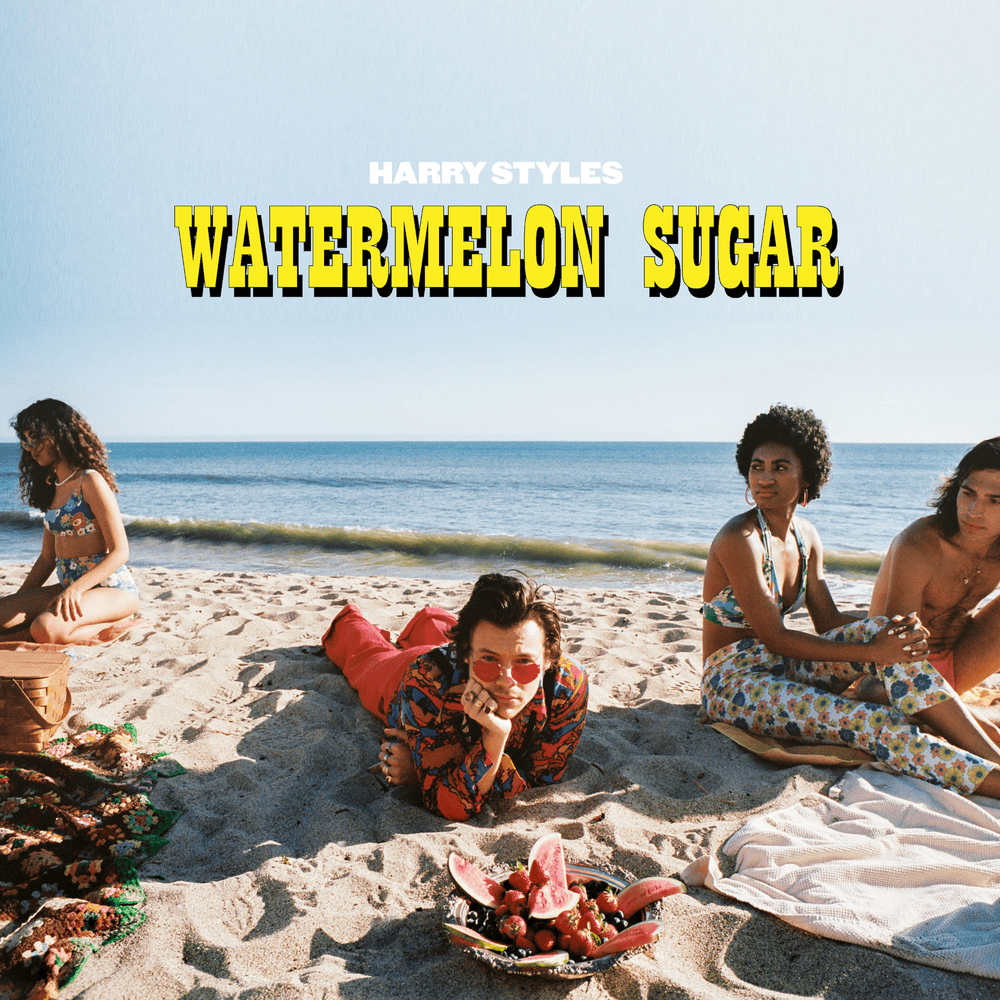
By the time he finally scored his first #1 hit in the US, Harry Styles was already a gigantic deal. Both as a member of One Direction and as a solo artist, he'd made a handful of smashes -- songs that were huge in the US and even bigger elsewhere in the world. "Watermelon Sugar," the song that finally took Styles to #1, wasn't a noisy, splashy pop event, though Styles kind of tried to make it into one when he first released it. The song lingered around the top 10 for months, finally sneaking up to #1 at a slow week between two big releases. The song was nine months old when it reached #1. In a summer full of ephemeral insta-pop nothings, a story like that is refreshing. Too bad about the song itself.
So: That backstory. Chances are good that you already know it. Styles has definitely gotten a lot out of that backstory. I'll tell it anyway, since that's what we do here. Harry Edward Styles -- impossibly, that's his real name -- was born in the English town of Worcestershire. He has always had the sauce. I had to make that terrible joke, and I will not apologize. (When Styles was born, Bryan Adams, Rod Stewart, and Sting's "All For Love" was the #1 song in America. In the UK, it was D:Ream's "Things Can Only Get Better." A lot of Styles' music sounds like a cross between those two songs.) When Styles was young, his parents broke up, and he moved to Cheshire. Too many places in England have "Shire" in their names. Hobbit-ass country.
Young Harry Styles wasn't really a stage kid. He liked singing karaoke, and he briefly led White Eskimo, a high-school band that probably should've considered that name a little harder. When he was 16, he mom told him that he should audition for The X Factor, a show that had a seismic impact on UK pop. That's what he did. Styles, a little cutie pie, was immediately able to establish a nice little repartee with Simon Cowell. He was not the slightest bit intimidated. If anything, he carried himself like a celebrity already. I bet that made a bigger impression on the judges than Styles' actual vocals. He sang Train's "Hey, Soul Sister," a terrible song, poorly. When Cowell told him to sing something else, he tried an acappella version of Stevie Wonder's "Isn't She Lovely," a much better song. He did better with that one, but it still wasn't a "get this guy on the radio immediately" type of situation. ("Hey, Soul Sister" peaked at #3. It's a 1. I once gave it a 2, but no, it's a 1. "Isn't She Lovely" never became an actual single, so it didn't chart.)
Styles made it through the X Factor audition process, but then he got cut during the boot-camp stage. Famously, the show's judges then decided to put Styles into a group with a bunch of other cute boys who got cut. They became One Direction, and they came in third in their X Factor season but then became a giant global pop phenomenon. I already went over the whole One Direction saga in the column on Zayn's "Pillowtalk," so I won't do that whole thing again. But I'll point out that Styles was immediately the most famous member of One Direction. All five of those kids got famous, but Styles was the Nick Carter, the Justin Timberlake, the Bobby Brown. He got all the attention, and he seemed to love it.
Later on, Harry Styles said that he didn't have any real freedom as a member of One Direction, but he sure seemed happy about his line of work at the time. Video directors and vocal arrangers did their best to give shine to all of the group's members, but Styles always seemed to find his way front and center. When he was still a literal child, Styles dated Caroline Flack, a UK TV presenter who was 14 years older than him. (Flack went on to host the first few Love Island seasons, and she died by suicide in 2020.) Styles also dated Taylor Swift for a minute, and a bunch of the best songs on 1989 seem to be about him. Styles himself co-wrote some One Direction songs, and he didn't even seem that weirded out about all the slash fiction about him hooking up with bandmate Louis Tomlinson. Maybe Styles wasn't that devoted to One Direction as a concept, but I'm sure he knew it could serve as a vehicle to bigger things.
As huge as they were, One Direction never made it to #1 in the United States, though they came close a few times. (Their highest-charting single over here was 2013's "Best Song Ever," which peaked at #2. It's a 6.) Zayn Malik, the resident bad boy of One Direction, was the first to leave the group in 2014. Styles stuck around for one more album until the group went on indefinite hiatus in 2016. With the sudden and shocking death of Liam Payne last year, that hiatus now feels permanent, though I guess the surviving members could always get back together sometime.
Quickly, Styles got himself signed as a solo artist, and he got to work on his self-titled 2017 solo debut. With that record, Styles gestured at the titans of '70s pop -- Elton John, David Bowie, Fleetwood Mac -- without committing to the freakiness or the hooks that those people brought to the table. It was cute, I suppose, to see this boy-band kid doing his best to showcase old-school musicianship and to shoot for big statements, but the music itself was adult-contempo mush, as if Styles was no longer trying to appeal to teenage girls and was now aiming at their parents.
Adult-contempo mush isn't necessarily a bad thing, and I kind of like Styles' debut solo single "Sign Of The Times," which sounds like a Kidz Bop version of "Bitter Sweet Symphony." (It's a 6.) But Styles' music didn't have any of the charged excitement that I tend to want from pop music, especially from former kiddie-pop stars in the growing-up phase of their career. When he was trying to make the same leap, Justin Timberlake worked with peak Neptunes and peak Timbaland. Styles went with credible muso types like Jeff Bhasker and Kid Harpoon, and he made something much more tasteful and much less interesting.
Harry Styles sold a lot of copies and eventually went double platinum in America, but only "Sign Of The Times" did any real chart numbers. As my man Chris Molanphy once wrote, Styles' chart fortunes were a little bit kneecapped by his teen-idol status. Radio programmers don't like to play an artist who might turn off adults, so artists like Styles need to prove themselves to adult listeners before they could claim pop-titan status. On Harry Styles, virtually every musical decision seems to be engineered to appeal to those theoretical adult listeners. There's no verve, no forward motion.
But Styles didn't need to have verve or forward motion in his music, since his celebrity had so much of it. In 2017, Styles made his screen debut as part of the ensemble in Christopher Nolan's Dunkirk, which is probably the best way that a young actor could possibly hope to make a screen debut. A year later, Styles started modeling for Gucci. Things just seemed to work out for him. At the tail end of 2019, Styles released Fine Line, his second solo album. In an interview around the release of Fine Line, Zane Lowe asked Styles about his first solo album, and Styles said, "I can hear all the places where I feel like I was playing it safe because I just didn't want to get it wrong." That's what you're supposed to say when you're coming off of a blandly respectable debut, but Styles responded to the challenge by playing it safe all over again.
Fine Line is not terribly different from Harry Styles. If anything, it might be even more musically staid. Styles recorded most of the LP with Kid Harpoon and Tyler Johnson, two of the producers who worked on Harry Styles. Kid Harpoon, whose real name is Thomas Hull, comes from the UK, and he released a sleepy indie-folk album called Once in 2009. He got his start writing songs with Florence + The Machine, and he co-write the Florence/Calvin Harris collab "Sweet Nothing," which peaked at #10 in 2013. (It's an 8.) Harpoon also co-wrote Jessie Ware's "Wildest Moments," and I love that song. So Harpoon was a talented pop journeyman when he co-wrote and co-produced a couple of Harry Styles tracks, including "Sweet Creature," a single that peaked at #93 over here.
Tyler Johnson, a California native, got his start as a recording engineer and as an assistant producer to Jeff Bhasker, a guy whose work has appeared in this column a few times. In 2015, Bhasker and Johnson co-wrote and co-produced a bunch of tracks for the pop-country singer Cam, including the #29 crossover hit "Burning House." Johnson got writing and production credits on every track on Harry Styles; Styles definitely likes working with him. Kid Harpoon and Tyler Johnson have done a lot of work together over the years. We'll see both of them in this column again.
When he was touring behind his first album in 2017, Harry Styles spent an off-day in a Nashville studio. He was in there with some collaborators, including Kid Harpoon, Tyler Johnson, and Mitch Rowland, a guitarist from Ohio who played on all of Harry Styles because his roommate was the audio engineer and because another guitarist dropped out late. Just like Tyler Johnson, Mitch Rowland has writing credits on every song on Harry Styles. Rowland joined Styles' touring band, and he met his wife Sarah Jones because she played drums in that same band. Madi Diaz, a singer-songwriter who I really like, was in that band, too, but I don't think she was at the Nashville studio when Styles, Harpoon, Johnson, and Rowland wrote "Watermelon Sugar."
Harry Styles told the story behind "Watermelon Sugar" when he taped a Tiny Desk Concert early in 2020: "We had this idea, and we had this chorus melody, and it was pretty repetitive. The Richard Brautigan book In Watermelon Sugar was on the table, and I was like, 'That would sound cool!'" At the time, Styles was dating Camille Rowe, a model who has said that In Watermelon Sugar, a minimal 1968 tale set on a commune after an apocalypse, is one of her favorite books. We don't know whether Styles actually read it, but at least he had a copy lying around. He came up with a chorus just by repeating the same three words over and over: "Watermelon sugar high."
Styles and his collaborators wrote "Watermelon Sugar" quickly, and then they kept messing with it for a while. In his Tiny Desk intro, Styles says, "We really liked it when we first had it, and then I really hated it for a long time. It kind of came back and kept seeming to come into the mix. It's kind of about, like, that initial, I guess, euphoria when you start seeing someone or you start sleeping with someone, just being around someone, and you have that kind of excitement about them, and... you know." He probably trails off because he doesn't want to go on NPR say that "Watermelon Sugar" is about eating pussy. But the guy is on the song talking about "I just wanna taste it." He's not that subtle.
That's part of the Harry Styles experience. He sings a song with a plain and obvious meaning, and then he plays coy about what that meaning actually is. In the aforementioned Zane Lowe interview, Lowe says, "Everyone's kind of figured out what it's about -- the joys of, you know, mutually appreciated oral pleasure." Styles shoots back, "Is that what it's about?" Well, yes. Yes, it is. At a show years later, Styles said that "Watermelon Sugar" is about "the sweetness of life" but also "the female orgasm," which duh. He was giving his audience what they wanted while pretending that he wasn't being so crude, which is also what they wanted. That's how you play the game.
Styles wasn't kidding about "Watermelon Sugar" being repetitive. It's less of a song, more of a groove, which wouldn't be a problem if the groove was nastier. It's not nasty, though. It's funky in only the vaguest possible way. The pieces are all in the right places -- the acoustic guitar plucks, the electric guitar riff, the rippling percussion, the horn-stabs. The bass comes from Pino Palladino, the session wizard who has been in this column a bunch of times, and that guy obviously kills everything. Some nice disco-shimmy strings come in partway through. The whole thing is crisp and professional, but it feels airless. You can tell that actual instruments are involved, but it feels ProTooled together in some strange, ineffable way. Most of the songs in this column this century are ProTooled together, and I don't have a problem with it. Here, though, the song seems to be selling us the live-band feeling while only giving a slight touch of how that feeling really feels.
The writing is pretty bad, too. Styles' innuendos are clumsy. He sings that an unspecified "it" tastes like strawberries on a summer evening, and he likes that line so much that he repeats it again and again. There's really nothing more to the song's lyrical idea, and maybe there shouldn't be. It's not like I judge funk or disco songs on their lyrical complexity. I judge them on how hard they groove, and "Watermelon Sugar" is lacking there. But Styles hits some nice falsettos, and his drawl has presence. I guess I don't like how serious he sounds. A song like "Watermelon Sugar" should have some winky playfulness to it, and Styles can do that. He did it on a whole lot of One Direction records. But he won't do it on his own oral sex song. Even when he's at his horniest, this guy's brow is firmly fixed in the middle.
Harry Styles started building up to his Fine Line album with the release of "Lights Up," a song that peaked at #17. A month after that song came out, Styles was both host and musical guest on Saturday Night Live. When he was on the show, he performed "Watermelon Sugar" for the first time, and the song itself came out that very night. It debuted at #60, and it didn't get a big push. Within a few weeks, it was off the Hot 100. Another single, "Adore You," got a louder rollout and an attention-grabbing video. "Adore You" slowly inched its way up the Hot 100, peaking at #6. (It's a 5.) American radio had come around on Harry Styles.
Styles shot his "Watermelon Sugar" video on a California beach in January 2020, just before the pandemic hit. The clip looks gorgeous, and it's just Styles and a bunch of models in a cuddle puddle, eating literal watermelon as suggestively as possible. They must've had to spit out so much sand. Otherwise, that's nice work if you can get it. The clip didn't come out until May, when COVID lockdowns were in full swing. At the beginning, a message appears onscreen: "This video is dedicated to touching." That is some clumsy motherfucking verbiage, "dedicated to touching." You get the idea, though. Pre-pandemic, Harry Styles was just some hot pop star singing about going down on you. During the pandemic, he became an avatar for all the physical contact that people could no longer enjoy, unless they were all cuffed up in committed relationships. That's a fairly manufactured bit of cultural resonance, but it helped draw attention to the song.
"Watermelon Sugar" returned to the Hot 100 in May, with the release of the video, and it gradually pushed its way up into the top 10. A week after three songs from Styles' ex-girlfriend Taylor Swift debuted in the top 10, Styles had his window. He sold vinyl and cassette singles of "Watermelon Sugar," and a discounted download went up on sale for 69 cents. The song already had plenty of momentum, and that extra bit of promotion was enough to give it a week at #1, just before the noisy arrival of a different song about vaginal juices. We'll get to that one next week. Summer 2020 was evidently a horny, frustrated time for a whole lot of people.
Harry Styles' Fine Line album sold nearly 500,000 copies in its first week when it came out at the end of 2019, and it eventually went platinum. The "Watemelon Sugar" single, meanwhile, went platinum nine times over. Styles' next big venture was a cameo in a post-credits scene in The Eternals, the Marvel movie. He gets a real movie-star entrance, but the scene is sadly completely incoherent, even to those of us who have wasted our lives watching Marvel movies. Nobody liked The Eternals, and it seems likely that Styles' cameo will just be allowed to dangle forever, like so many random-ass Marvel things in recent years. But Styles had more movie roles on the way, and he also had a bigger album in his future. We'll see him in this column again.
GRADE: 5/10
We rely on reader subscriptions to deliver articles like the one you're reading. Become a member and help support independent media!
BONUS BEATS: A surprising number of past Number Ones artists have covered "Watermelon Sugar." Here, for instance, is Kelly Clarkson singing the song way better than Harry Styles ever could on a 2020 episode of her talk show:
Here's Jon Bon Jovi doing an acoustic live-in-studio version in 2021:
And here's Rick Astley singing "Watermelon Sugar" at a 2021 live show in Bournemouth:
The Number Ones: Twenty Chart-Topping Hits That Reveal The History Of Pop Music is out now via Hachette Books. I don't know if you could ever go without, but you don't have to. You can just buy it here instead.