
October 10, 2020
- STAYED AT #1:1 Week
In The Number Ones, I'm reviewing every single #1 single in the history of the Billboard Hot 100, starting with the chart's beginning, in 1958, and working my way up into the present. Book Bonus Beat: The Number Ones: Twenty Chart-Topping Hits That Reveal the History of Pop Music.
Imagine trying to explain the backstory of "Savage Love (Laxed - Siren Beat)" to your grandparents, or maybe your parents, or maybe your younger self. Hell, imagine trying to understand it by yourself, right now. There's honestly too much stuff in this story. A teenage kid in New Zealand makes an instrumental track on his computer, and that track goes viral and soundtracks a particularly wholesome TikTok dance trend. Then a fading American pop star grabs that track, sampling it without permission or attribution and basically just singing along with its keyboard melody, in an attempt to power up his flailing comeback attempt. And it works, at least for a minute. The song becomes a global smash, but it doesn't triumph on the Hot 100 until a molten-hot South Korean boy band releases its own remix of the fading American pop star's version. Don't worry, I'll get into the whole thing in more detail. But it's a lot.
The title and credits of "Savage Love (Laxed - Siren Beat)" are awkward and ungainly as all hell, but they're not half as awkward and ungainly as the creation of the song itself. The romantic ideal of the out-of-nowhere pop hit is the That Thing You Do! story: Some kids mess around in a garage and make something irresistible, and then that thing takes the world by storm. Variations on that story have happened many times throughout pop history. They're still happening now. At least in the very beginning, the "Savage Love (Laxed - Siren Beat)" story was a variation on that one. In this case, though, the Cinderella story had to come into contact with the cold machinations of the music business and the roiling, unregulated chaos of the internet. Both of those things have a way of leeching the romance out of something.
But forget about romance here. We're not talking about romantic love. We're talking about "Savage Love." More specifically, we're talking about "Savage Love (Laxed - Siren Beat)." It's pop music. It doesn't have to be romantic to be great. Lots of incredible music has emerged out of the same depressing morass that gave us "Savage Love (Laxed - Siren Beat)." If we take the romance out of the equation, how is it as a song? That's what I've been trying to figure out with every edition of this column. In this case, the answer is this: As a song, it's really fucking annoying. And I'm afraid it would still be really fucking annoying even if the romance remained intact.
Let's go back to the beginning. Let's start it out with Jawsh 685, the teenage kid who kicked this whole phenomenon off. Joshua Christian Nanai comes from South Auckland, New Zealand. (When Jawsh was born, Nelly and Kelly Rowland's "Dilemma" was the #1 song in America. In New Zealand, it was Atomic Kitten's cover of "The Tide Is High.") Jawsh 685 is not the first teenage kid to come from New Zealand and appear in this column, but he doesn't have too much in common with Lorde, the last one to do it. Still, they've got some creative kids over there in New Zealand. I guess they've got creative kids everywhere, but the ones from New Zealand have been in this column twice, which is twice more than you might've expected.
Jawsh 685 comes from a family of Pacific Islander, or Pasifika, heritage. His father is from Samoa, his mother from the Cook Islands. Jawsh added the "685" to his name because that's the country code for Samoa, even though he'd never been there when he started using the name. He'd never been on a plane at all. When The New York Times first interviewed Jawsh, he was still sharing a bedroom with his younger brother, the two of them sleeping in a bunk bed. (The Times neglected to report whether Jawsh had the top or bottom bunk.) In high school, Jawsh got into a subculture known as siren jams, which is extremely specific to Pasifika communities in Auckland and the surrounding area. Basically, kids strap big siren speakers with rigged-up batteries to their bikes, and they ride around playing music really, really loud, competing to see whose siren is the loudest.
In a 2016 Vice article about the siren jams culture, Aubrey Edwards, a photographer who published a book of images of those kids, explained what music was popular in the world of siren jams: "Apparently, the worst music has the highest treble and that’s the loudest music, so the battles are really horrible music going back and forth. Maroon 5. Lady Bee. Céline Dion." By this point, you should be utterly charmed. Tongan and Samoan kids going head-to-head, playing gloopy pop music on their homemade bike-speaker setups? That's fucking awesome. I'm glad they're not doing it right outside my window, but I'm into it.
Eventually, those kids started making their own music specifically to play on those bike sirens.. That music drew inspiration from reggae and dancehall, which have long been popular in New Zealand, and from more traditional Polynesian music, which has its own harmonic and rhythmic convergences with reggae. I'm just now reading about how the Māori strum, a traditional guitar style from New Zealand, lags just behind the beat, the way the one-drop guitar pattern has always done in reggae. So lots of the siren jams that those producers would post on YouTube basically sounded like cheap, homemade versions of reggae instrumentals, but with way less focus on bass and way more on treble.
Jawsh 685 loved this stuff; it was the main thing he listened to. When he decided that he wanted to make that music himself, he couldn't get any of the other siren jams producers to teach him, so he taught himself. He downloaded a version of the FL Studios app on his broken laptop, and he started posting his own tracks on YouTube. Jawsh posted "Lá Kóta (Siren Beat)," his first YouTube instrumental, in April 2019. The original "Laxed (Siren Beat)" is the sixth video on his YouTube page, and it went up in July 2019, when he was 16. (The music video, embedded below, came more than a year later.)
Here's Jawsh 685's explanation for the title of "Laxed (Siren Beat)": "[I was] feeling relaxed so it made sense to call it ‘Laxed.'" Look, he's a kid, OK? Did you really want more than that? He made it when he was feeling relaxed, so it's called "Laxed." It doesn't have to be more complicated than that. Jawsh says the track only took about four hours to make, and I'm honestly surprised that it took that long. Maybe the problem was the broken laptop, or maybe it's just that he was still learning to make music. It doesn't sound like it took four hours, though. It sounds more like it took four minutes.
I'm being unfair. The interesting thing about "Laxed (Siren Beat)" is that it's a complete structured song. Title notwithstanding, it's more than just a beat. Even as an instrumental, it's got a few different melodies, broken into verse and chorus. The beat itself is a super-rickety digital reggae thing. It would make an unremarkable but perfectly functional vehicle for any singer who wanted to use it. But in place of a singer, we get a super-obnoxious klaxon synth sound. This is clearly what's supposed to cut through the air on those siren speakers, its treble overwhelming the treble of the kid from the next block over who's playing Maroon 5 on his siren speaker.
At heart, "Laxed (Siren Beat)" is an expression of community. That's what I like about it. Jawsh 685 basically made this track for himself and his friends. He took part in an extremely local tradition. The song is supposed to serve a definite, limited function. It's meant to be played when you're riding around South Auckland on a bike, with a car battery rigged up to a siren speaker. It's not supposed to be more than that. But thanks to the mysterious workings of the internet, it became something more than that. Somehow, TikTok users found "Laxed (Siren Beat)," and they used it as the soundtrack for a dance trend that also served as an expression of community.
The #culturedance challege went like this: Someone would do an extremely simple dance -- a couple of shoulder touches, a couple of dips -- and then they'd suddenly and magically be wearing the traditional clothing of their ethnic background. It was cute, honestly. It's hard to trace the histories of viral dance challenges, but I have to imagine that the #culturedance challenge started with Pasifika people and then spread out from there. In the early lockdown days of 2020, people would post videos to celebrate all sorts of different backgrounds -- Korean, Pakistani, Ukrainian, Nigerian, Native American. You'd also get your obligatory "oops I'm just a basic white girl lol" posts, but those never hurt anybody. As TikTok trends go, this was about as positive and non-toxic as it gets. And then Jason Derulo got involved.
You remember Jason Derulo? He's been in this column before. In 2009, the 20-year-old Florida singer Derulo reached #1 with his debut single "Whatcha Say," a solid but forgettable dance-pop track built on a sample of Imogen Heap's "Hide And Seek." "Whatcha Say" feels like the work of a one-hit wonder, but Derulo managed to parlay its success into a pretty good run as a B-list hitmaker in the first half of the '10s. Derulo never became a pop star; he never showed enough personality to earn that title. But he did make some jams. Between 2009 and 2015, Derulo sent five more songs into the top 10, and I like most of the ones that came out after "Whatcha Say." My favorite of them is probably "Want To Want Me," a delirious '80s-style fist-pumper that peaked at #5 in 2015. (It's a 9.)
But "Want To Want Me" was the end of the run. After that song, the hits dried up. Derulo didn't make it back into the top 10 for another five years. The last Jason Derulo song that even touched the Hot 100 pre-"Savage Love (Laxed - Siren Beat)" was 2017's "Swalla," which couldn't get past #29 even with Nicki Minaj and Ty Dolla $ign in supporting roles. It was supposed to be the lead single from a Derulo album, but that album never came out. Derulo specialized in a kind of anonymous streamlined dance-pop, and when that sound disappeared from the zeitgeist, so did he.
But hey, maybe Jason Derulo could pivot to acting! In 2019, Derulo played the crucial role of Rum Tum Tugger in the Cats movie, and you already know how that turned out. I never saw Cats, but I did read reviews that singled Derulo out as the one person who really popped in a cast full of unhappy celebrities. But the most famous thing about his performance was what wasn't in there -- the costume dick-bulge that reportedly was CGI'ed out of the final film. Derulo and his absent dick-bulge got a Razzie nomination for Worst Screen Combo, but they lost it to Derulo's Cats co-stars, "any two half-feline/half-human hairballs." Fuck the Razzies, honestly. I'm starting to feel like I need to watch and enjoy Cats, just to spite those unfunny fucking dorks. Anyway, Derulo and Warner Bros. parted ways early in 2020. Derulo was a man adrift, but at least he had TikTok.
Jason Derulo loved TikTok. Probably still does. Back when TikTok was still known as Musical.ly, Derulo learned about the app from his nieces and nephews, and he jumped right in. At that point, the app mostly existed to post dancing and lip-syncing videos. Say what you will about Derulo, but the man can dance. He became a true early adapter, a grown-ass minor celebrity on an app that was mainly populated by non-famous children, and he did very well for himself. Soon, he had one of the most-followed accounts on the app. At one point, Derulo even claimed responsibility for the popularity of TikTok itself: "TikTok used to be just a dance app, and it wasn’t until I started to introduce other things that it became the app that it is today." I don't know about all that, but he was good at it. You can easily waste entire minutes of your life watching a Jason Derulo TikTok compilation. I don't necessarily recommend it, but the option is available to you. Do what you want. It's your life.
In May 2020, Jason Derulo posted a TikTok of himself singing a piece of a new song called "Savage Love," which was obviously just Derulo singing over the "Laxed (Siren Beat)" instrumental. His caption: "Made this song last night. #SavageLove Full song in my bio." At first, Derulo's video didn't include any attribution for Jawsh 685, which led to a predictable backlash. The optics were terrible -- a flailing pop star stealing a song from a no-name child musician without clearing anything. Variety ran an article on it soon afterward, and Derulo declined to comment.
It turned out that Derulo was just being sneaky. Thanks to the viral success of "Laxed (Siren Beat)," Jawsh was already talking to Columbia about signing a deal, and he was in conversations with a few artists about a new version of the track with vocals. One of those artists was Derulo. He'd DM'ed Jawsh about using his track, but Jawsh never gave the OK. So Derulo just posted his version without clearing anything, possibly to get ahead of any other remixes that might come out. An unnamed source told Variety, "Jason wanted the beat for a record -- he wanted the song to be a Jason Derulo song with Jawsh as a producer. But Jawsh should make decisions of what he wants to do with it, not be bullied by a bigger artist into putting it out."
That means "Savage Love" is a true case of a bootleg getting an official release. Maybe it belongs to the same lineage as the time that DNA remixed Suzanne Vega's "Tom's Diner." In 1987, a British dance duo used the acapella vocal from an old Vega song and set it to a Soul II Soul beat. The track went off in clubs, and an amused Vega signed off on its proper release. Ultimately, that remix became a global smash. (On the Hot 100, "Tom's Diner" peaked at #5. It's a 10.) The "Savage Love" story is a bit like that, but it's not some unknowns remixing a pop star; it's a pop star remixing an unknown. Also, "Tom's Diner" is an immortal banger, and "Savage Love" sucks.
Jason Derulo's "Savage Love" vocal melody is just him singing over the synth melody from "Laxed (Siren Beat)." He doesn't do anything with it. He just changes that instrumental into a song about being addicted to a lover who treats you like shit and who is probably cheating on you. We have heard a million songs like that, and "Savage Love" adds nothing to the tradition. Instead, Derulo makes an annoying track even worse. He tries to emote over that melody, and he just sounds silly. It's a TikTok stunt in song form.
Somehow, Derulo needed help putting this together. The track credits two other songwriters. There's Jacob Kasher, who has been in this column before for working on Kesha's "We R Who We R" and who will be back because he's now a regular Morgan Wallen collaborator, and there's Phil Greiss, a French producer with credits on a bunch of dance-adjacent pop tracks. Those guys must've cashed an easy paycheck on "Savage Love." (I'm pretty sure "Savage Love" is not named after Dan Savage's old alt-weekly sex column, but I guess anything's possible.)
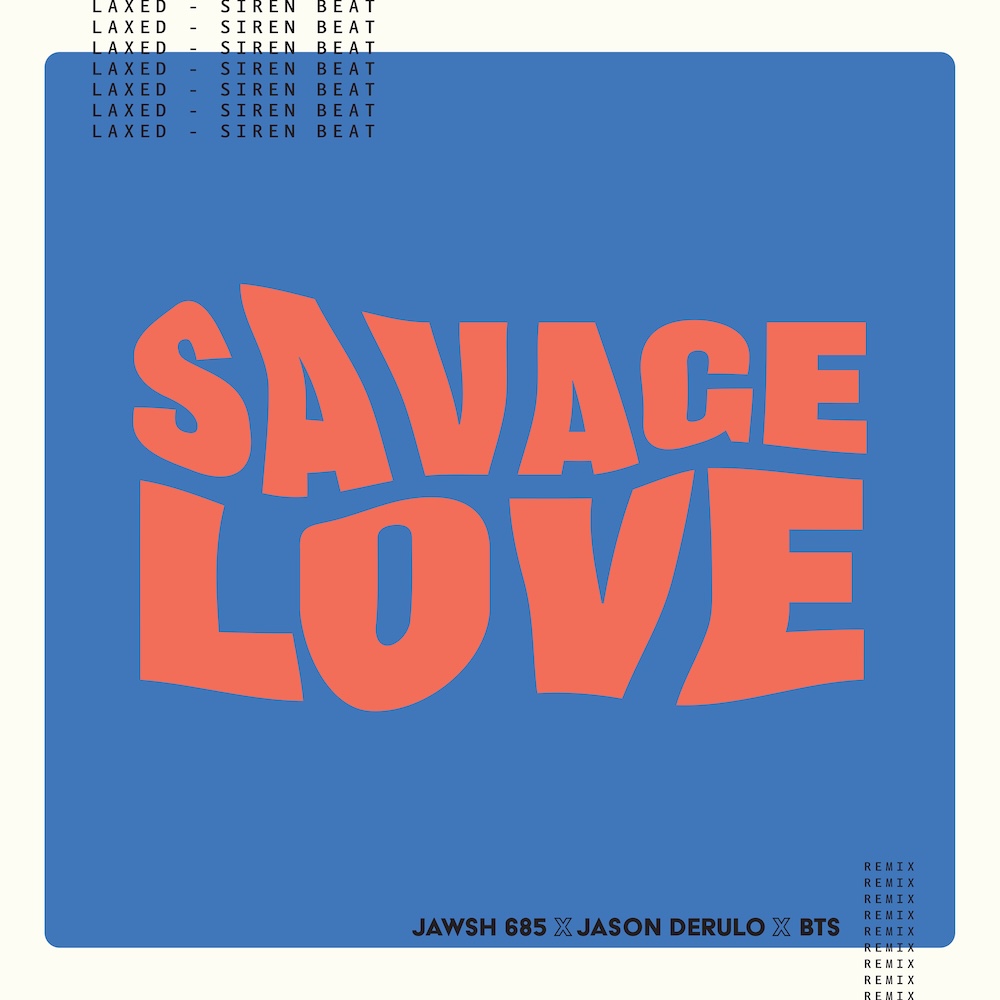
Even with the bad optics, "Savage Love" became even more of an online sensation than "Laxed (Siren Beat)" had already been, and a bunch of TikTok influencer types posted videos of themselves dancing to it. There was money to be made, so Jawsh 685 and Jason Derulo came to a deal. They would both be credited on the song -- it's technically a Jawsh 685 x Jason Derulo track, with the "x" instead of the ampersand -- and it would be given the new car-crash name "Savage Love (Laxed - Siren Beat)." The single came out on Columbia in June 2020, and it quickly became Jason Derulo's biggest hit in years. He and Jawsh even put out a new video for the song, with Derulo in Los Angeles and Jawsh and his friends back in South Auckland. The pieces didn't match up, but that apparently didn't matter.
After a couple of months, Savage Love (Laxed - Siren Beat)" made its way into the top 10, and it rattled around in there for a few weeks. And then: BTS. In America, the mega-popular South Korean boy band were signed to Columbia, and Columbia masterminded the release of their first English-language single "Dynamite," which topped the Hot 100 when "Savage Love (Laxed - Siren Beat)" was still on its way up. BTS agreed to do a "Savage Love" remix, and their version came out in October 2020. As soon as that happened, the song shot straight from #8 to #1.
Just in terms of music, I don't think BTS add much to "Savage Love (Laxed - Siren Beat)." Jason Derulo's chorus doesn't exactly improve when phonetically delivered by someone who doesn't speak English. We don't get all seven BTS members on the "Savage Love" remix, which is probably for the best. We only get three of them: Jung Kook singing the chorus, Suga singing a verse that's entirely in Korean, and J-Hope doing a quasi-rapped verse that goes between Korean and English. They sound fine, I guess? But they don't exactly grab the song and make it their own. They seem to be there as for transactional reasons. By delivering some Korean lyrics on the track, BTS were able to get some of their own language into a #1 American hit, which they hadn't previously done. This opened up the possibility that they could sing something entirely in Korean and still conquer the Hot 100, and yes, that did happen. We'll see the results pretty soon. (Jung Kook will also be in this column as a solo artist.)
But where the success of "Dynamite" felt like an actual cultural-watershed moment for K-pop in the US, the group's appearance on "Savage Love (Laxed - Siren Beat)" was just a cynical push to get the song to #1 -- the same trick that the music business had been employing for years. The BTS bump didn't last. When the remix came out, the song's streams and download sales went way, way up, but the track only got a week at #1. I don't think BTS did anything for the cultural longevity of "Savage Love." I never hear that song anymore. I don't hear much about Jawsh 685 or Jason Derulo, either.
It seems likely that Columbia only signed Jawsh 685 so that they label would be able to release "Savage Love (Laxed - Siren Beat)." Just before the "Savage Love" remix came out, Jawsh released his single "Sweet & Sour," a collaboration with two American musicians, Lauv and Tyga. It was a hit in New Zealand but nowhere else. Jawsh hasn't been back on the Hot 100 since "Savage Love," and he hasn't released an album. Last year, he re-teamed with Jason Derulo for a song called "Make Me Happy," another one that only did numbers in New Zealand. The "Savage Love (Laxed - Siren Beat)" saga didn't exactly turn Jawsh into a superstar. On the plus side, his family moved into a bigger house, and he got to have his own bedroom.
Jason Derulo hasn't made any big hits since "Savage Love," either. He's been on the Hot 100 a couple of times, but only in the lower rungs. He made it to #57 with "Take You Dancing," a song released later in 2020, and his Gotye-jacking Adam Levine duet "Lifestyle" peaked at #71 a year later. Nothing since then, though he still has his nearly 70 million TikTok followers. That seems like a lot, though I don't really know what TikTok numbers mean. In 2023, another singer sued DeRulo for sexual harassment. I don't expect to see Jason Derulo in this column again, but I wasn't expecting to see him in here with "Savage Love," either.
"Savage Love (Laxed - Siren Beat)" is a strange little one-off hit with a freaky, implausible backstory and no real societal impact beyond its ability to demonstrate the strange effects that TikTok has had on the global population. Seen from a certain angle, maybe it's cool that a hyper-regional New Zealand scene was in the spotlight for a minute. But to do that, Jawsh 685 had to become a vehicle for two different global acts who were already enjoying varying levels of success. In all of its many forms, "Savage Love (Laxed - Siren Beat)" is an irritating song, and I wasn't sorry to see it disappear. If something was already a TikTok hit, it probably won't get a TikTok revival, right? I hope this song doesn't get a TikTok revival. Fingers crossed.
GRADE: 3/10
BONUS BEATS: Wow, I have nothing for this section. I've been facing this problem more and more often in recent columns, so I'll have to improvise here. In that spirit, please enjoy Jason Derulo singing about how Rum Tum Tugger is a curious cat in the major 2019 motion picture Cats:
The Number Ones: Twenty Chart-Topping Hits That Reveal The History Of Pop Music is out now via Hachette Books. I got a way of making you spend all your cash, and that's telling you to buy the book.