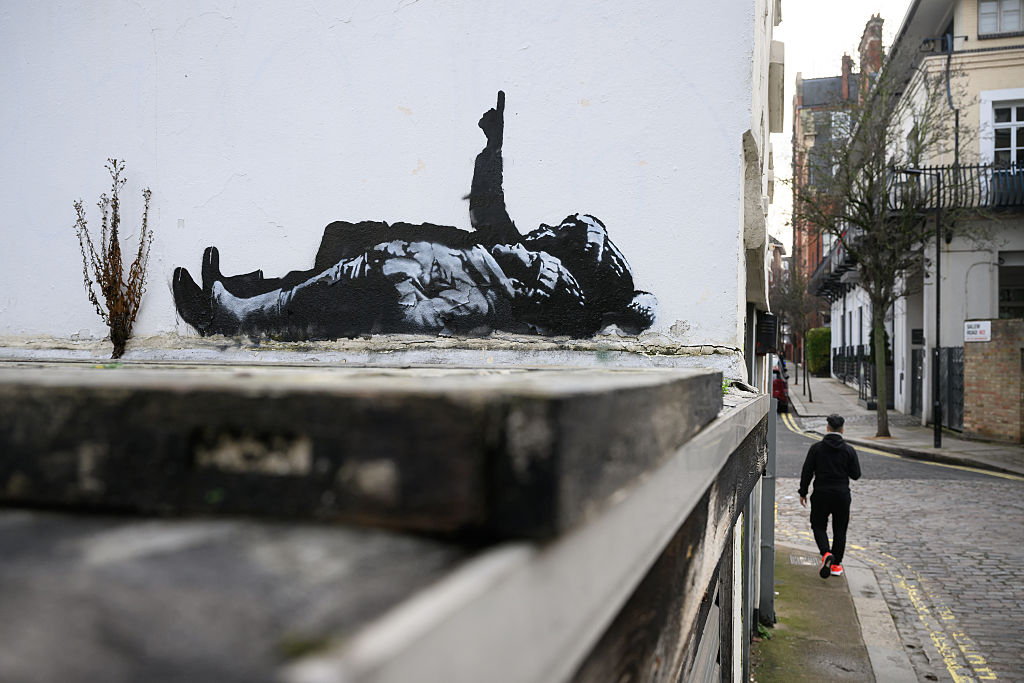
For many years, there's been widespread speculation that the famously anonymous British street artist Banksy is really Robert Del Naja, otherwise known as Massive Attack co-founder 3D, and/or a man named Robin Gunningham. Banksy and Massive Attack have crossed paths many times over the years, and Banksy claimed to be from Bristol, Massive Attack's hometown. But that speculation was always part of the fun of the Banksy phenomenon. He's became arguably the world's most sought-after artist while remaining anonymous, and that anonymity has been central to his art. That time may be over. Over the weekend Reuters published a huge exposé, more than 7,000 words, that purports to reveal Banksy's real identity "beyond dispute." Their conclusion is the same The Mail On Sunday published in 2008: It's Robin Gunningham.
To figure out Banksy's identity, Reuters combed through previously unreported business records, travel documents, and eyewitness accounts. It's especially focused on Bansky's recent art activities in Ukraine. Before we get into their conclusions, we should talk about why these reporters were so intent on discovering who Banksy really is. Here's Reuters' own explanation:
Reuters took into account Banksy’s privacy claims – and the fact that many of his fans wish for him to remain anonymous. Yet we concluded that the public has a deep interest in understanding the identity and career of a figure with his profound and enduring influence on culture, the art industry and international political discourse. In so doing, we applied the same principle Reuters uses everywhere. The people and institutions who seek to shape social and political discourse are subject to scrutiny, accountability, and, sometimes, unmasking. Banksy’s anonymity – a deliberate, public-facing, and profitable feature of his work – has enabled him to operate without such transparency.
By way of explaining the need for such transparency, Reuters cites a piece that Banksy stenciled on the wall of London' London’s Royal Courts Of Justice last year. In the piece, which was powerwashed from the building, a judge uses a gavel to beat a protester. It appeared two months after the British government controversially declared the protest group Palestine Action as a terrorist organization, using that rationale to jail anyone who expressed any kind of support of the group. Reuters notes that the courthouse is "a historically protected building." The implication, not stated by Reuters, is that the British government should be able to punish Banksy for statements like those.
Robert Del Naja comes up many times in Reuters' report, and Del Naja was reportedly in Ukraine at the same time as Banksy. The Del Naja rumors have been flying for years, and one of his friends, the veteran drum 'n' bass producer Goldie, seemingly confirmed them when he accidentally referred to Banksy as "Rob" in a 2017 podcast interview.
But Reuters ultimately came to the conclusion that Banksy is actually a guy named Robin Gunningham. After The Mail On Sunday's report in 2008, Gunningham had "seemingly gone off the grid," according to Reuters. The publication found that Gunningham legally changed his name to "David Jones" to travel undetected and that he entered Ukraine on the same day as Del Naja. Banksy and his associates would not confirm Reuters' reports, but this may finally end the speculation. You can read Reuters full report here.
I legit found Banksy first ? pic.twitter.com/HNcpSwdh5P
— Yoshi Babaganoush (@minted_i) March 16, 2026