Skip to Content
The Alternative Number Ones

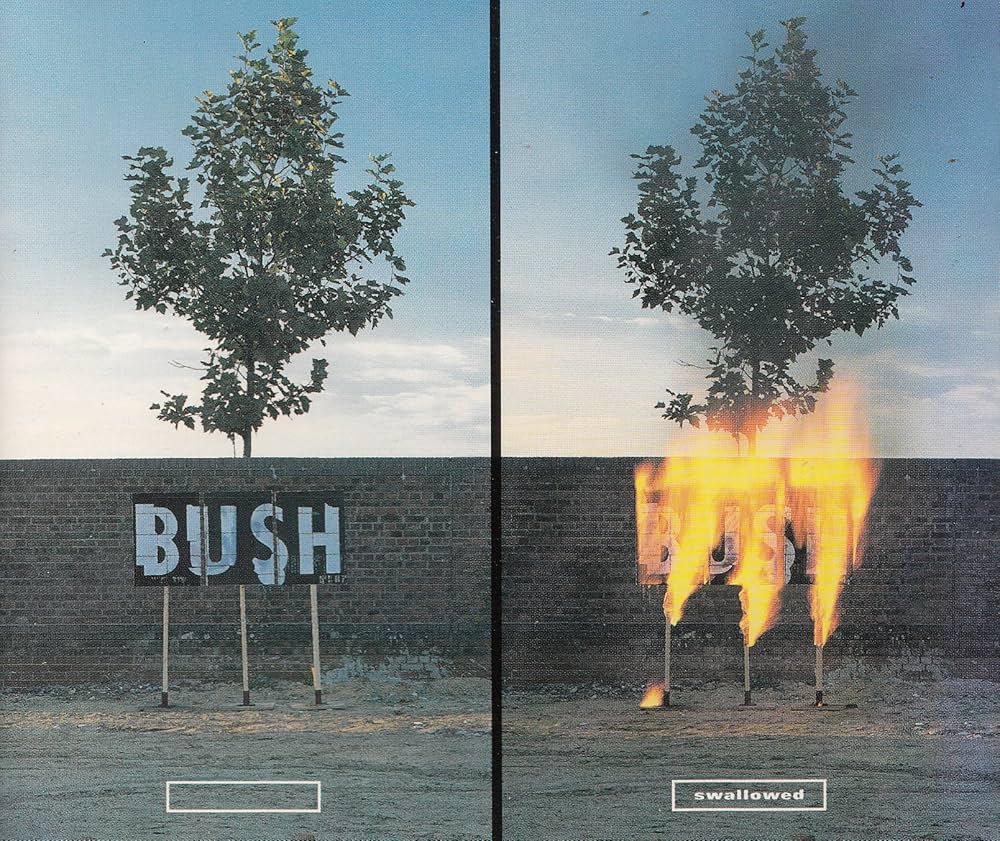
The Alternative Number Ones: Bush’s “Swallowed”

November 16, 1996

  • STAYED AT #1:7 Weeks

In The Alternative Number Ones, I’m reviewing every #1 single in the history of the Billboard Modern Rock Tracks/Alternative Songs, starting with the moment that the chart launched in 1988. This column is a companion piece to The Number Ones. The column is now biweekly, alternating with The Number Ones on Mondays.

Did you watch the Bush Tiny Desk Concert? I watched it. It was what I was expected. A couple of weeks ago, Gavin Rossdale parked himself in the NPR offices. He brought along three guys who were not in Bush in the '90s, and they played artfully arranged versions of ultra-familiar '90s songs like "Glycerine," as well as one newer song that, I swear to god, is called "I Beat Loneliness." Rossdale wore a T-shirt that looked expensively moth-eaten, if that makes any sense. He is 60 years old now, and he remains way more stupidly handsome than any just god would allow. If he's had work done, it's that good work — none of that Mar-A-Lago face for our boy. He is no Goo Goo Doll. It's probably easier to beat loneliness if you still look like that.

Within the confines of the Tiny Desk Concert, Bush become a tasteful nostalgia act. That's how '90s acts always come off in Tiny Desk Concerts, whether we're talking about Pulp or Juvenile — or, for that matter, the Goo Goo Dolls, whose Tiny Desk was a big hit back in November. These videos have a way of presenting heritage artists in frictionless ways that remove any context, just dipping you into the warm bath of your memory instead. You're supposed to put the video on and be like, "Ah, man, that takes me back. Perhaps I should check and see if they're touring near me anytime soon." If you've harbored a weird and possibly pointless grudge against this band for decades, you're supposed to just let it go. I understand the intent, but I can't do it.

Look, what would you have me do? I was in ninth grade when Bush suddenly blew up and became the biggest thing on alt-rock radio. I was an opinionated ninth grader, too. I was the kind of ninth grader who read music magazines. I saw this absurdly attractive British man singing his grunge songs, and I forcefully rejected it. I made fun of him at every available opportunity. I sang along to the Bush songs on the radio in the most sneerily fake-sincere baritone that I could conjure. I can't just turn around three decades later and be like, "You know what? Bush were fine. They have some jams." It would be an unforgivable betrayal of my younger self.

Funny thing: I have always felt that Gavin Rossdale is trying to win people like me over. When Bush's debut album Sixteen Stone was going supernova, Rossdale would always come off funny and self-aware in interviews, even when the writers would transparently bait him. He'd sometimes admit that Bush sounded like Nirvana but would always insist that they weren't trying to sound like Nirvana, that they merely had a similar set of cool-kid influences. So when Bush hired Steve Albini to produce their sophomore album Razorblade Suitcase, my reaction was pretty much the same one I had when I saw that Tiny Desk Concert: "Nice try, dickhead! You can't fool me!"

All's to say: I was all set to shit all over "Swallowed," the lead single from Razorblade Suitcase. I definitely remember when that song was all over the radio, and I definitely remember thinking it was bullshit. But it turns out that "Swallowed" is pretty good. It's not great, but it's pretty good. I am not very happy about this. It is what it is.

In April 1996, Gavin Rossdale appeared on the cover of Rolling Stone, and the photo was what we would now call a thirst trap: This guy shirtlessly sprawled on a messy hotel bed, looking up at the camera with his finger in his mouth. It's the same kind of pose that the magazine would have Britney Spears doing a few years later. The line on the cover: "Why won't anyone take Gavin Rossdale seriously?" But Rolling Stone wasn't exactly trying to help his case, was it?

Eight months later, Rossdale was also on the cover of SPIN. (The other Bush guys were on that cover, too, but they were in the background, and Rossdale was obviously in the foreground.) In the accompanying profile, writer James Hannaham noted that Rossdale had that Rolling Stone cover hanging on the wall of his London apartment but that it had been altered to take out the "why won't anyone take Gavin Rossdale seriously?" part. Rossdale was not happy to tell Hannaham, "If you look closely, you can see it." (The coverline for that SPIN issue: "Don't hate them because he's beautiful." Magazine editors really got their licks in on this guy.)

When news got around that Bush were working with the late Steve Albini on their second album, people naturally had questions for both Rossdale and Albini. As you probably already know, Albini was a scabrous noise-rock specialist, and he's still best-known for his work on In Utero, the album that Nirvana made when they tried to reject their own pop success. Bush blew up in the immediate aftermath of Kurt Cobain's suicide, and they consistently faced accusations that they ripped off Nirvana, or that Rossdale was trying to become a fresher, handsomer, more sanitized replacement for Cobain. Considering those allegations, working with Albini was quite the choice.

In the SPIN profile, Rossdale tried to justify himself: "Steve Albini has been more important to me in terms of records I've listened to than any other person. In Utero is included in that, but it came out after. I'm talking about before." By "before," Rossdale seemed to specifically mean Albini's work on the Pixies' 1988 debut Surfer Rosa. Rossdale even admitted to SPIN that he wished he was better at emulating the Pixies: "I'm not good enough to show my influences where they really are. I can't quite appropriate well enough. I love the Pixies, but I still can't sound like them."

He kept trying! Rossdale even got Vaughan Oliver, the 4AD graphic designer who put together the Surfer Rosa cover, to do the artwork for Razorblade Suitcase. But then again, the Pixies might've been the single biggest influence on Nirvana, as well, so that connection wasn't getting Rossdale out of jail free. (The Pixies' highest-charting Modern Rock hit was "Here Comes Your Man," which peaked at #3 in 1989. It's a 9.)

Also! Gavin Rossdale dated Courtney Love for a few months after Cobain's suicide! I don't think he did this to send a message that he was trying to follow in Cobain's footsteps. People connect to other people, and things happen. Life isn't as neatly mapped-out as we might like to imagine. But you can see how onlookers might've gotten the wrong impression there. After they broke up, Rossdale and Love remained on good terms. In the SPIN feature, Love said, "He asked me not to say he's nice. But I'm me, and even I can't say anything mean about him."

By all accounts that I've seen, Gavin Rossdale both was and is a very pleasant human being. Steve Albini's decision to work with Bush probably had something to do with that. Albini worked all the time, and he famously agreed to engineer people's records even when he didn't like their music. After his work on In Utero, Albini went right back to the noise-rock underground, and he later said that the major labels all blacklisted him over the way he stridently advocated for his own work on the Nirvana record. Albini refused to call himself a producer, favoring the term "recording engineer" instead. The same year that he worked on Razorblade Suitcase, Albini did the same recording-engineer work on albums from Palace Music, Oxbow, Silkworm, Man Or Astro-Man?, Scrawl, and a bunch of other bands who you will sadly never see in this column.

For all the parties involved, the pairing of Bush and Steve Albini was a very real risk. Albini mostly remained in the underground rock realm for the rest of his life after producing Razorblade Suitcase, except for the unlikely 1998 moment when he served as recording engineer on Robert Plant and Jimmy Page's semi-Zeppelin-reunion album Walking Into Clarksdale. For both Razorblade Suitcase and Walking Into Clarksdale, Albini left his Chicago home base and set up shop at Abbey Road, a London studio that you might've heard of before.

In any case, Gavin Rossdale still seems to genuinely love noisy, clangy American underground rock music, and Albini was the king of that. When Bush toured through Chicago behind Sixteen Stone, Rossdale called Albini and took him and his future wife out to lunch at a Thai restaurant, and they found Rossdale to be "genuine" and "remarkably untouched by his success." In the SPIN piece, Albini said that he actually liked Bush's music, and he wouldn't have been shy to say it if he didn't: "I've put in more time and energy on this record than any record I've ever done, and you can't work on something for that long if it doesn't have some resonance for you. Our tastes are not as far apart as people assume." I wonder if Bush's lack of cool wasn't attractive to Albini, too. Drummer Robin Goodridge said that Albini told him one of the reasons he agreed to work with them: "People actually like your music."

I'd never listened to Razorblade Suitcase before working on this column, and I have to say that I find the combination of Bush's towering post-grunge and the dry clangor of Albini's production style to be pretty fascinating. It's not like Bush just made a noise-rock record, but there's noise-rock in the Razorblade Suitcase DNA. The instruments scrape and scratch against each other. The drums are huge. Discordant string arrangements slash their way through a few ballads. But Gavin Rossdale's broody megawatt baritone continues to cut right through everything. This guy always sounds like a handsome rock star, and that'll be the case no matter who's recording him. So the end product comes off as a bit of an experiment, like if Michael Hutchence sang for the Jesus Lizard or something. I'm exaggerating, but you get it.

Gavin Rossdale wrote the songs on Razorblade Suitcase when Bush were touring behind Sixteen Stone. The album was originally slated to come out early in 1997, but Bush decided to move its release up even though Sixteen Stone was still selling when it dropped. "Swallowed" was a direct response to the disorientation that comes with sudden fame, but you wouldn't necessarily know that just from listening to the song, since Rossdale's lyrics are the same kind of evocative poetic mush that he uses for every other Bush song. "Loathing for a change, and I slip some, boil away" — that's word salad. That doesn't mean anything. But when Rossdale growl-purrs that he's swallowed, hollowed, and heavy with everything but his love, I can get something out of that.

Compared to almost anyone who could be considered a peer, Gavin Rossdale adjusted to '90s alt-rock celebrity awfully easily, but he still had to go through all the same weird, disoriented feelings as everyone else. He wrote "Swallowed" just after going through a breakup, and you can hear that he sometimes wishes he was back home, living a regular human life. Rossdale expresses those feelings in some goofy-ass ways — "piss on self-esteem, and I'm forward, busted knee" — but at least he's expressing something. At the end of the song, Rossdale drops all his pretensions and just repeats the phrase "I miss the one that I love a lot." Finally, he tells us what he meant. Was that so hard?

Rossdale's voice and a lightly tangled guitar are the first two things that we hear on "Swallowed." He delivers the song with a theatrical intensity that I can't help but find a little silly. In the SPIN piece, there's a moment where Albini tries to coax that voice out of him: "It's intimate, Gavin. Think of all the trim it'll get you." (While Rossdale is in the booth, his bandmates are watching BBC, waiting for a news report on how Bush are super-famous in the US even though nobody knows them in the UK. Magazine profiles: They used to really be something.)

I guess I'm a little more interested in that tangled guitar than Rossdale's permanent thot-mode vocals. "Swallowed" does the quiet-to-loud thing awfully well. When Rossdale gets up to the chorus, there's a heartbeat pause, and then everything comes rushing in: crashing drums, "Where Is My Mind?"-ass backing vocals, guitars that are still tangled but now in slightly more triumphant ways. In the spaces between the choruses, the Bush members take turns stepping out of the quiet. We'll hear nothing but Rossdale's voice and the bassline for a few seconds, then his voice and the guitar. The chorus itself might not pack that much punch, but the arrangement gives it the extra force that it needs.

As the song builds, it finds noisy, scratchy ways to convey its melody. The guitar solo reminds me of the tone that Weezer, a band who will appear in this column in the distant future, used on Pinkerton, an alt-rock sophomore album that came out two months before Razorblade Suitcase and famously flopped upon release. (Weezer's debut had three top-10 hits, but "El Scorcho," the lead single from Pinkerton, peaked at #19.) You can hear some of the same impulses at work on both Pinkerton and Razorblade Suitcase, but the results are different. Rivers Cuomo wrote a fucked-up album about being a fucked-up person, and it's brilliant. Gavin Rossdale wrote a Bush album and then made it sound just slightly more fucked-up, and it's not bad. One succeeded commercially, and one did not.

That's the thing about Razorblade Suitcase. When Gavin Rossdale got his blank check, he didn't ultimately change his style all that much. Even when recording Sixteen Stone, Rossdale would bring Albini-engineered albums to his producers, UK new wave vets Clive Langer and Alan Winstanley. When he got the chance to work with Albini, Rossdale didn't stop writing sexy stadium-rock songs. He just packaged them a little differently, and I find that different packaging to be more appealing than I expected. I did not remember the riffs on "Swallowed" hitting quite as hard as they do.

The "Swallowed" video is some good '90s alt-rock silliness. Rossdale smoulders at the camera while the band rocks out in a dusty-looking house with a neon cross on the wall. Sometimes, businessman types appear and yell at each other as Rossdale claps his hands over his ears. Sometimes, kids make out with each other in corners. When the song reaches its rage-out climax, the room fills with young people who have been styled to look very alt-rock, and they all thrash around. I have been to many house shows in my life, and none of them ever looked quite so much like fashion-magazine photoshoots. I must've been at the wrong house shows.

In the US, "Swallowed" kept Bush's momentum going. It topped the Modern Rock chart for longer than any other Bush song, and it reached #2 at Mainstream Rock. Razorblade Suitcase debuted at #1, and it ultimately went triple platinum — about half what Sixteen Stone sold, but nowhere near the falloff that some of Bush's radio-rock peers faced. "Swallowed" also did the impossible: It gave Bush a hit in the UK, their actual homeland. Over there, "Swallowed" reached #7 on the pop chart — way higher than any other song that Bush ever made. The Britpop era was still pretty close to its peak, and Bush got people to pay attention to them while operating as the opposite of all that. That's impressive.

Bush followed "Swallowed" with the similarly churning "Greedy Fly," the song where Gavin Rossdale asks the deep questions: "Do you feel the way you hate? Do you hate the way you feel?" Damn, brother. Never looked at it that way. You really changed my perspective. Director Marcus Nispel made a super-expensive mini-movie video for that one, shooting in some of the same locations where David Fincher filmed Seven and pretty much ripping off that movie's aesthetic wholesale. (The song peaked at #3. It's a 6.) About a year later, a cheesy trip-hop remix of the Razorblade Suitcase track "Mouth" came out on the soundtrack of the instantly forgotten sequel An American Werewolf In Paris and peaked at #5. I bet Steve Albini felt great about that. (It's a 4.)

Ultimately, Razorblade Suitcase didn't change all that much for Bush. They kept touring for another few years. Gavin Rossdale and Gwen Stefani got involved more seriously than they'd been when Bush and No Doubt first toured together. The Albini association didn't earn Bush any credibility or critical acclaim, and people kept refusing to take Gavin Rossdale seriously. But Bush kept selling, too. Radio kept playing them. We'll see them in this column again.

GRADE: 7/10

BONUS BEATS: Perhaps because "Swallowed" became an actual UK hit, the song got a remix from the big-deal drum 'n' bass producer and Bond-villain henchman Goldie. That remix, which could not possibly sound more 1997 than it does, popped up on the soundtrack of the 1997 Bruce Willis/Richard Gere version of The Jackal. It also ended up on Bush's gold-selling 1997 remix album Deconstructed. At that moment in time, as many as 500,000 Americans were willing to pay retail prices for a Bush remix album. Here's Goldie's Toasted Both Sides Please mix:

GET THE STEREOGUM DIGEST

The week's most important music stories and least important music memes.