
January 4, 1997
- STAYED AT #1:4 Weeks
In The Alternative Number Ones, I’m reviewing every #1 single in the history of the Billboard Modern Rock Tracks/Alternative Songs, starting with the moment that the chart launched in 1988. This column is a companion piece to The Number Ones. The column is now biweekly, alternating with The Number Ones on Mondays.
Garbage shouldn't have worked. The band's entire story is deeply unlikely on every level. Here we've got three middle-aged Midwestern underground rock dudes. These guys worked together in a couple of bands for many years, and they had a couple of shots at success, though they never quite broke through. But then one of those guys — the drummer, at that — happened to produce some of the biggest, most important rock records ever made. That doesn't mean that anyone was checking for the drummer's new band. You don't become a star by producing rock records, or by playing drums. You need to find a star. The drummer and his friends did exactly that.
Specifically, these guys recruited their star directly from 120 Minutes, finding themselves a charisma-bomb singer from all the way out in Scotland. Her own band wasn't really going anywhere, and the guys knew that she had a spark even though the early audition process didn't go well. That singer moved to Wisconsin, and the newly formed band leaned into the avant-garde studio-pop sounds of their moment. Unlike most of the other acts who played around with those styles, Garbage were never really a critics' band. Instead, they became a radio band, and possibly the only radio band of their kind.
Garbage originally intended to work as a studio project that would never play live. Thirty years later, they're a touring institution. In their first few years, they made hit after hit. They looked and sounded sleek and expensive and produced, but they still belonged in the alternative rock universe through connection, pedigree, and general attitude. They thought of themselves as futuristic new wavers, not as straight-up rockers, though you couldn't take the rocker out of them. In the '90s, Garbage looked like a fascinating evolution, a glimpse at what alternative rock might become in the future. But Garbage were a path not taken, and the commercial zeitgeist moved in different directions instead.
Over about a decade, Garbage racked up a greatest-hits album's worth of alternative rock hits — five songs in the top 10, as well as a handful of other seemingly omnipresent jams that must've only been kept out by sheer witchcraft. After their extended spotlight moment, Garbage just kept working. They're still a band today, and they have had zero lineup changes over the years, even though one of the band members is now 75 years old. But thanks to the mysterious way that weekly charts work, Garbage only ever made one chart-topping Modern Rock hit, and it's a remixed B-side that became a hit when it showed up on the soundtrack of one of the most bonkers teen blockbusters of an era that was rich in bonkers teen blockbusters. Also, their only #1 hit is the one that has "#1" in its title. Makes you think.
The Garbage story goes back a long time, longer than you think. You might say that the story began 52 years ago, in 1974. That's when a guy named Duke Erikson started a band called Spooner in Wayne, Nebraska. Spooner made a fuzzy kind of power-pop, and they found a regional audience after they moved to Madison, Wisconsin. They didn't have a drummer at first, but local teenager Butch Vig joined the band in 1978. Gary Klebe, from the cult-favorite Illinois power-pop band Shoes, produced Spooner's debut EP in 1979, and they put out a couple of '80s independent albums before breaking up. Years later, Vig told SPIN that Clive Davis once attempted to sign Spooner and to put them in the studio with Def Leppard producer Mutt Lange. This did not happen. Based on an extremely brief perusal of their discography, I can tell you that Spooner were pretty good!
When he was at the University Of Wisconsin, Butch Vig met a guy named Steve Marker, and the two of them became friends and got into music production together. They built a studio in Marker's basement, and they used it to record Spooner's music, which they released on their own label. Soon afterward, Vig and Marker opened a proper facility that they called Smart Studios. Starting in the mid-'80s, Vig produced a bunch of records for Midwestern underground noise-rock bands like Killdozer, the Laughing Hyenas, and Die Kreuzen at Smart Studios. At the same time, Vig played drums in Duke Erikson's post=Spooner band Fire Town, which sounded like a slightly sleeker take on Spooner. Fire Town released a couple of albums on Atlantic, and they made it onto the Modern Rock chart exactly once. In 1989, their song "The Good Life" peaked at #18. That same year, Fire Town broke up.
Spooner got back together and released one more album in 1990, but it didn't really go anywhere. Butch Vig's career took a sharp turn in 1991, when he produced Nirvana's Nevermind and the Smashing Pumpkins' Gish — a pretty good year. Suddenly, major labels identified Vig as the guy who could take wooly sounds from the suddenly-hot underground and turn them into something resembling pop. He produced the Smashing Pumpkins' blockbuster 1993 follow-up Siamese Dream, as well as albums from Sonic Youth, L7, Helmet, and Soul Asylum. He's been in this column as a producer a few times.
After Butch Vig got industry-famous, labels started hitting him up for remixes. Vig went to work with his friends Duke Erikson and Steve Marker, and their first effort was a very silly 1993 riff-rock take on House Of Pain's "Shamrocks And Shenanigans," which was already a very silly song to begin with. After that, Vig and his friends did remix work for big bands like U2, Depeche Mode, and Nine Inch Nails. Their remixes always had big, fuzzed-out guitar riffs, but they also played around with gothed-out keyboards and rap-adjacent drum loops. Talking to SPIN, Erikson described their process as "not like a rock band at all," but they decided to start a new band anyway. They called it Garbage after one of their friends complained that that's how they sounded.
Duke Erikson had handled lead vocals in Spooner and Fire Town, but he didn't want to be the frontman for Garbage. Instead, the three guys in the band wanted to find a tough, powerful woman to sing for the band. One night, Steve Marker was watching 120 Minutes on MTV, and he happened to see the exact right woman. Shirley Manson was the leader of Angelfish, a Scottish group who released exactly one album, a self-titled 1994 LP, before breaking up. According to the commendably dependable 120 Minutes Archive, Angelfish's "Suffocate Me" video played exactly once on 120 Minutes, near the end of a September 1993 episode. This was fortuitous. If you watch the "Suffocate Me" video today, you can see that Shirley Manson was already pretty much fully formed.
Shirley Manson — it's her real name, not an edgy affectation — grew up middle-class in Edinburgh, and she studied music and theater in high school before dropping out and turning into a bit of a delinquent. She sang for a couple of local bands before joining the group Goodbye Mr Mackenzie as a teenager. Manson played keyboard and sang backup in that band for 10 solid years, some of which she spent in a relationship with frontman Martin Metcalfe. Goodbye Mr Mackenzie released a couple of major-label albums around the turn of the '90s, and their synth-rock single "The Rattler" scraped the bottom of the UK top 40 in 1989. (Good song!)
Angelfish started off as a Goodbye Mr Mackenzie side project because their manager wanted them to record an album with Manson on lead vocals. Former Talking Heads Tina Weymouth and Chris Frantz produced Angelfish's self-titled LP, and they toured the US with Live, a band that's already been in this column a few times. But Angelfish's album didn't sell well in the US — just enough to peak at #196 on the album chart.
When Shirley Manson got the call to try out for Garbage, she didn't know who Butch Vig was; someone had to tell her to go look at the credits on her copy of Nevermind. The gentlemen flew out to London to meet her. The day that she met them was the day that Kurt Cobain's body was discovered. Thanks to that sad and freaky coincidence, Garbage can be framed as a clear example of a thing that came after grunge, one that easily slotted into the chaotic alt-rock radio moment when nobody knew what the next thing was.
Manson and the Garbage guys met again later on, when Angelfish played in Chicago. Manson came to Madison to try recording vocals with them, but they couldn't get on the same page. Manson had never written songs for Goodbye Mr Mackenzie or Angelfish, so that was new to her. The guys asked her to go into the vocal booth and come up with stuff, and she was intimidated. Also, her accent was strong enough that the guys couldn't understand what she was saying at first.
Not long after that first frustrating session, Angelfish broke up, and Manson called the Garbage guys back and told them that she had some ideas of what she wanted to do with their tracks. When they tried again, everything clicked. Manson co-wrote and co-produced Garbage's self-titled 1995 debut with her new bandmates, and she quickly emerged as a real-deal bandleader. She favored lyrics about depression and obsession, familiar topics in '90s alt-rock, but she sang them with a level of sexual intensity that was pretty rare at the time. The other Garbage members say that Manson wasn't just their singer. They had a sound, but she gave them a direction. For the first few months, Garbage were sold as Butch Vig's band. But very quickly thereafter, Garbage became the Shirley Manson show. When you go see the group live, she's the one you watch.
Figuring that they were a studio project who would never play live, the band built a musical style out of layers of processed sound. The guitars could be shoegaze smears or industrial crunch-squeals, and the beats often verged on trip-hop. For a couple of tracks, Garbage brought in Clyde Stubblefield, the former James Brown drummer who might've been the most sampled man in the world. He happened to be living in Madison at time time, so it was really just luck, but I like the circularity of this band of rock dudes playing around with "Funky Drummer" loops but then realizing that they could get session work from the actual Funky Drummer.
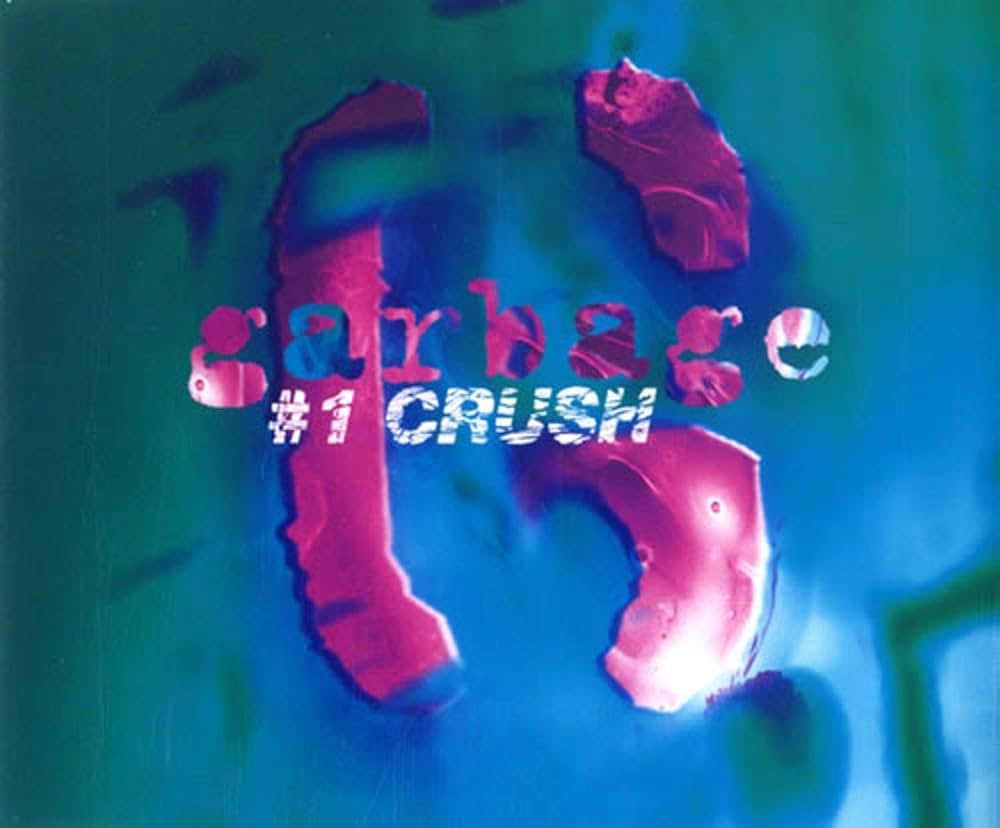
Things moved quickly. Garbage found a record deal even though they didn't put Butch Vig's name on their demo, and they released their debut single "Vow" in March 1995. That song introduced everything about their sound — warped electro-guitars giving way to sudden processed roars, keyboard sounds piled on top of keyboard sounds, Shirley Manson's snarled new wave melodies. Garbage enjoyed filming the song's video with "Smells Like Teen Spirit" director Samuel Bayer enough that they decided maybe they could try playing live after all. Before long, they were touring arenas with Smashing Pumpkins. "Vow" got serious MTV burn, and it peaked at #26 on the Modern Rock chart and #97 on the Hot 100. The original version of "#1 Crush" first came out as a "Vow" B-side.
When you get used to hearing the "#1 Crush" remix that became a hit, the OG version sounds surprisingly sparse. It's got programmed shakers and digital distortion all over it, but it sounds like a rock song, more or less. The grimy riffs get a lot of room to operate. Shirley Manson sings about romantic obsession with feverish severity. She starts off purring that she would die for you, an expression of affection that we've heard many times through pop history. As the song progresses, she takes things further and further, really showing how fucked up that cliché actually is.
Shirley Manson's narrator won't just die for you. She'll wash away your pain with all her tears and drown your fear. She'll sell her soul for something pure and true, someone like you. She'll burn for you, feel pain for you. She would steal for you, do time for you. She'll lie for you, beg and steal for you, crawl on her hands and knees until you see you're just like her. You will believe in her, and she will never be ignored. The song quickly blows past all notions of seduction, taking things into alarming territory almost immediately. Manson throws up red flag after red flag. If someone were to actually tell you the things that she sings on "#1 Crush," you would get the fuck out of there. Well, you'd get the fuck out of there if someone other than Shirley Manson were to tell you those things. If it was Shirley Manson, maybe you'd take your chances.
"#1 Crush" didn't make the cut for the Garbage album, possibly because one of their label guys worried that the lyrics might appear in somebody's suicide note. But it turned out that Garbage didn't need "#1 Crush." The singles from that album stayed in alt-rock radio rotation through 1995 and 1996. "Queer," one of the songs with Clyde Stubblefield on drums, reached #12. "Only Happy When It Rains" peaked at #16, and I'm frankly shocked that it didn't go higher. I remember that song being everywhere. The frankly magnificent "Stupid Girl," for my money the best song that Garbage have ever released, made it to #2 on the Modern Rock chart and #24 on the Hot 100 in summer 1996. (It's a 10.)
Critics embraced Garbage, to an extent. It came in on the 1995 Pazz & Jop poll at #19, between Sonic Youth's Washing Machine and Matthew Sweet's 100% Fun. But the group's success came through radio and MTV rotation, not cool-kid cachet. MTV might've been more important to Garbage than the radio. In the band's videos, Shirley Manson emerged as an edgy, snarly sex symbol, and she was surprised when she started to get calls from fashion houses.
I saw Garbage play my local alt-rock radio station's annual summer festival in 1996, and I remember liking them a lot. I don't remember too much about the set, though, possibly because I was doing the cartoon-wolf bug-eyes thing at Manson. Almost everyone I knew was in love with her. It was a whole thing. Garbage went double platinum, but I actually never bought a copy of it. The songs were in the air enough that I didn't need to. (I wrote a 20th-anniversary piece on Garbage in 2015, and I genuinely don't remember writing a word of it.)
The Garbage album cycle was still going strong when Romeo + Juliet hit theaters in November 1996. Romeo + Juliet is a movie. Before that, the mad Australian Baz Luhrmann had only directed one film, a critically acclaimed 1992 adaptation of his own stage play Strictly Ballroom. But that was evidently enough for 20th Century Fox to accept Luhrmann's pitch for a gonzo contemporary retelling of the Shakespeare tragedy about star-crossed lovers. In an effort to translate Shakespeare into the language of full-on cinema, Luhrmann threw every attention-deficient '90 filmmaking trick at the movie — frantic editing, herky-jerk camera movement, John Woo heroic-bloodshed gunfight poses, helicopter shot after helicopter shot, literal fireworks popping off onscreen.
Luhrmann made the perverse choice to leave Shakespeare's archaic language intact, giving the whole thing an even more heightened affect and leading to funny-clever little touches like how all the guns are branded "Sword" or "Dagger." (In this version, the Montagues and Capulets are rival '90s crime families, and the Capulets are some strange fusion of Latin and Italian even though the daughter of the family is whiter than day.) Luhrmann also got movie stars in there.
Leonardo DiCaprio was a promising and serious young actor at the time. He was coming off of What's Eating Gilbert Grape and The Basketball Diaries, and he already had one Oscar nomination. Romeo + Juliet turned DiCaprio into a full-on teen heartthrob; he got the lead Titanic role right afterward and became a one-man cultural phenomenon. Claire Danes was just starting her movie career, a year out from her extremely important work on My So-Called Life. The two young leads were convincingly swoony together. Luhrmann plugged gravitas-machine veterans like Pete Postlethwaite and Paul Sorvino in there, as well as baby Paul Rudd, looking exactly the way he does now. He dropped the leash on supporting players John Leguizamo and Harold Perrineau, encouraging them to go all the way over the top, with memorable results.
Given how MTV-brained this whole enterprise was, it's no surprise that the Romeo + Juliet soundtrack was hugely important to the film. The movie did healthy business at the box office, but it wasn't as big a hit as the soundtrack album, which reached #2 and went triple platinum. Luhrmann set DiCaprio's worshipful golden-hour entrance to Radiohead's "Talk Show Host," and that scene is probably still the best thing that Luhrmann has ever done. The singer Des'ree appeared in the movie, belting out her love theme "Kissing You." Perrineau, playing an extremely flamboyant version of Mercutio, lip-synced the disco classic "Young Hearts Run Free." And of course, Romeo + Juliet had the Cardigans' "Lovefool," one of the most memorable crossover smashes of the '90s. (On Modern Rock radio, "Lovefool" peaked at #9. It's a 7.)
"Lovefool" was such a catchy little bop that vast swaths of the public never noticed that the song's version of love is bleak, obsessive, and self-annihilating. But nobody could've overlooked those qualities in "#1 Crush." Garbage's song barely even appears in Romeo + Juliet. It's remixed into the score, smothered into the background, turned into a subliminal ghost. Maybe that's because "#1 Crush" spells out the movie's themes in too bright a font. In Romeo + Juliet, teenage love is a beautiful thing, and it's also a plague that bedevils us. Romeo and Juliet are so into each other that they lose all sight of the wider world. They destroy themselves and many of the people closest to them because it's the only thing they know how to do. They die for each other.
For the Romeo + Juliet score, Baz Luhrmann assembled a team, putting the composer Craig Armstrong together with the pop producers Marius de Vries and Nellee Hooper. Hooper has been in this column a few times, and he'll be back. For the soundtrack, Hooper and de Vries remixed Garbage's B-side, cranking up some of the elements that were already present in the track and turning it into a seething trip-hop dirge. Hooper forefronted Manson's voice even more than Garbage did, and he anchored the track to a gigantic breakbeat and some sampled sex-moans. (According to sites like WhoSampled, the breakbeat comes from underground rap producer Peanut Butter Wolf's 1994 instrumental "Charizma." The moans might've been taken from a Madonna hit and then distorted all to hell.)
It's kind of fun to have Nellee Hooper and Butch Vig, two hugely important producers who occupied vastly different sides of the early-'90s alternative landscape, involved in the same track. Hooper was the Soul II Soul/Sinéad O'Connor/Björk guy, while Vig was the Nirvana/Smashing Pumpkins/Sonic Youth guy. They were not the same. But Vig started out Garbage as a remix operation, so it's only right that one of Garbage's biggest hits should be somebody else's remix. And Hooper's take on "#1 Crush" didn't work against Garbage's vision. It just nudged them a little further along the trajectory that they were already traveling, away from traditional guitar-rock and towards a seedy, threatening, gothed-out take on glamorous nightclub music.
Garbage's original "#1 Crush" already had the predatory bassline, the ominous ahhh-ahhhs, and the warped spy-movie guitars. It had Shirley Manson making derangement sound sexy. (Much like Portishead, Garbage made music about the depths of human desperation, which humans then put on their makeout mixtapes.) The Romeo + Juliet remix pounds all that stuff home a little harder, adding in fun touches like a sampled drum-roll with so much echo that it sounds like a cartoon gunshot ricochet. Halfway through, the breakbeat practically gives way to a house thump that's been slowed to a heartbeat tempo. In Hooper's hands, "#1 Crush" becomes a sleazy club jam, more for grinding than for dancing. Maybe that's what it needed to become.
Getting Garbage onto the Romeo + Juliet soundtrack was a complicated process, since the soundtrack came out on a different label. The Garbage album cycle wasn't over yet, and their label still wanted to push more tracks to radio. The band was still on tour when the movie came out, and they never ended up making a "#1 Crush" video. But a hit is a hit. "#1 Crush" was all over alt-rock radio, and it crossed over to pop as well. Garbage were already big, and the song made them bigger. Garbage got nominated for the 1997 Best New Artist Grammy, though they lost it to LeAnn Rimes. A SPIN cover story captured their reaction: Shirley Manson bolting from the Madison Square Garden ceremony, saying, "We suck, we're shit, I'm shit, and I can't believe we're such losers," before going out and drinking with her bandmates.
After a few drinks, the subject of LeAnn Rimes came up, and Manson said, "She's singing all these romantic, dramatic songs now. Then after she grows up, she'll be like, 'What the hell happened? It's not at all like I thought!'" When SPIN's Charles Aaron replied that Rimes seems "prepped for massive pop success," Manson said, "Success is a seduction that loosens your resolve and corrupts your soul, unless, of course, you're elderly and embittered like us!" She was, like, 30. Magazine profiles, baby! We never knew what we had until it was gone.
In that SPIN story, all the Garbage members kept saying that they'd all gotten to know each other better while promoting their debut. Garbage weren't really a band when they made Garbage, but a couple of years of hard touring can turn strangers into lifelong comrades. (It can also turn them into bitter lifelong enemies, but that didn't happen here.) While they were working on their second album, Garbage's members all claimed that it would reflect their growing bonds, the chemistry that they found on the road. Bands say stuff like that all the time, but Garbage actually made it happen. Their 1998 sophomore effort Version 2.0 is a fucking banger.
Garbage had already flirted with techno textures on their debut, and they went deeper into that territory on Version 2.0. Their music became brighter and more hectic, putting all of the big-budget pop tools of the late '90s into the service of the dark, angry throb that they'd already established. Once again, the album was full of hits, and it kept them in radio rotation for a solid year and a half. Lead single "Push It," which made oblique reference to both the Ronettes and Salt-N-Pepa, peaked at #5, while the oddly bright and cheery follow-up "I Think I'm Paranoid," which sounded like the Pretenders making Y2K car-commercial music (complimentary), reached #6. (They're both 9s.) A couple of other singles peaked outside the top 10 — "Special" at #11, "When I Grow Up" at #23 — but I remember hearing them out in the world a lot.
Garbage worked Version 2.0 really, really hard. I went to school at Syracuse, and Garbage played my campus when they were touring behind Version 2.0. Only the real fucking road dogs made it all the way up to Syracuse. (The show absolutely ruled.) The album went platinum and got nominated for the Album Of The Year Grammy, which it lost to The Miseducation Of Lauryn Hill. On the Pazz & Jop poll, Version 2.0 came in at #19, exactly the same place as the previous album had been three years earlier. (This time, it was between Elvis Costello and Burt Bacharach's Painted From Memory and Mercury Rev's Deserter's Songs.)
In 1999, Garbage did the theme song for the James Bond movie The World Is Not Enough, which is a pretty clear sign that they were at a cultural saturation point. But the band's 2001 album Beautiful Garbage pretty much disappeared without a trace; none of its songs even made the alt-rock charts. Maybe you could blame the fact that the record came out in the immediate aftermath of 9/11, but I think it's just that the radio was into a very different kind of post-grunge rock right around then.
Garbage scored one more big Modern Rock hit when "Why Do You Love Me," the lead single from their 2005 album Bleed Like Me, peaked at #8. (It's a 6.) I saw Garbage again when they were touring behind that one; they played a good set at an otherwise abysmal festival. Since then, Garbage have remained active, putting out another four albums and landing a few songs on alt-rock radio. They just dropped an LP last year. In the meantime, Shirley Manson has done some cool things. She's collaborated with underground punk types like Screaming Females and the HIRS Collective. She played a Terminator on the TV show Terminator: The Sarah Connor Chronicles. Last year, Garbage toured the US for what they said will be the last time. At every show, Manson made a speech about how paltry streaming royalties and ballooning touring expenses have made band life untenable.
After that US tour, Manson went viral for a different kind of mid-show speech. During a Garbage set at an Australian festival, Manson got absolutely fucking livid at some guy with a beach ball. She hates beach balls! When you hate beach balls, an Australian festival must be a tough place to be. Manson became an online punching bag for a few days, but she didn't back down. At subsequent shows, she stuck with her anti-beach ball message. I have no issue with beach balls, but I am not the goth-glamorous Scottish rock star who moaned and wailed her offer to die for you all over the radio in 1997. We never really got another band like Garbage. They shouldn't have worked, but they made themselves undeniable. After they did what they did, they can say whatever they want about beach balls.
GRADE: 8/10
BONUS BEATS: For this section, I was planning to include a young Lee Pace doing a drag routine to "#1 Crush" in the 2003 Showtime movie A Soldier's Girl, a dramatization of the real-life murder of an Army serviceman who was dating a trans woman, but the YouTube video of that scene isn't embeddable. Instead, I'll do something else involving another famous person's early acting days. Before Michael Fassbender became a movie star, he was part of the cast of Hex, a British supernatural TV series about fallen angels, and "#1 Crush" was its theme song. Here's the opening title sequence, from 2004: