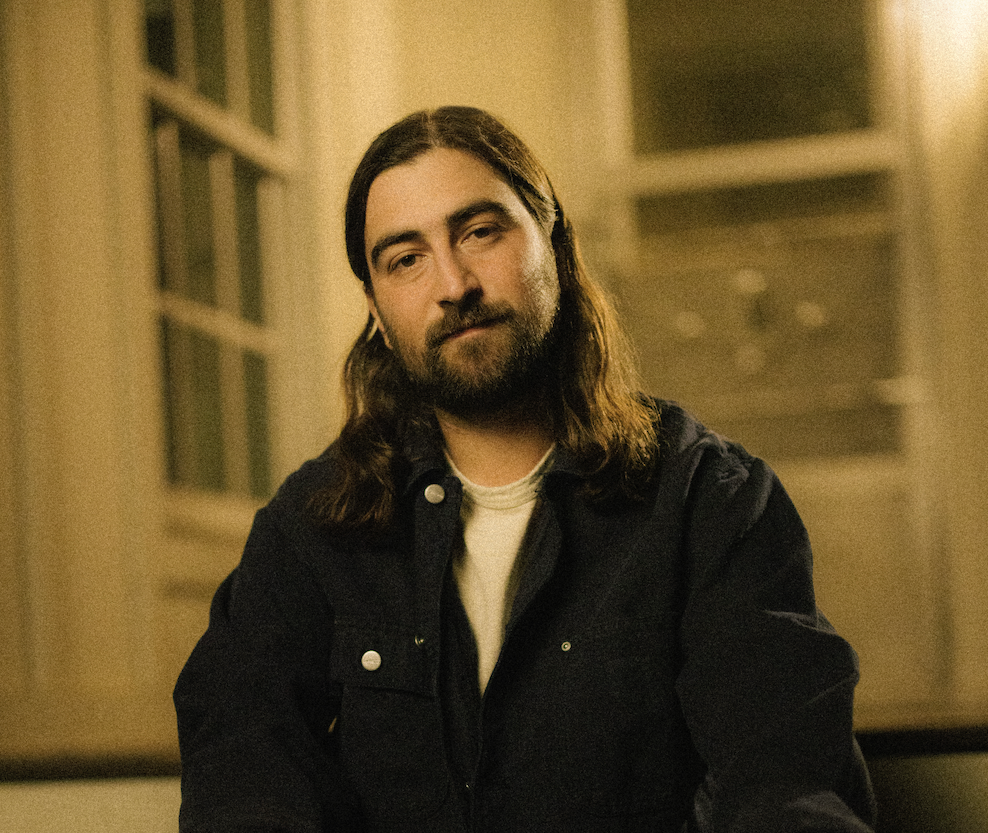

How famous can a musician become and still seem like he isn't? How much musical precedent must exist — how many artists like you, coming before you — before an artist's ascent is no longer "unlikely"? These are the questions Noah Kahan's The Great Divide had me asking.
I've written about Kahan here before, because I couldn't not. His single "Stick Season" went from midlist folk-pop to viral hit. At the time of writing this column, Kahan had 18 songs on the Hot 100. They've all been there for weeks. He also has a documentary introspecting on his fame, Out Of Body, that premiered earlier this year at SXSW and then hit Netflix. He's received a coveted folk-musician accolade, shared with veterans like Willie Nelson, Jerry Garcia, Dave Matthews and Phish: getting his own Ben and Jerry's flavor. (It helps that Kahan's from Vermont.) He also has an LL Bean collaboration — actually two of them now — and a craft beer. Where did all this come from? It's simple: As Out Of Body director Nick Sweeney told Billboard, "Noah's music was everywhere."
Is that unlikely? Kahan is a modest guy even by folkie standards. His hair is long and almost pointedly disheveled; he kind of resembles a rustic cousin of streamer MoistCritikal, or a less feral Andrew W.K. Most of his photoshoots look like he was styled by The Dude. Kahan's a lot more talkative in interviews than you'd expect, a little more fratty than you'd expect, and somehow even more self-deprecating than your expectations. He's emotionally open and vulnerable, or more precisely a vulnerability advocate. He talks constantly about going to therapy and the pressure on men to avoid their feelings, which has gotten him comparisons to the everyman anti-toxic-masculinity image of Tim Walz (a thoughtful piece that could only be written in October 2024). In short, as recent Kahan collaborator Aaron Dessner of the National told Rolling Stone: "He's the anti-idol. He's not seeking it." And yet, he found it.
Kahan's self-effacing schtick is sometimes hard to believe. In Kahan's telling, "Stick Season" was an overnight success, literally: "I ate an edible after I finished editing ["Stick Season"]," he told The New Yorker. "By the time I posted it and I realized it wasn’t getting any likes or whatever, I was too high to delete it, so I fell asleep." (Not to Geese-is-a-psyop this, but Kahan leaves some things out of this story — like the pre-existing marketing plan from digital agency the Trenches, who count Kahan as one of their biggest success stories.) In that Billboard interview, Sweeney said Kahan's documentary was not intended to coincide with his new album, despite being perfectly timed to his promotional cycle, and I had to rewind the clip to double-check whether Sweeney kept a straight face. He did.
The Great Divide, the record, projects far more assurance. The album comes in at a sprawling 17 songs, 21 if you count bonus tracks. Like Stick Season, it was written with Kahan's longtime producer Gabe Simon (no relation to Paul). Dessner cowrote a few tracks, and Bon Iver's Justin Vernon both sings on it and fills out its band. The album is small-c conservative in its folk-pop arrangements, and beholden to musical tradition. But which tradition? In 2026, anything acoustic by men will probably be compared to Mumford & Sons or the Lumineers and their retroactively assigned microgenre "stomp clap." But Kahan's music isn't quite so affectedly rustic. (Also, The Great Divide contains almost no stomping or clapping.) There's a fair amount of Springsteen here, particularly in rollicking, burly tracks like "The Great Divide" and "Deny Deny Deny." The verses of "We Go Way Back" invoke Simon & Garfunkel in their hushed harmonies; elsewhere, I hear James Taylor in a few turns of melody. Dessner and Vernon's presence is felt in the pretty drift of opener "End of August" and Carrie K's almost homeopathically faint harmonies on tracks like "Paid Time Off."
But Kahan's real predecessors are people like Ed Sheeran (whom Kahan's compared himself to), or British folk-rocker Sam Fender (whom Kahan called his favorite modern artist), or adult-contemporary like Jason Mraz or John Mayer (both of whom Kahan also said he likes), Gavin DeGraw or Jack Johnson. You could splice his vocals seamlessly into the vocal of Isaac Slade from the Fray, or the electronized tenor of Adam Levine, or even Pat Monahan of Train (truly the Wario of this genre). This is the voice of Adult Hits Radio, the inescapable sound of waiting rooms and in-store playlists; it's also the sound of money.
It is often hard to tell these artists apart, partly since they keep collaborating with each other; Kahan has duets with Fender, James Bay and the Lumineers. (That's James Bay and the Lumineers, simultaneously; the vibe their performance clip is... potent.) What does Noah Kahan, specifically, bring to this very crowded field? The answer, for many people, is his connection to Vermont, as if he's the state's busker laureate. Those Springsteen connections don't just come from the music; they’re rooted in his close association with a certain place.
But while Kahan's hometown has clearly carved deep emotional trenches in his imagination, his lyrics aren't rooted in any one place. Nor do people always make a good case for that; Vermont DJ Llu described "Porch Light" on NPR by saying that "in Vermont, a porch light is really an important part of your home." (And here I thought it was the South that got precious about porches.) The phrase "The Great Divide" literally refers to the Vermont-New Hampshire border, but it also nods to another great divide that permeates Kahan's lyrics: the tension between homey but limiting small-town life and the glittering seductions of the big city; the way both places are defined by the dream of leaving one for the other; and the question of which direction means escape. This is a country-music trope; the genre has a long history of both playing it nauseatingly straight and thoughtfully deconstructing it. Kahan's lyrics wield small-town gun-shootin' almost as much as Jason Aldean's; disses like "[I hope] the streetlights bleed into your bedroom" could come from Brad Paisley or Eric Church.
Kahan's other defining trait is the way that, compared to his folk-pop cohort, his lyrics hit harder with riskier aim. He's willing to punch down, punch toward the crowd, and most of all, to punch himself. This, too, is a tradition: there's a line to be drawn from Dylan's caustic takedowns to Kahan's, and a shorter but equally bold line from his soul-scouring lyrics and those of Zach Bryan. (Kahan's songs are easier to listen to, though, given that Bryan's nasty lyrics have come to uncomfortably mirror some real-life nastiness.) But Kahan taps into the tradition remarkably well. On "Headed North," he gripes about interlopers in Cybertrucks and how they make him want to "floor it," an instantly quotable Pam Bondi-baiting lyric that unsurprisingly kicked off a promo clip Kahan posted on his TikTok. But he also gripes about local jerks with "a Coexist-in’ sticker on the bumper of their car," a description that probably describes a fair amount of his target audience.
Kahan sings all this with conviction that is deeply emotionally felt, and the more insistent his voice grows, the more these start to sound like, as Pitchfork put it, "self-directed diss tracks." And indeed, The Great Divide has a rejoinder for almost everything said about Kahan. His public vulnerability? May you too live in vulnerable times: "I'm hoping that you open up to someone kind, and they hold it all against you," he sings on "Downfall." His ties to Vermont? On "Spoiled": "Where I'm from and what I'm worth have gotten too damn intertwined." Kahan is well aware of his sudden fame, and he writes about stardom changing him for the worse as if that's already happened. (Note: I have not seen any indications of this.)
Most rock stars get around to their anti-fame album eventually; it's a little unusual for Kahan to do it at this point in his career. He's said that the fixation came from the fact that he just made an entire documentary grappling with his fame, which makes a lot of sense. But man, his inner critic gets really brutal: "You're not a goddamn hero now that you cry on live TV," he sings on the sneering, singsong "Haircut." This all crescendos on "Dashboard," where masses of backing vocal tracks join Kahan in shouting "You're an asshole!" It's anthemic — the closest thing to a singalong on the album — and almost proud, like a folk version of the "toast to the assholes" on Kanye and Pusha T's "Runaway." (Given that Pusha T is another one of Kahan's avowed influences, that may even be deliberate.)
All these threads intertwine on "Spoiled," the album's most subtle and thoughtful track. The song clocks in at a comprehensive five minutes. Its hymnlike melody lends it gravitas, and the slide guitars groan like cabin floorboards. For all Kahan's mentions of therapy, this song feels actually therapeutic, in the cognitive-behavioral sense: he confronts his fears at their worst, then reframes them into something more nourishing.
"Paid Time Off" hinted at the financial grind of the music business, but "Spoiled" is downright morbid: "Tell the folks at the morgue that I'm headin' back on tour." On "Haircut," he addressed the possibility of career failure in a semi-joking way, singing about how he'd be fine "even if I'm eatin' fast food and sleepin' at my dad's place." "Spoiled" fast-forwards that scenario a few years. In this telling, he now has kids, those kids are watching him wash out, and they find it pathetic: "I wanna be you, but I don't wanna be that." And this, Kahan says, is the driving motivation of his musical career: "So my children get spoiled when they get old, so they can fuck up all they want and blame it all on their dad." There's a Philip Larkin-esque resentment in this, but there's plenty of self-loathing too. And there's also love. Being a hitmaker is easy; it's this kind of emotional complexity that makes someone a songwriter.
POP TEN
Charli XCX - "Rock Music"
If Sucker has a million fans, then I'm one of them. If Sucker has one fan, then I'm THAT ONE. If Sucker has no fans, that means I'm dead. Actually, no, that's wrong: if Sucker has no fans, that means that both I and Charli XCX are dead. Maybe? Ever since The Moment, a brat documentary that pointedly refused to give the fans what they wanted -- the movie gave more spotlight to "Bittersweet Symphony" than any of her actual songs -- Charli's music has started to feel like she's mocking her audience, and this feeling has gotten stronger with every single she's released. (There's a reason the Charli track here is "Rock Music" and not the newer "SS26.")
So it's a little hard to tell what level of irony "Rock Music" is on. As many people have jested, the track does not sound like rock music. The guitars might as well be guitar emoji. Lyrics like "real incestuous vibes (I knew you'd like that)" turn "show, don't tell" into "troll, don't tell." The track ends with a stuttering outro that comes off less like vocal-production wizardry than an equipment glitch, like a turbo-speed recreation of Milli Vanilli's backing-track failure — and I would only say something like that if I thought it might be on purpose. Memeing aside, Charli has not spoken particularly highly of Sucker, her actual rock album, and this single almost feels like a continuation of the bit: If you like "Rock Music," the song seems to suggest, then you are the sucker. And if there are no suckers, that means I'm dead.
Olivia Rodrigo - "The Cure"
Speaking of trolling, Olivia Rodrigo has followed up her single that quotes the Cure with a single called "The Cure." This one is serious, though: a specimen of swelling strings and surging guitars, a perfectly timed crescendo of vulnerability into release. This is the kind of slow-build structure that Dan Nigro's done so often and so faithfully that he could probably produce one now purely by muscle memory. But it's still a marvel to hear the two of them execute it so well: the way the bridge perfectly places ghostly backing vocals beneath Rodrigo's cathartic wail, or the quadruple-time drum fill that leads into the final chorus, a trick that gets me every time.
Taemin - "Permission"
"Personal Jesus" beat = automatic inclusion. The streamlined and sharp arrangement and the faint operatic sample in the background are just bonuses.
Gracie Abrams - "Hit The Wall"
Gracie Abrams is yet another of Kahan's self-avowed influences. Specifically, he sung the praises of "Gracie," no last name. Is this premature? (What's premature, anymore?) And "Hit The Wall" is about as brutal as Kahan is, invoking self-harm and breakdowns and psych wards and all the monstrous ruined relationships she sees the second she looks behind her to her past. Abrams' voice is tremulous in a way that no longer sounds like a quirk, but exactly what the song demands. Maybe it isn't premature after all.
Dominic Fike - "Babydoll"
"Babydoll" is a 2018 demo Fike released in March — "casually 8 years late," as the lead YouTube comment puts it. And it's spent the past few months climbing the charts on the strength of its casual sleaze.
Shakira - "Dai Dai" (Feat. Burna Boy)
It's been over 15 years since Shakira released her 2010 World Cup theme "Waka Waka," and two months since Jelly Roll released a 2026 World Cup theme that was so corny that even its Wikipedia article reads like a Fantano "NOT GOOD": "The song was met with heavy critical outrage from fans and reviewers and failed to chart on major music charts."
Shakira, by contrast, knows what she's doing. She hires Ed Sheeran and Jon Bellion, some of the most proven anthem-makers in the biz. She includes plenty of clapping and chant-alongs for gametime fans, and makes one of those the very first line; but she also commissions a laid-back afrobeats track that's plausibly listenable outside the of the stadium. And Nigerian star Burna Boy delivers his verse like his own energetic walk-up music.
Swae Lee - "Mural" (Feat. Jhené Aiko)
Another near-automatic inclusion here: artists who ruled the lifetime ago of the 2010s coming back with music more lush and sumptuous than ever before. "Mural" might better be called "Immersive Experience," so enveloping is its sound. Also, giving your duet partner the line "not a pick me, pick me kind of girl" is extremely funny, intentional or not.
Cannelle - "Stereo"
Cannelle is French, but spiritually she hails from the stylish enclaves of Internet moodboards. "Stereo" is an electrosleaze single that's pastel and pneumatic and aesthetically optimized, and gloriously, we live in a world where there are a lot of songs like that. This one is especially glorious.
Mixol - "Mixologist"
There are currently 5,538 emails in my inbox, most of which are press releases about various songs, some of which are years old, and all of which I swear I'm getting to. Describing your influences as "Björk, Kate Bush, Fiona Apple, and Sheena Ringo" — especially Ringo, a legendary Japanese artpop musician but for many people a deep cut — will get you to the front of the queue. And Beijing artist Mixol earns the comparisons; I can trace each of those influences to a vocal flourish in this single, and the drama and ambition of this arrangement, careening from electronic squelch to nostalgic movie soundtrack to industrial grind, is also worthy of those greats.
Bea Miller - "Depressed On The Internet"
Man, who isn't.