

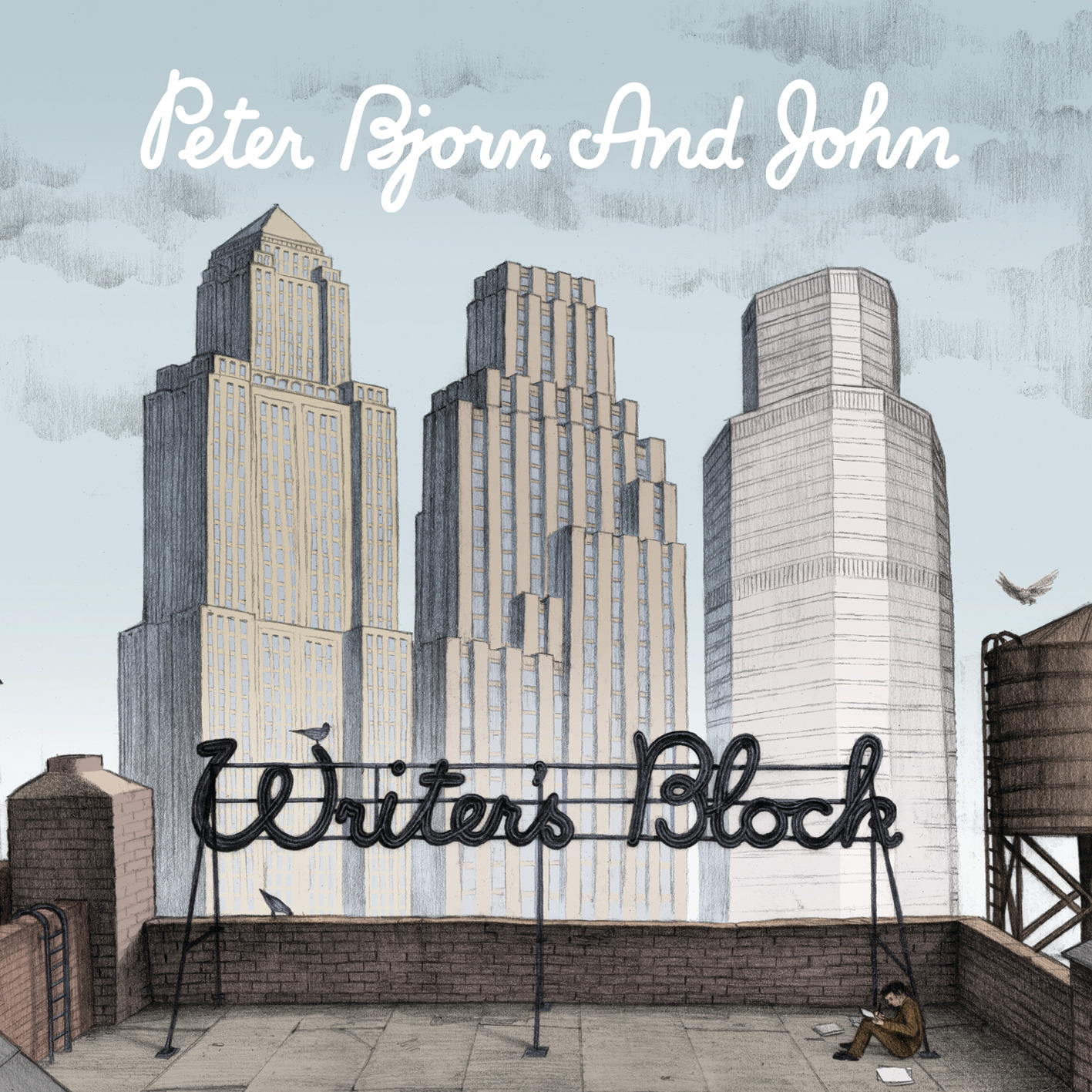
- Wichita/V2/Startime
- 2006
In the late 2000s, “Young Folks” was like fairy dust. You’d hear that whistling hook wisping down a city block, and a microbrewery and a Whole Foods would spring up around you. Every Discman spinning it on a burned CD magically transformed into an iPod Nano programmed by Alex Patsavas. When the music wafted into a roomful of actual young folks, they were suddenly clothed in garments from Urban Outfitters, debating which quirky sitcom to binge on DVD.
Here is the negative spin, the cultural context I can’t escape no matter how much I enjoy the music: Writer’s Block, the album Peter Bjorn And John released 20 years ago today, might as well have been the tipping point in the gentrification that swept across indie rock and its attendant culture throughout the early 21st century. Take it from the guy who wrote the book about how indie went pop: Revisiting the Swedish band’s breakthrough LP, it’s hard not to hear it as a bridge between scrappy homespun blogger music (say, Jens Lekman, since we’re talking Swedes) and the pristine lifestyle soundtrack of the future (e.g. Foster The People). So many of these songs literally became commercial fodder, licensed by music supervisors and ad execs who listened to this buzz band’s approachable chic and heard “ch-ching.”
And here is the positive spin — the takeaway that, for me, trounces any and all downer connotation: I love Writer’s Block unreservedly. I love “Young Folks” specifically, but Writer’s Block is so much more than “Young Folks.” It’s one of the best indie rock albums of the 2000s, a top-to-bottom masterpiece of songcraft. A decade ago, when the album turned 10, I zeroed in on PBJ’s signature hit, one of the defining indie songs of its era, reasoning that readers were more likely to remember that particular tune than its parent album. At this point in the timeline, I feel compelled to broaden my scope and sing the praises of the full tracklist, for fear that history might forget how much it (politely) bangs.
Guitarist Peter Morén and bassist/keyboardist Björn Yttling started making music together as ’90s teens in the Swedish town of Västerås. By 1999, they’d relocated to Stockholm and joined up with percussionist John Eriksson, taking on the utilitarian band name Peter Bjorn And John. The group’s first couple albums, 2002’s self-titled and 2004’s Falling Out, were stylish and energetic ’60s-indebted pop-rock records — nothing special, but enough to situate them in a scene with likeminded Swedes such as the Concretes and the Shout Out Louds, both of whom would contribute to the “Young Folks” phenomenon (contributing a duet partner and music video director, respectively). Nothing about those early PBJ releases suggested they were about to make a brilliant collection of tracks and become a global sensation, but that’s exactly what happened next.
Writer’s Block would be a knowingly ironic title for an album where the floodgates opened and the greatest songs of this band’s lifetime came spilling out, but it’s said to be a nickname for Hornstull, a Stockholm neighborhood heavily concentrated with creatives, where the band recorded the album in Yttling’s studio. There, they upped their game as songwriters, producers, and arrangers. You can get swept away singing along to every track, yet the album shines for reasons that go far beyond attaching the right topline vocals to the right chord progressions. On these songs, every instrument feels like a hook, including and especially Eriksson’s endless array of drumbeats. Every guitar chord and riff is its own little attention-grabbing detail, but not in ways that overshadow the unified whole.
They went big here, and they pulled it off through their attention to the little things. One album prior, these dudes were banging out replacement-level guitar tunes, and now here they were summoning a heavy haze of emotion on “Roll The Credits” and personifying quaint quirkiness on “Amsterdam.” Bombarding us with the weight of years on “Objects Of My Affection” and paring it all away on the lovestruck “Paris 2004.” Weaving wordless “sh-sh-sh” mouth sounds into something like jungle breaks on “The Chills,” then pivoting to awestruck near-silence as if Morén just saw the love of his life bathed in celestial light. Pulling layers of beauty in and out of “Up Against The Wall,” a fine-tuned machine of emotion and momentum, then piling them all back on until the listener spirals into euphoria.
Again and again, PBJ made magnificent musical decisions here. Sometimes, as on “Young Folks” and “Amsterdam” and “Let’s Call It Off,” those decisions contributed to the twee-but-polished zeitgeist that was about to turn vast swaths of pop culture adorkable. Those songs are smartly assembled, and you can see why they worked their magic on so much of the world, including ascendant rap hipsters like Kanye West and Drake. But to me, the best songs on the album aren’t the lighthearted ditties; they’re the ones charged with emotion. Writer’s Block tracks run the gamut from brokenhearted to madly in love, from plaintive to overjoyed. Thanks to heartfelt, specific lyrics and the boyish texture of Morén’s tenor, these tracks are like real life taking on an epic cinematic quality. It’s the kind of impact most pop songwriters can only dream of.
I listened to Writer’s Block so many times in its heyday. Its rise coincided with my first months on the job at a weekly newspaper, a gig I worked/lucked my way into directly after college, and it ended up soundtracking so many of my drives around Columbus. The paper’s archives from 2006-07 are no longer online, but I almost certainly graced its pages with enthusiastic praise for PBJ. If this body of work marked a crucial transition point for indie rock, it also set the tone for my own transition into adulthood. Coming back to it now, I was afraid that it would not hit the same, that it would strike me as flimsy and overly quaint. After spending the past week immersing myself in PBJ’s opus all over again, I’m even more convinced that it’s a stone cold classic.
Still, if “Young Folks” were this album’s only legacy, Peter Bjorn And John could still be proud of it. Yttling’s whistling Oriental riff, Eriksson’s brisk backbeat, the coy interplay between Morén and Victoria Bergsman, those bongos — it all came together as if by magic. Much of that magic persists today, and not just the kind that spreads commodified whimsy throughout the land.