
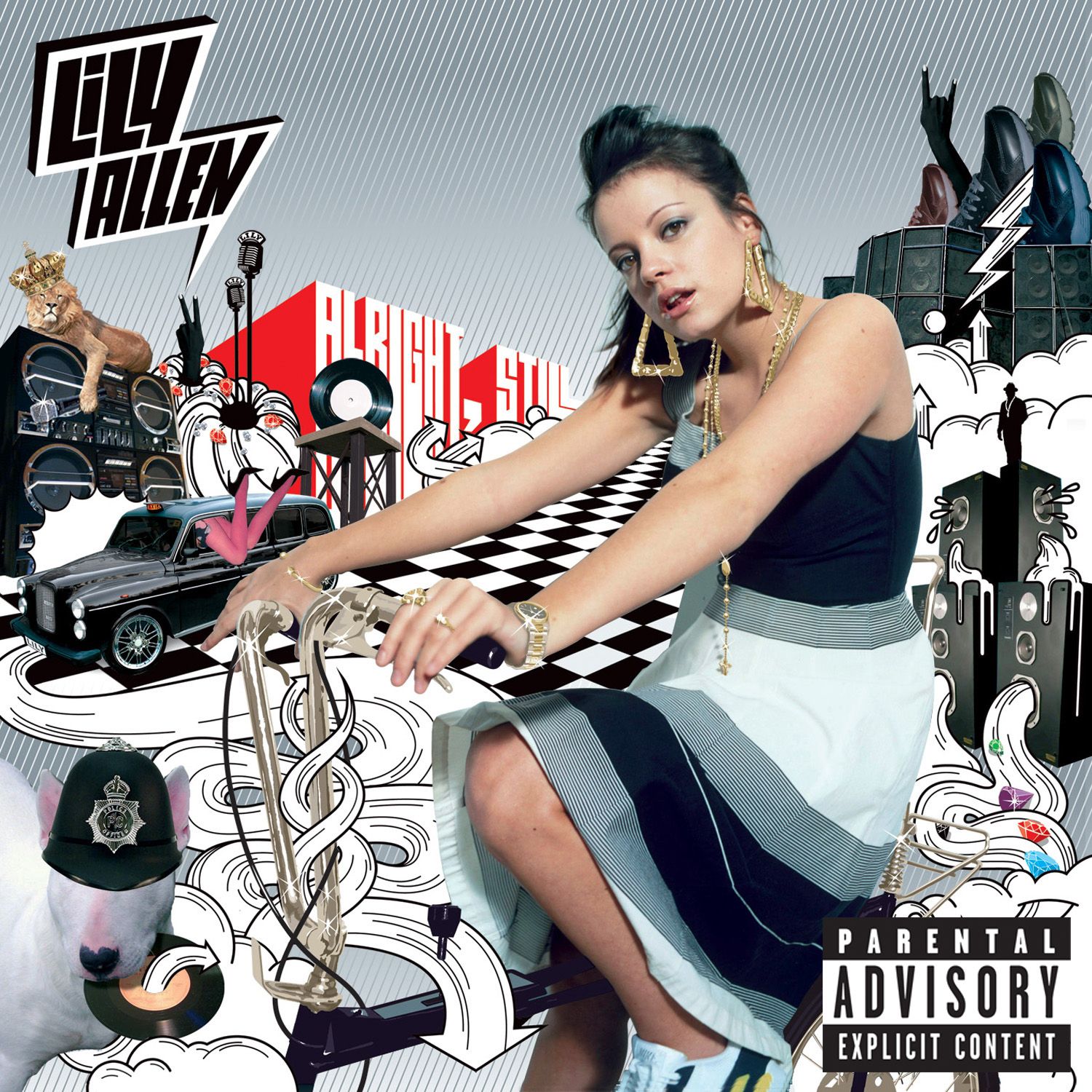
- Regal/Parlophone
- 2006
"She dances like Karl Rove." That's something that my brother told me while the two of us watched young music-industry hope Lily Allen play one of her first American shows. I busted out laughing then, and I bust out laughing when I remember it now. It was spring 2007, and Allen was already a pop sensation at home in the UK. Her debut album Alright, Still had come out the previous summer over there. Many months later, the album got its American release, leading to a fresh wave of critical hype for Allen. She was on MTV a lot, and US pop radio was beginning to pick up on songs that had been all over MP3 blogs for months. The audience at New York's Irving Plaza was full of music-industry types, and the show could've been an important one for Allen. But she didn't exactly solidify her rising pop-star status that night, since she was drunk as shit and dancing like this.
She could get away with it. Lily Allen was a charming mess back then, and she's a charming mess today. Messiness was built into her version of pop stardom. She sang about shitty exes, sloppy pick-up artists, and nightclub fights with breezy, snarky panache. She took clear delight in gossip and shit-talk, and she brought that delight to the stage. She moved around clumsily. She giggled while doing her stage-patter bits. She didn't seem to take her own incipient pop-star status even remotely seriously. Just before covering "Naive," a song from fellow hyped-up UK act the Kooks, Allen told us, "It’s actually quite rubbish, but I make it sound quite good."
That night, all the music-industry types showed up to see Lily Allen because Allen seemed like she might be the future. Her version of pop music was sly and funny and conversational. She described grimy nightclub situations with a sense of diaristic immediacy, convincingly portraying someone who'd been in plenty of grimy nightclub situations and who still intended to get into plenty more. She sang over ska samples and rap breakbeats with sunny, effortless joy, even as she sarcastically dismantled one ex after another. Most importantly, she ascended to stardom without ever putting too much radio-friendly gloss into her music. Instead, she was the kid who figured out MySpace.
It wasn't just MySpace that broke Lily Allen. She already had a record deal before she started posting her tracks on the flagship website of the web 2.0 revolution. She also had a famous last name. Allen's father is Keith Allen, an actor, comedian, and "professional geezer," per The Guardian — a general all-around UK celebrity who, much like his daughter, coasts through life on charm. Her mother is the movie producer Allison Owen, and that's presumably why Allen had a brief child-acting role in the 1998 costume drama Elizabeth, which her mother produced. (Owen still produces films, and I'm just now learning that her most recent effort is Back To Black, the 2024 biopic about her daughter's contemporary Amy Winehouse. That's pretty weird!) Joe Strummer was a family friend. Allen's show-business roots ran deep.
Later on, Allen bristled at the idea that she had a career advantage because her parents were famous and successful. In 2007, she told The Guardian, "It's funny when Lady Sovereign said that thing about me, 'She doesn't have to work as hard as me because her dad's Keith Allen.' Do you know what, Lady Sovereign? Have my dad. Go on! I'd love to see how many people buy your records. Go on! Take him!" But part of Allen's magic was that she didn't seem to work hard at all. She treated the entire enterprise of pop stardom as a hobby, a laugh. That's why she was up onstage dancing like Karl Rove. Her superpower was not giving a shit.
Lily dropped out at 15 after apparently getting kicked out of multiple schools for smoking, and she met her first manager while partying in Ibiza. At 17, she got a deal with London Records, and she recorded a bunch of folk songs that her father wrote for her. But those songs never came out, and she got dropped. A little while after that, she started recording with Future Cut, a Manchester production duo with roots in the jungle underground. Their demos led to another record deal, this time with Parlophone, but label higher-ups didn't pay much attention to her until she started putting songs and mixtapes up on MySpace.
The idea of "famous on the internet" was still a relatively new phenomenon in 2006. Around the same time, the Arctic Monkeys, a band whose members were about the same age as Allen and who sang the same kind of offhand lyrics about the same janky nightclub culture, were rocketing to the top of the UK charts. The Streets' Mike Skinner, who came from a slightly earlier generation but whose conversational club-culture story-songs shared plenty of Allen's aesthetic reference points, was another key precedent. Also, while Lily Allen didn't rap, she did make mixtapes. Sometimes, she pulled the mixtape rapper's trick of flipping a popular hit, using its instrumental for her own purposes. One of her early viral tracks was "Nan, You're A Window Shopper," a parody of a 2005 50 Cent hit where she made fun of her grandma for being old.
Thanks to the success of those early hits, Parlophone had to fast-track the release of Alright, Still, an album that turns 20 years old this Friday. In the UK, that record hit a cultural nerve. Allen went straight to #1 with "Smile," a deliriously happy put-down of an ex who'd cheated on her. She became an instant tabloid fixture, and her signature look — TopShop dresses, doorknocker earrings, sneakers — inspired plenty of imitators. So did her sound. Allen liked singing over old reggae and soul samples, and her bright, contemporary take on those styles probably helped open the door for the UK's retro-soul explosion that was already gathering steam. Amy Winehouse released her big breakout Back To Black a few months after Allen came out with Alright, Still, and both of those records had Mark Ronson production. Allen also worked with big-deal producer Greg Kurstin before he worked on some of Adele's biggest hits.
Unlike Amy Winehouse and Adele, though, Lily Allen never had a bazooka for a voice. Instead, she skipped over tracks, using them as vehicles for her personality. The first Lily Allen song that I ever heard was "LDN," and it's still probably my favorite. The lyrical conceit is simple and light. Allen sings about riding her bike around London, pointing out the city's veneer of civility and all the greasy things happening underneath — a little kid robbing an old lady, "a pimp and his crack whore." But Allen sang about the city with such sunny affection that the obvious jokes never got obnoxious. She was clearly having fun, and the feeling was infectious.
Allen sang directly about her real life and the real people in it, and her fame-adjacent status gave the songs a little extra frisson. The most annoying song on Alright, Still is "Alfie," the giddy music-hall oompah in which Allen berates her younger brother for staying at home all day, smoking weed and watching TV. Alfie Allen was apparently so annoyed by his characterization on the song that he refused to appear in the video, with Lily starring alongside an exaggeratedly ugly puppet instead. That song was pretty funny at the time, and it's even funnier now that Alfie Allen is himself famous-ish as Reek from Game Of Thrones, or as the Russian mobster failson who killed John Wick's dog.
If I were Alfie Allen, I probably would've been annoyed, too. Lily has never stopped singing personal, embarrassing things about the people in her life. She's the reason that I now know things about David Harbour that I never, ever wanted to learn. But Allen is arguably her own biggest target. Alright, Still is a work of magnificent pettiness. A great many of the album's songs are about trifling exes, and Allen generally comes off as the more chaotic person on those past relationships even when she tries to strike triumphant poses. One song is about fighting girls in the club, and another is about getting annoyed when too many guys at the club hit on her. This girl won't even spare her own grandmother. The sheer mess is a key part of the appeal, to the point where it's almost shocking when Allen confesses to missing some guy on "Littlest Things," the one genuinely vulnerable song on the album. (Allen and Mark Ronson wrote that one with a not-yet-famous Santigold.)
"Smile," "LDN," "Alfie," and "Littlest Things" were all hits in the UK. Over there, Alright, Still was a cultural phenomenon and a triple-platinum seller. A year later, Allen was back in the top 10 when she and Mark Ronson covered the Kaiser Chiefs' "Oh My God." In the US, Lily Allen was more of a critical sensation. Thanks to the differences between their UK and US release dates, Alright, Still and "Smile" both made it onto two consecutive Pazz & Jop critics' polls. The album and single both went gold over here, too. I don't think Allen ever could've been much bigger in America, since her sensibility is so definitively British. But the entire idea of a glamorous pop star who casually talks shit about famous exes and acquaintances certainly had an impact.
Lily Allen is still a major figure today, especially after coming back with last year's gossip-forward breakup album West End Girl. She went on to make a bunch more UK hits, but I don't hear the same unforced charm in any of her later records. Alright, Still was the product of a moment, and moments don't last. Allen also went through many well-publicized struggles — with mental health, with substances, with body-image issues, with record labels, with Hopper from Stranger Things. But it's still hard to imagine how pop's landscape would look today without her.
There's no Charli XCX without Lily Allen, to name only the most obvious of her stylistic descendants. Charli continues to mine gold from the "messy, glamorous British girl who sings candidly about her public life" archetype. Sabrina Carpenter has covered "Smile." So has Olivia Rodrigo. These days, pop songs' backstories are almost as important as their hooks. Pop stars are expected to be certain levels of petty. Nobody in Irving Plaza could've known it that night, but Lily Allen really was the future — in ways that have very little to do with MySpace, or with her terrible dancing.